

Search
The Rare & Early Newspapers Hobby

Receive the Newsletter

Buy Historic Newspapers

No smoking in the court of King James…
May 9, 2009 by TimHughes · Leave a Comment
 The Gazette of the United States from Philadelphia, Nov. 24, 1790, includes an interesting item on a treatise of King James I, who was way ahead of his time in opposing smoking.
He considered it a: “…heinous sin…” and those who used it were: “…guilty of great vanitie & uncleannesse–of sinful and shameful lust…”. He considered it: “…harmfull to the brain–dangerous to the lungs–and in the black stinking fume thereof, nearest resembling the horrible stygian smoake of the pit that is bottomlesse.”
See the photo for the full text.
Sharing My Story… How I got started…
May 7, 2009 by TimHughes · 1 Comment

Tim Hughes, founder
Invariably there is the quizzical stare I get from anyone who asks “what do you do?” and I answer by saying, “I sell old newspapers.” The typical response is, “…what??” Any follow-up to the inquiry usually leads to, “How did you get started?”
We all have our own stories of what lead us to early newspapers, and mine may not but much different from yours.
I have always collecting something. I guess I was always intrigued by what was old, and coin collecting captured my interest when I was in 3rd or 4th grade, a hobby which still gets my attention but on a dramatically smaller scale. Collecting coins lead to old books, which lead to old bottles, which lead to old radios; and perhaps a few other items which struck my interest through the years.
I eventually found coin collecting a bit frustrating, as the rarities I needed to fill some holes in my collection were way beyond my budget. Coin collecting has always been a well exploited hobby so rare items were almost impossible to find at reasonable prices as the “heavy hitters” kept the prices quite high. I always dreamed of finding a collectible which few people knew about, where truly rare & historic items could be found at reasonable prices.
One day while browsing a local flea market I cam across an 1846 Philadelphia newspaper for $3. I was intrigued. I knew an 1846 coin in nice condition would be ten times that amount. I bought it, took it home and read all four pages and was fascinated by the content. I had found my new collectible and was hoping my dream had come true.
I expended much effort over the next several years looking for more newspapers and found several sources for 18th & 19th century issues at what I thought were amazingly low prices given my coin collecting experience.
Then one day I asked a source from whom I had been buying issues for $3 each if I could get a better price if I bought more than one. His response was fateful and set the course for the rest of my life: he said, “If you take 100 issues you can have them for $1 each”.
Although $100 was likely half of my net worth at the time, I sent the check, received my 100 issues, and starting advertising the issues for sale at $3 each (plus 25 cents for postage; which actually covered the cost).
As I sold the issues I bought more, and found more sources for different titles and different time periods. I eventually found several auction halls which regularly listed newspapers, and established contacts in England for early British material. In time I would travel not only throughout the Middle Atlantic & New England states but went to London each year to to search the back roads for antique & book shops which had material I could use.
Those were very exciting days, as material was plentiful and I bought voraciously. Buying today is more of a challenge so I take great comfort in knowing my appetite some 30 years ago was justified as much of our inventory of over 2 million newspapers was purchased long ago.
Good material still comes our way. Having our name in the marketplace for over 30 years and maintaining considerable Internet presence has allowed much great material to end up at our doorstep, a trend which–hopefully–will continue as we allow my dream to be realized by our customers: rare, historic material at reasonable prices.
In the coming months we will be posting the stories of other collectors as well. Details are forthcoming.
Marriage & death in the same news report…
May 2, 2009 by TimHughes · 1 Comment
 Typically marriage and death reports are found in separate columns in the newspapers, but one news item in the Salem Mercury of July 6, 1831 could combine both into one:
“Marriage and Death — In Bath, Steuben Co. N.Y. 11th ult. Mr. Moses Alexander, 88, to Miss Frances Tompkins, 105. They wre taken out of bed dead on the following morning.”
Great reference work for pre-1821 American newspapers…
April 27, 2009 by TimHughes · Leave a Comment
 We are often asked about appropriate reference books for rare newspaper collectors, particularly when it comes to relative rarity of newspapers. When one encounters an early title not seen before, how can we judge how rare or common it might be?
Thankfully for all collectors, Clarance Brigham undertook an exhaustive 30 year project to record all know issues of every newspaper title printed in the United States prior to 1821. This effort, published by the American Antiquarian Society (Brigham was directory of the Society) back in 1947, is titled: “History & Bibliography of American Newspapers 1690-1820“, a two volume set with some 1500 pages in total.
This work lists all American newspapers from the noted timespan, by state, then by city, then by title. The true value of this work is the brief historical account of each title with the exact dates of changes of titles & names of publishers, followed by a checklist of all files located. This last piece is what reflect relative rarity. If a title has just one or two holdings in institutions, and only a few issues within these institutions, then it would be consider rare. If a title has 15 institutional holdings noted, and complete or near complete holdings within those institutions, the title might be considered common.
This set has been out of print for many years, including the more recent edition done in 1975, but they occasionally come up on eBay or web-based rare book sites such as abebooks.com. Prices tend to run from $200 to $400 for a set, but a lucky person might find it for much less. I believe we have a set of the 1947 edition priced at $265.
I would encourage any collector of pre-1821 newspapers to think about adding this work to their reference library. It contains a wealth of information and is a resource which I have used regularly for over 30 years.
Responding to the patriotic call…
April 25, 2009 by TimHughes · Leave a Comment
 The Columbian Centinel newspaper from Boston, April 28, 1792 contains a very inconspicuous notice at the bottom of the front page which calls for recruits for the military. It’s the wording which is a delight, as the call was put forth:
“To the sons of ambition—Those noble fellows whose courage and superiority of soul dictate to them to enter the list of Fame…Her field is now open and filled with every inducement for a Soldier; every necessary of life and every chance for fortune. It will be your fault if she does not stamp on your names HERO to be caught by every ear…” with more.
See the photo for the full text of this delightful little gem from the 18th century.
Twelve issues, twelves different cities…
April 23, 2009 by TimHughes · Leave a Comment
Occasionally one finds a single title which had two or maybe three cities of publication, particularly some of the Old West titles which moved from place to place during their early years. Even the venerable Gazette of the United States moved from New York to Philadelphia when the seat of government moved, in order to be close to the political action it was reporting.
 The Trans-Continental had a different take on printing in different cities. It’s creation was a stroke of historical genius in the mind of its editor, W. R. Steele, when on May 24, 1870 over 130 passengers boarded a beautiful eight car Pullman train built under special orders of George M. Pullman specifically for this trip, the first chartered excursion by rail from the Atlantic to the Pacific. On board was carried small printing press which was used to publish 12 issues of the “Trans-Continental” newspaper, each at a different point along the round-trip journey. By what is read in these twelve issues it was a glorious affair enjoyed by all, amid the splendor of the finest mode of living ever constructed on wheels.
For their enjoyment, the passengers were lavished with the finest food, surrounded by a setting which few of the finest mansions constructed could rival. Sights of the new West as well as extraneous news & anecdotes of the day were recorded in the pages of this newspaper, witnessed by the passengers continually in awe of the splendor of the prairies, magnificence of the Rockies and the warmth & hospitality of the people they met along the way.
The Trans-Continental lasted but 42 days and twelve issues–six printed on the westward journey & six printed on the return to the east coast. What is unique is that each issue not only carries a different date but a different city of publication.
Unfortunately for the collector exceedingly few genuine issues of the Trans-Continental remain. Having a complete set in our private collection we had each issue professionally reproduced and bound into a SINGLE BOOKLET so any collector can read from one of the more intriguing & unusual newspapers of the 19th century.
You may never own an original but you can take some vicarious enjoyment in the trip by reading what those 130 passengers enjoyed nearly 140 years ago by clicking on the “single booklet” link above. After all, isn’t this what brought is all to the hobby in the first place?
The plight of newspapers & its impact on the hobby…
April 20, 2009 by TimHughes · 3 Comments
 In recent years–and to a greater degree recent months–we’ve been hearing about the demise of the newspaper, at least that edition which has appeared on newsstands & doorsteps for many generations. Much blame goes to the internet and our increasingly digital society, although the proliferation of cable news, now available 24 hours a day, shares in the blame as well.
For us hobbyists, who have collected the “hard copy” while they are still rolling off the presses across America, what will the impact be if print editions die off completely?
 If the past is any example I would suggest there will be heightened interest in collecting newspapers. Much of what is popular today in the collecting world are items which are now obsolete: phonograph records, old telephones, mustache cups, treadle sewing machines, and on and on. While one school of thought is that interest is heightened once an item is no longer produced, another thought is that collecting interest will fade when they are no longer produced. How many thousands of items which have faded from memory & long ago ceased production are not on the “radar” of collectors?
Let hear of your thoughts. You are the collectors; your passion and holdings may well be impacted one way or the other if current newspapers cease publication. How do you think this could impact the hobby?
Wishful thinking…
April 18, 2009 by TimHughes · Leave a Comment
 The “Epitaph” shown in the photo is taken from the Columbian Centinel, Extra newspaper from Boston, Nov. 26, 1806. The graphic devises add a bit of charm to the simple–perhaps hopeful–thought:
“I John Gayre, am ready to swear,
That thought I lie here, I’m yet up there.”
Rare & early newspapers never cease to provide a bit of comic relief to the harsh edge of life. Enjoy!
Double-dated newspapers: the Julian and Gregorian calendars…
April 9, 2009 by TimHughes · 1 Comment
 If you have some 1600’s newspapers in your collection you may have a few with dates showing years as “1683/4″ or 1686/7”, or perhaps you have a few issues from a single year where a later date has an issue number lower than an earlier date, and you’ve wondered “how could this be?” Well, it’s due to the calendar, or more specifically which calendar was in use at the time.
Although the differences between the older Julian calendar and our current Gregorian calendar are many and very complicated and can be understood by visiting this site, the short answer is that in the latter part of the 17th century & a portion of the 18th century both calendars were in use in England, and the date of the issue would reflect which calendar was in use.
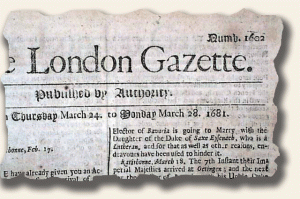 The new year of the older Julian calendar began on March 21, so an issue dated March 17, 1675 would be followed by the next weekly issue dated March 24, 1676. This would also mean that an issue dated December 31, 1675 would be followed by an issue dated January 7,1675. This was how the London Gazette dated it’s issues for much of the 17th and early 18th centuries. At first glance one would think that the issue of Jan. 7, 1675 was older than one dated December 31, 1675, but the opposite was true.
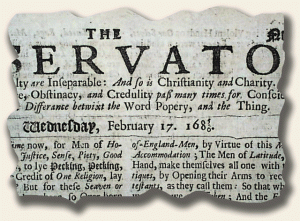 Other titles were a bit more helpful in noting the year of publication by dating issues from January 1 thru March 20 with a double-dated year such as “1684/5” or “1686/7” so the reader would know that it was from the year 1684 under the Julian calendar, or 1685 under the Gregorian calendar.
Some American newspapers of the 18th century have similar double dates, but by the beginning of the 19th century–if not reasonably before–newspapers had converted exclusively to the Gregorian calendar. The same was true with most of the Western world, while other portions of the globe adopted the Gregorian dating system much later.
Hopefully this answers a few questions you have had. Be in touch if we can be more helpful!
Numbering an issue….how was it done?
April 6, 2009 by TimHughes · Leave a Comment
 The numbers noted at the top of the front page of a newspaper, typically at the far left and right of the dateline, may seem a bit confusing so I’ll try to explain what they mean.
Most newspapers had two sets of numbers: 1) the issue & volume numbers, and 2) the whole number.
The issue & volume number often appear such as “Vol. 5 num. 237” which means this is the 237th issue from the fifth year of the newspapers existence. Newspapers would assign a volume number to their publication which would increase by one on the anniversary of its beginning, so if a newspapers published it’s first issue on March 5, 1837, volume two would begin with the first publication after March 5, 1838. The issue number notes the issue from within that volume, meaning that issue “Vol. 5 num. 313” might be followed by issue “Vol. 6 num. 1” if the newspaper published 6 days a week (365 days less 52 Sundays = 313 published issues in the year).
 But to many the more mysterious number is the “whole number”. Essentially it indicates how many issues have been published since the founding of the paper, and can be a very large number if the paper has been in publication for many years.
Using the above example of “vol. 5 num. 313” the “whole number” of this issue would likely be 1565 (313 issues per year x 5 years = 1565). And the very next issue, noted as “vol. 6 num 1” would be whole number 1566.
 The tricky thing is that when some newspapers were sold, reorganized, changed their name, or merged with another they might begin a “new series” and the volume/issue numbers would begin afresh, and the whole number may or may not start over with number 1, depending on the whim of the publisher. So these numbers cannot be depended upon to give an accurate reflection of how old the newspaper is, nor the number of issues that were printed since its inception. Niles’ National Register did this at least twice in its 40 years’ existence.