From Passion to Legacy: 50 Years Strong… and Counting…

November 28, 2025 by · 5 Comments 

The following, penned by the founder of Timothy Hughes Rare & Early Newspapers, appeared on the front page of our most recent catalog (#361):

It was 50 years ago this month that the Rare & Early Newspapers business began.

Having been a collector of many things in my earliest of years, primarily coins, venturing into this fascinating world of old newspapers was a logical step. I never really saw a truly old newspaper until I stumbled across an 1826 Philadelphia newspaper at a local flea market, I was convinced I had discovered an unexploited hobby. So my new adventure began. 

Although I started collecting somewhat earlier, I sold my first newspaper on December 1, 1975. I used a manual typewriter to list various newspapers on a legal-size sheet of paper, then making photocopies at a local college to print multiple sheets. When an issue or two sold, I typed up replacements and taped the listings over those that sold, then made more photocopies.

How to advertise in the pre-internet era? I would place small, classified ads in various history & collector-themed magazines. As for research, I kept a set of encyclopedias next to my desk.

Eventually, the single sheets of offerings turned into small catalogs. The first formal catalog was issued in the spring of 1978 and wasn’t even numbered, as I wasn’t sure there would be another.

This catalog you have in your hands is number 361. My ad mentioned “…send 25¢…” for the catalog, which more than covered the cost of postage. Imagine that! 

It was always my goal to continue to offer more issues, earlier issues, and more historic offerings with each passing month. I’ve been pleased with our progress, and for those who have been with us for many years, hopefully you’ve noticed the dramatic growth in the range of our inventory. It was my hope that collectors would look forward to each catalog, anxious to discover new “goodies” we’ve not offered before.

I became semi-retired some 23 years ago with Guy Heilenman taking over, but I remain actively involved, primarily with buying inventory. My wife and I moved West to be close to family, but I get back to Williamsport for “hands-on” work about six weeks a year.

There will be no end to this business. We remain the only full-time dealers in early newspapers in the world. At some point another generation will take over, and our inventory and offerings will, hopefully, continue to expand. I hope to remain involved for as long as God allows.

Thank you all for 50 years of fun!

Tim Hughes

As I reflect on all that has unfolded since Tim first placed those typewritten listings on a photocopied page, I am deeply grateful for the foundation he built — one rooted not just in curiosity and perseverance, but in faith, integrity, and a desire to honor God through honest work. What began as one man’s fascination with the past has become a legacy business that has served thousands of collectors, connected generations through the printed word, and provided meaningful work for more than twenty dedicated team members — including Tim’s younger brother (Brian), my wife (Laura), and all six of our children. Tim’s vision and steadfast commitment to excellence continue to shape every part of who we are as a company.
Furthermore, I’m thankful Tim remains actively involved today, still sharing his wisdom and passion with us. Lord willing, when both of our times have passed, my children — and/or perhaps even my children’s children — will carry the torch forward, preserving not only the newspapers of history, but the faith, integrity, and purpose that have guided this work from the very beginning. May the legacy Tim began continue to remind us that while newspapers record history, it’s the lives behind them that make it truly worth remembering. After all, as Tim said back in 1975: “History is never more fascinating than when it’s read from the day it was first reported” – that is, through the eyes of those who lived it. Thanks Tim.
Guy Heilenman

Properly Directed Thankfulness – George Washington and the Foundations of a New Nation…

November 25, 2025 by · Leave a Comment 

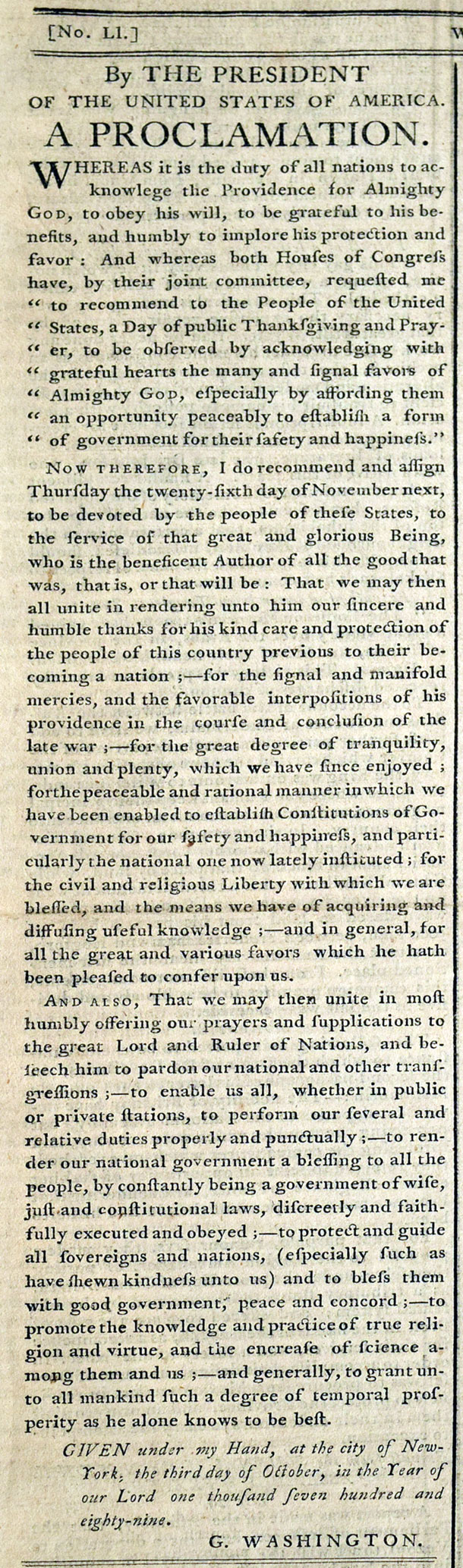
On October 3, 1789, just months into his presidency, George Washington issued the very first official presidential proclamation. Fittingly, his choice of subject set the tone for a new nation: a call for a national day of thanksgiving and prayer. In it, Washington urged the people of the United States to acknowledge “with grateful hearts the many signal favors of Almighty God, especially by affording them an opportunity peaceably to establish a form of government for their safety and happiness.” This was more than a holiday declaration—it was a reminder that gratitude, humility, and faith would form part of the nation’s foundation.

Below is the complete text of Washington’s Thanksgiving Proclamation as it appeared on the front page of the Gazette of the United States on October 7, 1789:
From the Vault: The top ten: “20th century”…

November 21, 2025 by · 9 Comments 

From this period in newspaper publishing history, displayability has much to do with the desirability of a newspaper, perhaps more so than historical significance. Since I come to this task of listing the “top ten” from the perspective of a rare newspaper dealer and knowing the requests we receive for certain events, the following list may not be the same as my most “historic” but they are my thoughts for the most “desirable” based on customer demand. Certainly FDR’s New Deal is more historically significant than the death of Bonnie & Clyde, but not more desirable from a collector standpoint. I’d be curious to hear of your thoughts.

Bonnie&ClydegifHere they are, beginning with number ten:

10) St. Valentine’s Day Massacre, Feb. 14, 1929  An issue with a dramatic banner headline, & ideally dated the 14th. Morning papers would be dated the 15th.

9) Death of Bonnie & Clyde, May 23, 1934  The gangster era remains much in demand, & perhaps due to the movie this event beats out Dillinger, Capone & the others from the era. A dramatic headline drives desirability–ideally with a photo–even if not in a Louisiana newspaper.

8.) Charles Lindbergh flies the Atlantic, May 22, 1927  The New York Times had a nice headline account with a map of the route, and the prestige of the newspaper always keeps it in high demand.

Dewey_Defeats_Truman7) Call-Chronicle-Examiner, San Francisco, April 19, 1906  I note a specific title & date for this event, as these 3 newspapers combined to produce one 4 page newspaper filled with banner heads & the latest news. No advertisements.

6) Crash of the Hindenberg, May 6, 1937  The more dramatic the headline the better, & ideally with the Pulitizer Prize winning photo of the airship in flames.

5) Wright brothers fly, Dec. 17, 1903  Here’s where the significance of the event drives desirability over dramatic appeal. Few can argue the impact of manned flight on the world. Reports were typically brief & buried on an inside page with a small headline, so a lengthy front page report would be in top demand.

4) Stock market crash, October, 1929  Demand is driven by the dramatic headline and its wording. Too many newspapers tried to put an optimistic spin on the tragedy. Collectors want “collapse, disaster, crash” & similarly tragic words in the headline (how about Variety magazine’s: “Wall Street Lays On Egg”?)

Pearl_Harbor_HSB_1_extra3) Honolulu Star-Bulletin, Dec. 7, 1941  “1st Extra”  The defining issue from World War II but be careful of reprints as most issues on the market are not genuine.

2) Chicago Daily Tribune, Nov. 3, 1948 “Dewey Defeats Truman”. What more need be said?

1) Titanic sinking, April 14, 1912  Certainly low on the historically significant list, but off the charts on the desirability scale, much due to the block-busting movie. The more dramatic the headline the better, and hopefully with a nice illustration of the ship going down.

My “honorable mention” list might include baseball’s “Black Sox” scandal of 1919, sinking of the Lusitania, end of World War II, D-Day, JFK’s election, the New Deal, a great Babe Ruth issue, etc. Maybe they would rank higher on your list. Feel free to share your top choices.

Lead-up to a Nation… as reported in the newspapers of the day (October, 1775)…

November 6, 2025 by · Leave a Comment 

Today we continue our series, “Lead-Up to a Nation… as reported in the newspapers of the day” – the anniversary of the greatest experiment in democracy and self-government.
The following are the installments from last month (October), which reflected on the events as they were reported in and around October, 1775:

England Misses the Temper of the Times (Lead-up to a Nation – E9)

The Liberty Tree (Lead-up to a Nation – E12) 

George Washington – Integrity, Leadership & Humility (Lead-up to a Nation – E13)

We hope you are enjoying this year-long trek to the 250th anniversary of The United States through the eyes of those who were fully engaged, first hand. As mentioned previously, all accounts are rooted in what they read in the newspapers of the day.

“History is never more fascinating than when read from the day it was first reported.” (Timothy Hughes, 1975)

From the Vault: Headlines drive interest in World War II…

October 24, 2025 by · Leave a Comment 

For likely a multitude of reasons, interest in World War II newspapers ranks far higher than in the Korean War, World War I, or the Spanish-American War.  It may be a generational thing, as most collectors today are children of World War II veterans and likely heard stories of the war first-hand, or found newspapers in their parents attics which sparked an interest. One could debate a number of other possible reasons why other wars lack the intrigue found in that fought by the “greatest generation”.

Headline collecting has always been a focus for this hobby, and as any collector knows, bold, banner headlines did not become commonplace until late in the 19th century. With the increasing competitiveness of daily newspapers across the country–Hearst, Pulitzer & others rising to prominence–flashier front pages were needed to draw attention at the corner news stand. It’s a shame there is not more interest in the Spanish-American War and World War I as both events resulted in some huge, dramatic, & very displayable headlines.

Because there are a plethora of newspapers from the WWII era available, collectors have become very discriminating in what they collect.  Only the “best of the best” will do, meaning just the major events and only those with huge and displayable headlines. If there is a “top 6” list of sought-after events, our experience is they would be: 1) attack on Pearl Harbor; 2) the D-Day invasion; 3) death of Hitler; 4) end of the war in Europe; 5) dropping of the atomic bomb; 6) end of the war in the Pacific. One could add any number of other battle reports such as Midway, battle of the Bulge, fall of Italy, Iwo Jima, battle for Berlin, and so much more. And we could step back before American involvement in the war and add Hitler’s invasion of Poland and the battle of Britain.
The bigger the headline the better. With some newspapers the entire front page was taken up with a headline and a related graphic. The U.S. flag was a common patriotic device. Tabloid-size newspapers commonly had the front page entirely taken up with a singular headline and tend to be better for display given their smaller size.

And not just American newspapers draw interest. German newspapers hold a special intrigue, but the language barrier is a problem for many. But the British Channel Islands, located in the English Channel between England & France, were occupied by the Nazi during the war so their reports were very pro-Nazi while printed in the English language (ex., Guernsey Island). And the military newspaper “Stars and Stripes“, while certainly being American, was published at various locations in Europe and the Pacific. Collectors have a special interest in finding World War II events in the official newspapers of the American military forces. Plus there were a multitude of “camp” newspapers, amateur-looking newspapers printed on a mimeograph machine for consumption limited to a military base, and typically printed is very small quantities. Their rarity is not truly appreciated by many.

For obvious reasons, there is also a high degree of collectible interest from those wishing to make sure certain aspects of history are not forgotten. The Holocaust, and the Nazi propaganda used to provide a rationale for eliminating the Jewish people, is well documented in newspapers from the era. In addition to the Holocaust and its atrocities, issues providing context through reporting other pre-war events such as the Great Depression, fascism, and increased militarism, are also desirable.

True to any collectable field, newspaper collectors are always on the lookout for an issue better than what they have, and collection upgrades are constant. Finding that special, rare, unusual or fascinating headline is what makes the hobby fun. Will interest in the Korean War and the Vietnam War gain more interest in future years? Perhaps so. With interest currently low and availability and prices very attractive, it might be a good time to explore.

Lead-up to a Nation… as reported in the newspapers of the day (Intro & Sept., 1775)…

October 3, 2025 by · Leave a Comment 

Today we continue our series, “Lead-Up to a Nation… as reported in the newspapers of the day” – the anniversary of the greatest experiment in democracy and self-government.
The following are the installments from last month (September), which reflected on the events as they were reported in and around September, 1775:

British News Delayed – Lead-up to a Nation (E5)

Lord Dunmore and Colonial Unrest – Lead-up to a Nation (E6)

Patrick Henry – Lead-up to a Nation (E7)

Benjamin Franklin – Lead-up to a Nation (E8)

We hope you are enjoying this year-long trek to the 250th anniversary of The United States through the eyes of those who were fully engaged, first hand. As mentioned previously, all accounts are rooted in what they read in the newspapers of the day.

“History is never more fascinating than when read from the day it was first reported.” (Timothy Hughes, 1975)

Lead-up to a Nation… as reported in the newspapers of the day (Intro & August, 1775)…

September 5, 2025 by · Leave a Comment 

At Timothy Hughes Rare & Early Newspapers, we feel like we’re stepping onto the field for our very own Super Bowl—only this time, the stakes are historical! As we begin the 12-month countdown to the 250th anniversary of the United States of America, we are honored to be part of this extraordinary moment in time.
To commemorate this milestone in our nation’s story—the anniversary of the greatest experiment in democracy and self-government—we’re thrilled to launch a special series that brings the past to life. Starting this month, and several Fridays each month between now and the official anniversary on July 4, 2026, we will highlight pivotal pre-Independence Day events exactly as they were covered in the printed news of the day.
As the year progresses, we’ll also shine a spotlight on the U.S. Constitution, the remarkable framework that has kept our Republic “between the bumper rails” for nearly 250 years. And of course, we’ll celebrate We The People and the visionary Founding Fathers whose bold leadership helped lay the foundation for a new nation.
As George Washington so aptly stated in his very first State of the Union Address in 1790, “The establishment of our new Government seemed to be the last great experiment for promoting human happiness.” We at Timothy Hughes Rare & Early Newspapers are proud to honor that enduring legacy—and we would be delighted if you would join in the celebration.

Shown below are the first four installments.

The Necessity of Taking Up Arms – Lead-up to a Nation (E1)

The Olive Branch Petition – Lead-up to a Nation (E2)

The Speech of Edmund Burke – Lead-up to a Nation (E3)

England Declares War – Lead-up to a Nation (E4)

We hope you enjoy this year-long trek to the 250th anniversary of The United States through the eyes of those who were fully engaged, first hand. All accounts will be through what they read in the newspapers of the day. After all, as Tim Hughes proclaimed back in 1975: “History is never more fascinating than when read from the day it was first reported.”

A 49 year search comes to an end… The 1765 “Tombstone” issue…

September 1, 2025 by · Leave a Comment 

There are a number of iconic American newspapers that every collector desires, most are for content alone such as the Declaration of Independence, the Constitution, the assassination of Abraham Lincoln, etc.

Not many are desired for both historical significance as well as graphic appeal, but such is the case with the Pennsylvania Journal of  October 31, 1765. Having been aware of it for many years (photos are found in many high school history books), I had always been in the search for a genuine issue (beware: many reprints exist). I came close about 35 years ago when an institution, which had two in their collection, gave thought to exchanging one with me for an unknown Philadelphia newspaper I had discovered. Ultimately, they opted not to do the swap, so the search was back on.

It ended earlier this year.

This particular edition, famously known as the “tombstone edition,” used striking visual and textual elements to express colonial outrage over the Stamp Act tax, which required many printed materials, including newspapers, to bear a revenue stamp. This tax directly impacted printers and publishers, placing a heavy economic burden on them and fueling widespread resistance.
As seen in the photos, the masthead featured a skull and crossbones, a powerful symbol representing the “death” of the press under the weight of the Stamp Act. Also, an engraving of a coffin appears at the bottom of the back page, captioned: “The last Remains of the PENNSYLVANIA JOURNAL Which departed this Life, the 31st of October, 1765, Of a Stamp in her Vitals, Aged 23 Years.”
Publisher William Bradford begins the issue with poignant commentary, including: “I am sorry to be obliged to acquaint my readers, that as The Stamp Act is fear’d to be obligatory upon us after the First of November ensuing (the fatal to-morrow) the publisher of this paper unable to bear the burthen, has thought it expedient to stop a while, in order to deliberate whether any methods can be found to elude the chains forged for us…”.
Published just one day before the Stamp Act’s enforcement, this edition cleverly voiced dissent without yet violating the law, making it a strategic act of defiance.
This “tombstone edition” of the Pennsylvania Journal captured this economic strain and transformed it into a public rallying cry.
This edition stands as a vivid example of how the colonial press used creativity to oppose British policies, contributing to the growing revolutionary sentiment. It underscores the critical role newspapers played in shaping public opinion and mobilizing opposition in the years leading up to the American Revolution.
While other newspapers also protested the Stamp Act, the Pennsylvania Journal’s dramatic tombstone imagery made it particularly memorable and influential. It galvanized public resistance, cementing its place as a powerful symbol of defiance in American history.

The July, 2025 Newsletter from Timothy Hughes Rare & Early Newspapers…

July 19, 2025 by · Leave a Comment 

Welcome to the July Newsletter from Timothy Hughes Rare & Early Newspapers… History’s Newsstand. Shown below are links to a Lincoln assassination broadside (available “on the cheap” due to condition), an expanded set of items added to Catalog 356 which are only available on-line (25 added just today), a new set of discounted newspapers (100+ at 50% off), recent additions to the History’s Newsstand blog, and the complete Catalog 356 (July’s catalog). Regarding the expanded set of new catalog items, just for fun, check out “The Speech of Polly Baker” and “Curious issue reporting Kennedy’s assassination“. We hope you enjoy!

– – – – – – – – – – – – – – – – – – – –

An inexpensive Lincoln Broadside

(on eBay)


– – – – – – – – – – – – – – – – – – – –

July’s Discounted Issues

(50% off – as shown)

– – – – – – – – – – – – – – – – – – – –

Newly Added to Catalog 356

(25+ more added within the past 24 hours)

– – – – – – – – – – – – – – – – – – – –

Catalog 356

(Complete list)

– – – – – – – – – – – – – – – – – – – –

The History’s Newsstand Blog (Recent Posts)

Editors take note: be careful what accompanies a headline…

Losses of the Past… Sherman’s March to the Sea…

From the Vault: American history in British newspapers…

Hearts & Minds… The Causes and Necessity of Taking Up Arms…

Claiming the Land… America Presses Westward…

The reason I collected it: an “association piece” attached…

The historical foundation of “Juneteenth” – June 19, 1865…

– – – – – – – – – – – – – – – – – – – –

Video Flashback (posted a few years ago)…

The Best of the Best – Part I

As always, thanks for collecting with us!
Sincerely,
Guy Heilenman & The Rare & Early Newspapers Team
570-326-1045

From the Vault: American history in British newspapers…

July 7, 2025 by · Leave a Comment 

After 50 years in the hobby I can honestly say today as I said then: collecting early newspapers is an inexpensive hobby when compared to other collectibles of like vintage. And the reason is basic economics: supply and demand. Although the collecting fraternity has increased through the years, and the supply of early newspapers has dwindled some, prices still remain a relative bargain for material over 100—and over 200—years old.

Exceptions exist. American newspapers of the 18th century are few and far between today. When I began in the hobby in the mid-1970’s, finding the occasional 18th century bound volume of American newspapers was rather common. I even purchased a number of volumes of colonial and Revolutionary War newspapers printed in the colonies. Such purchases are very rare today, and consequently prices for American titles before the1790’s can be exorbitant for many collectors.

Which brings me to this topic. We are fortunate in this hobby to have a terrific alternative to American newspapers of the colonial era: British newspapers. Keeping in mind that the American colonies were British possessions at the time, considerable American reporting was not uncommon (and I can attest that American newspapers of the same period had considerable European reports!). In fact most British newspapers took their accounts directly from American newspapers so the reporting was identical. And the added bonus of British newspaper reports is commentary with a British bias, offering an interesting perspective to what we remember from history class.

Hobbyists of 25 – 50 years ago eschewed British titles because American titles were so common. But today the collecting market is much different. In many respects I see today’s availability & pricing of British titles much like the situation with American titles 50 years ago. We can find major American events of the colonial era at prices still under $1000 (higher for the “best of the best”) in the London Chronicle or like titles, and under $300 for second tier events.  We find there is typically a 5 fold price difference between reports in American versus British newspapers. We’ve sold the Boston Tea Party for $1150 in the London Chronicle. In an American newspaper a like account would exceed $10,000.  We’ve sold the Boston Massacre in the London Chronicle for the same price. And yet again, it would easily exceed $10,000 in an American title. One of the most significant documents of the Revolutionary War, “The Causes & Necessity For Taking Up Arms”, we sell as a $540 item in the Gentleman’s Magazine, yet we sold it for $5550 in the New England Chronicle a number of years ago – and today it would go for $8,000-$12,000+. Same complete document, both from 1775, one within the budget of most collectors, the other not.

But prices are rising for British imprints as more collectors are becoming aware that if they want their collection to contain all the significant events of the 18th century, British newspapers and magazines are their only alternative.  The Declaration of Independence remains the most desired event for American collectors. An American newspaper printing is beyond the budgets of almost all collectors, if available at all. An auction price of $50,000 – $75,000 would be expected, while we recently sold the same document in the London Chronicle for $8775. But I will also note it was not long ago that we sold it for $4450. Our current price for a front page account of the Battle of Lexington & Concord in the London Chronicle is $985. Our previous sale of the identical dated issue was $440.

Where will the hobby be with such events in another 25-50 years? Will all 18th century newspapers–American and British–be considered museum pieces? Much will determine where prices go and I will not hazard a guess. But I am pleased that as the hobby enters a crossroad in availability versus pricing, we currently have a reasonable path to follow for the foreseeable future. These are interesting times for the collecting fraternity.

Next Page »