
Search
The Rare & Early Newspapers Hobby

Receive the Newsletter

Buy Historic Newspapers

Who’s Who in Newspapers? Lt. Colonel John Laurens edition (1782)…
November 20, 2026 by GuyHeilenman · Leave a Comment
If you’re a Revolutionary War enthusiast – or a fan of the musical Hamilton—you likely recognize the name Lt. Colonel John Laurens. Yet far fewer people realize the tragic timing and profound impact of his sacrifice in the final days of America’s fight for independence.
Born into wealth in South Carolina, Laurens emerged as one of the boldest and most idealistic figures of the Revolution. Serving as an aide-de-camp to General George Washington alongside Alexander Hamilton, he was renowned for his extraordinary bravery on key battlefields from Brandywine to Yorktown. Beyond his tactical courage, Laurens was a visionary ahead of his time, passionately advocating for the recruitment and emancipation of enslaved soldiers to fight for liberty. Tragic in its irony, his death came in a minor skirmish at the Battle of the Combahee River on August 27, 1782—months after the British victory at Yorktown and just as peace negotiations were drawing the war to a close.
His story came to our attention recently while cataloging an exceptional late-18th-century British issue in our collection. As we examined the back page of The London Chronicle dated November 16, 1782, our eyes fell upon a poignant dispatch sent from Astley Hill, South Carolina, detailing the late-war struggle and reporting the untimely loss of one of America’s brightest young leaders.
If you are fascinated by the unsung heroes of the American Revolution—and the poignant reality of lives cut short on the precipice of peace—spending a little time reading contemporary accounts of Laurens’ final battle is a sobering experience. It serves as a stirring reminder of the immense cost paid for American independence.
Below is a photo showing the back page of The London Chronicle from November 16, 1782, featuring the dramatic contemporary account of the engagement at the “Cumbukee” [Combahee] River and the loss of Lt. Colonel John Laurens.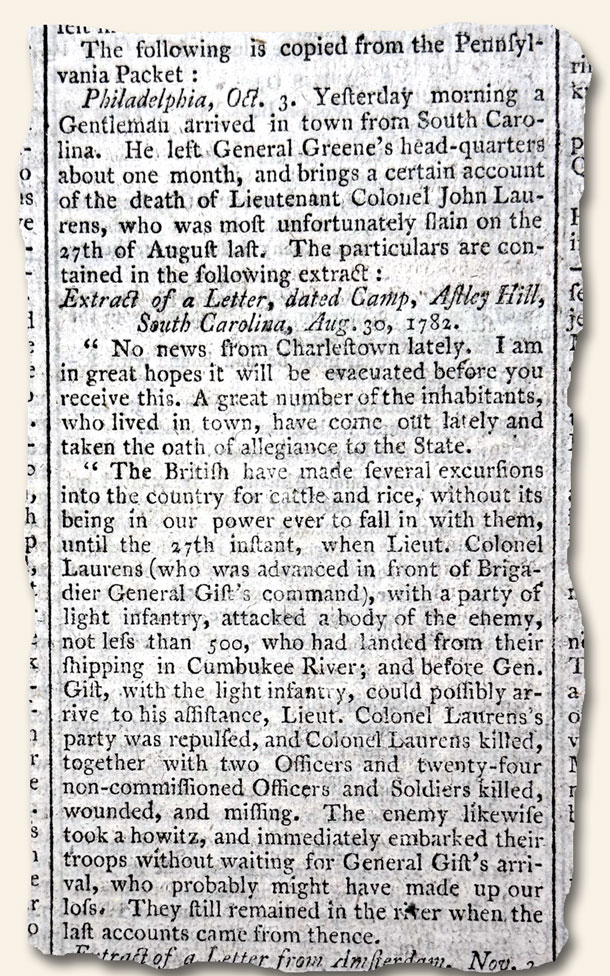
The reason I collected it: The Latimer Journal, And North Star…
November 13, 2026 by TimHughes · Leave a Comment
Although I have encountered many themed newspapers whether focused on sports, anti-slavery, literature, entertainment, presidential campaigns, and many other themes, this may be the first title I’ve encountered focused on a single cause. Hence, a great choice for the private collection.
The title is ‘The Latimer Journal And North Star’ from Boston, and this issue is dated Nov. 23, 1842.
As a bit of background, George Latimer was an escaped enslaved person whose case became a major political issue in Massachusetts. There is much on the internet concerning him and his legal case.
We credit the Rutgers School of Arts & Sciences for the following which ties this newspaper to the Latimer case: “George W. Latimer, was the first fugitive slave whose emancipation guided and influenced the American abolitionists of the 1850s. His flight to Boston, arrest, imprisonment, trial, and emancipation, as well as the numerous public meetings held all over Massachusetts on his behalf, made his a cause célèbre, fifteen years before the famous Dred Scott Decision. His supporters called it a “war on slavery.”
Supporters of the Latimer cause included Dr. Henry Bowditch, William Francis Channing, and Frederick Cabot. These men, described as “gentlemen of property and standing,” founded a newspaper called The Latimer Journal and North Star, which first appeared in Boston on November 11, 1842. Its purpose was “to meet the urgency of the first enslavement in Boston” and to rescue a fugitive slave from the custody in which he was detained. The editors of the Journal were determined to “discourage all intemperate and violent measures, even for the rescue of our citizens from enslavement.” [Note: A post featuring his son can be found at: “Who’s Who in Newspapers – Lewis H. Latimer edition”.]
Critics claimed that the Latimer Journal “greatly excited and alarmed the credulous, vexed the irritable, inflamed the passionate, and exasperated those whose sympathies ran beyond their judgments.”
Six [actually 7] issues appeared subsequently from November 11, 1842 to May 16, 1843, [the issue offered here is number 5]. The journal responded to a chain of events that had begun on October 4, 1842, when George Latimer, along with his wife Rebecca, ran away from slavery in Norfolk, Virginia, and fled to the North…” and more as can be seen on the link.
See the photos on the listing for “Great Massachusetts Petition” which would appear separately as a broadside, but consumes all of the back page of this issue.
The Great Massachusetts Petition sought to acquire signatures to put an end to the state’s “connection with domestic slavery” and to ensure that its citizens would be free from the “danger of enslavement.” The handwritten section reads: “This was the form sent to every town of Massachusetts for signature, the towns being organized for this purpose by correspondence, county conventions & public meetings.” The following is from the above mentioned newspaper: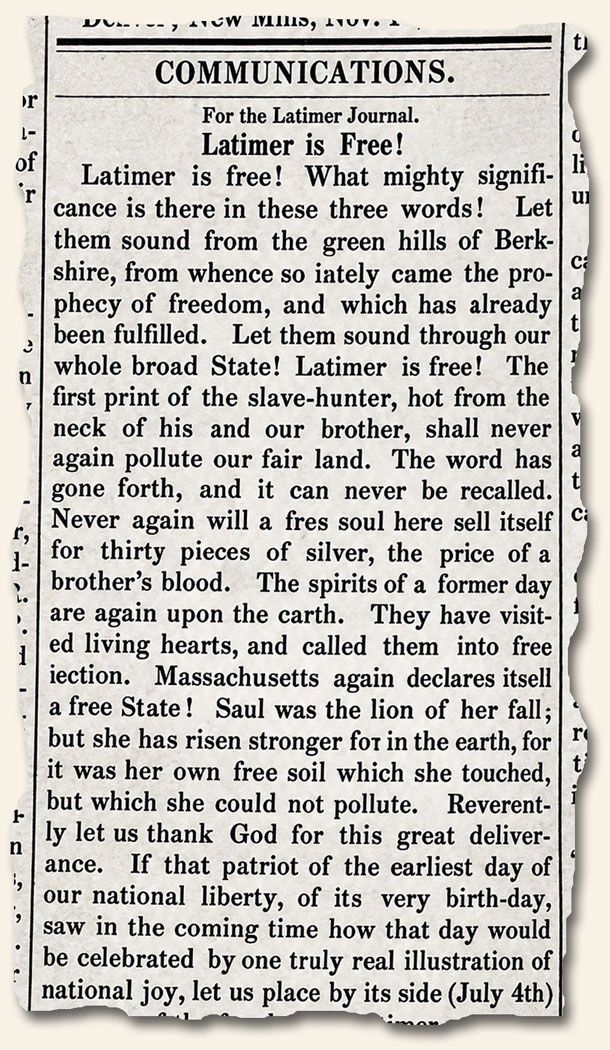
Niles’ Register – a Modest Footprint with a Massive Historical Record…
November 9, 2026 by GuyHeilenman · Leave a Comment
If you’re a serious collector of early American journalism, you almost certainly know Niles’ Weekly Register. Published out of Baltimore by Hezekiah Niles beginning in 1811, it stands as one of the most important—and most eagerly sought-after—periodicals in our entire inventory.
Long before the era of instant wire services or cable news, Niles set out to create a comprehensive, unbiased record of the young United States. He painstakingly compiled government documents, congressional speeches, statistics, foreign news, and key political debates, offering a national perspective at a time when most newspapers were fiercely local and unapologetically partisan. His devotion to facts and source documents turned the Register into the definitive national journal of record for the antebellum era. Today, historians and rare newspaper collectors view Niles’ Register as an indispensable treasury of early American history, covering critical events like the War of 1812, the Westward Expansion, and the fiery debates surrounding tariffs and state sovereignty, along with the publishers noteworthy “Mitigation of Slavery”. While the full list of desirable items is extensive, the most sought-after include:
- June 27, 1812: Covering the official declaration of the War of 1812.
- March 11, 1820: Printing the full, contentious text of the Missouri Compromise.
- December 6, 1823: Publishing President Monroe’s historic address, later known as the Monroe Doctrine.
- November 6, 1824: Chronicling General Lafayette’s celebrated return tour of America.
- May 29, 1819 & March 5, 1825: The Jew Bill – striving for equal rights for the Jews.
- April 16, 1836: Historic reporting on the Battle of The Alamo.
If you are passionate about early American history, spending a little time leafing through the dense, factual pages of Niles’ Register is a captivating experience. It offers a rare, direct window into how the founders and early citizens shaped the nation in real time.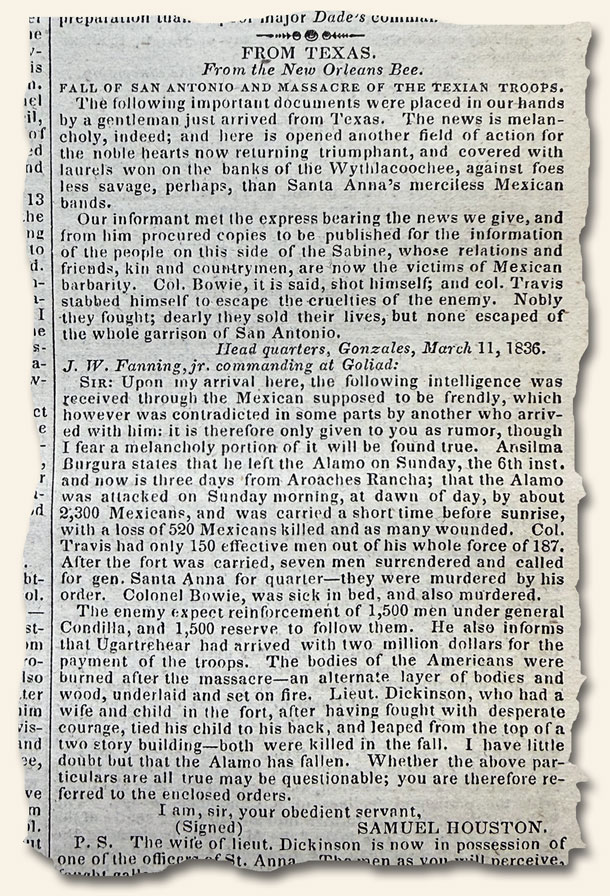
Top-Tier Treasures – 20th Century (The Spindletop Edition)…
November 6, 2026 by GuyHeilenman · Leave a Comment
Welcome to the inaugural post of our new series, “Top-Tier Treasures…”, where we showcase a premier issue from our archives, rotating century by century. In some instances the newspaper will have previously sold, but is included due to its significance. To kick off the series, we’re diving headfirst into the 20th century with a newspaper that captured the exact moment the modern world changed forever.
On January 10, 1901, a massive geyser of crude oil blew through a wooden derrick in Beaumont, Texas. Known as the Lucas Gusher at Spindletop, the well shot petroleum over a hundred feet into the air for eight wild days before it could be capped. Overnight, it nearly tripled U.S. oil production and birthed energy giants like Texaco and Gulf Oil. If ever a single moment ushered in the roaring industrial engine of the 20th century, this was it.
What makes this holding truly extraordinary is the paper itself: The Houston Daily Post from January 11, 1901. While national papers eventually covered the news days or weeks later, this local Texas issue captured the discovery as it was actively unfolding right in its backyard. Page 3 blares with historic headlines: “OIL STRUCK NEAR BEAUMONT” and “A Stream of Petroleum Shot Into the Air for a Hundred Feet”.
If you appreciate American history, reading early coverage of the Spindletop discovery is a treat. It offers a great snapshot of the moment the modern oil era began.
Below is a photo of a portion of this historic announcement – an article which elevates this newspaper to the level of a true 20th-century treasure.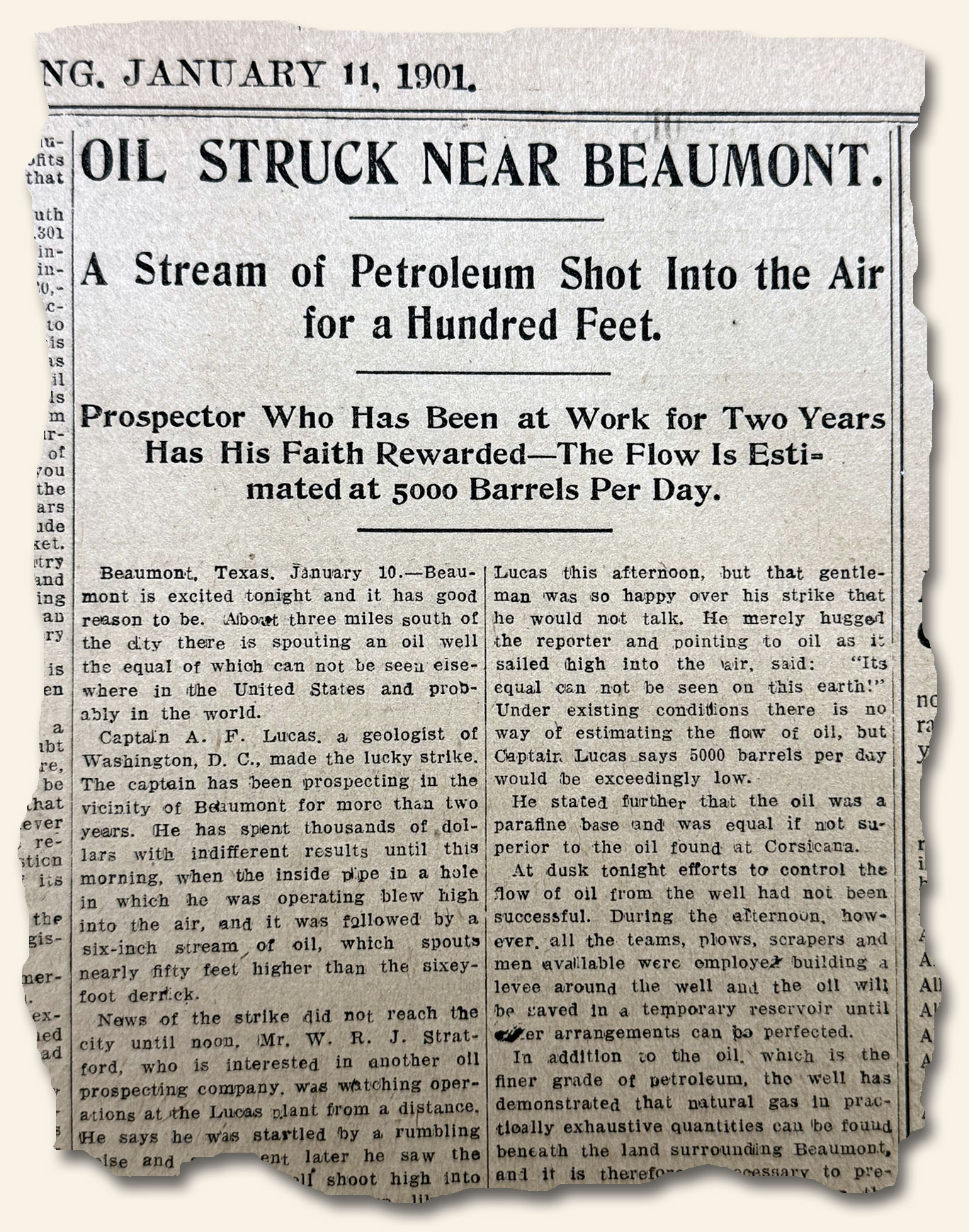
Great Headlines Speak for Themselves… The Hindenburg Disaster…
November 2, 2026 by GuyHeilenman · Leave a Comment
The best headlines need no commentary. Such is the case with THE GREENSBORO PATRIOT, North Carolina, May 10, 1937, which featured the headline:
“35 DIE AS HUGE ZEPPELIN BURNS”
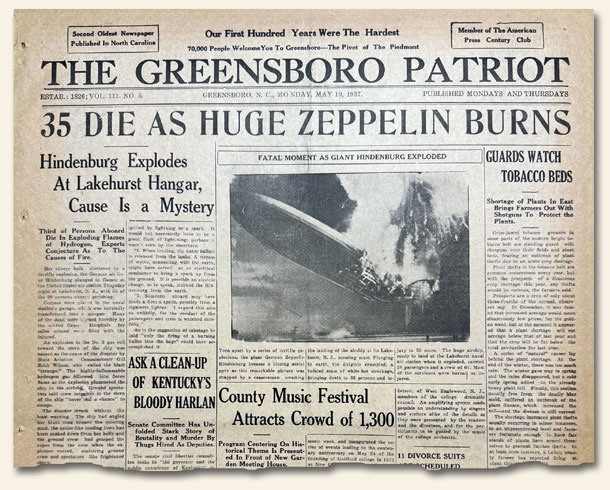
Okay, I can’t help myself. While the horrific fireball was a devastating tragedy – forever etched into history by dramatic headlines and accompanying photos such as the front page shown above, it remains a quiet miracle that 62 of the 97 passengers and crew somehow walked away from the inferno, defying the catastrophic odds.