
Search
The Rare & Early Newspapers Hobby

Receive the Newsletter

Buy Historic Newspapers

Same concern over 100 years ago…
August 30, 2010 by TimHughes · Leave a Comment
While listing an issue of “Judge” magazine, the political satire publication popular for the three color political cartoons in each issue, I noted the back page of an 1888 issue has a caption: “Goods Will Be So Much Cheaper–But what will become of all the American Industries?” The print (see below) shows the opening of the “Protection” flood gates with “European Pauper Manufactures” pouring upon American industries, shown in disrepair.
With one of the concerns of the American economy today being the flood of manufactured goods from foreign plants and the flight of American industries to off-shore sites, I find it curious that an identical concern was a focus 122 years ago. This political cartoon could well appear in a newspaper today.
Understated caption, or overstated print…
August 28, 2010 by TimHughes · Leave a Comment
This illustration appears in “Frank Leslie’s Illustrated Newspaper” dated August 5, 1871. The caption notes: “Mount Washington Storm Signals–Use of the Anemometer under difficulties.” Either the print is overstated or the caption is understated. I’m guessing the former, but it makes for a fun image.
The Traveler… who really invented “the talkies”?
August 26, 2010 by The Traveler · Leave a Comment
Today’s journey, through The Christian Science Monitor dated August 26, 1910, took me on the train ride with Colonel Roosevelt as he was traveling across the states on his campaign tour. I found a segment a bit amusing… “At Erie the Colonel spoke to fully 5000 people. At Dunkirk a crowd nearly as large surrounded the train, and some one shouted, ‘Hello, Teddy!’ ‘I used to think it lowered my dignity to have them call me Teddy,’ the colonel said to his party in an undertone, ‘but do you know I am getting to like it now.'” A this point in time, one just somewhat “assumes” that he was always called Teddy.
 While looking further into the issue, I found a one paragraph article with a headline “Mr. Edison Works On A New Device” and I just had to read it. “Moving pictures that talk, reproducing not only the action, but the spoken words of actors shown on the canvas, promise to revolutionize the moving picture business and the announcement that a machine that will combine the perfected phonograph with the present motion picture camera is being constructed in the laboratory of Thomas A. Edison in West Orange, has created a stir among inventors.”
This made me wonder just when were “talkies” invented and who invented it? Was this ground-breaking news? I did some researching through google. In the late 1890’s, there were some sound to movies but each person had to wear a listening device — early headsets?? Mr. Edison is mentioned as to be working on creating a special machine to make the “talkies” but the first talk was not to be until 1927 with the release of The Jazz Singer.
~The Traveler
First newspapers in Nebraska…
August 23, 2010 by TimHughes · Leave a Comment
 The Nebraska Territory came about as an important event in American history, repealing the Missouri Compromise of 1820 and allowing new territories to be slave or free as their citizens desired. It happened in 1854 and within the year three Nebraska newspapers were established, all in towns on the west bank of the Missouri River: Bellevue, Omaha City, and Nebraska City. Curiously, none of these towns had a printing office. Each newspaper was printed across the river in separate Iowa towns.
The first was in Bellevue, titled the “Nebraska Palladium” which began July 15, 1854 printed in St. Marys, Iowa. But in November of the same year a printing press was set up in town and on the 15th the first newspaper printed on Nebraska soil was issued.
The first newspaper in Omaha was the “Arrow“, printed in Council Bluffs, Iowa. It began just two weeks after the “Palladium” and only continued through the end of the year, succeeded by the “Nebraskian” which was printed in Omaha beginning January 17, 1855.
The Nebraska City “News” started in the fall of 1854 and was printed in Sidney, Iowa although the printing office would be moved to Nebraska City on Nov. 14.
The first daily newspaper in Nebraska was the “Telegraph” which began on Dec. 11, 1860.
A carefully worded conclusion…
August 21, 2010 by TimHughes · Leave a Comment
This item was published in the June 6, 1771 issue of the “London Chronicle“, but was taken from the Boston Evening-Post. It’s a comical piece which could have come from a modern-day situation comedy. As always, its the style of writing which adds to the article’s appeal.
First newspapers in Montana…
August 19, 2010 by TimHughes · Leave a Comment
 Similar to other eventual states in the western portion of the country, it was the search for gold & other precious metals which took some of the earliest adventurers to the Montana Territory.
Gold was discovered in Montana in 1858 and a “town” immediately sprang up, named Bannack. A newspaper, title the “News-Letter“, was started but not being successful only lasted a few numbers. (Given its format and short life it is not considered Montana’s first newspaper by some, that honor given more commonly to the “Montana Post“.)
The following year a richer strike was made in nearby Virginia City, where the first issue of the “Montana Post” was printed on August 27, 1864. Its publisher, John Buchanan, sold the newspaper just two weeks later to Tilton and Dittes, and 4 years later when Helena became the state’s capital the newspaper moved to that location where the first issue from Helena was dated August 25, 1868.
The next Montana newspaper was the “Montana Democrat“, printed in Virginia City from 1865. It would be followed by a few more in the 1860’s: the “Montana Radiator” in late 1865, the “Rocky Mountain Gazette” in 1866 and the first daily newspaper titled the “Herald” from Helena late in the same year.
Collectors prize issues of the “Montana Post” from Virginia City, although those with a Helena imprint are the more commonly found.
The influence of newspapers…
August 16, 2010 by GuyHeilenman · 2 Comments
I’m sure we would all agree with Edward Bulwer-Lytton (1839) that “the pen is mightier than the sword”. What about the pen as wielded via the text of a newspaper? Napoleon’s view was that “Four hostile newspapers are more to be feared than a thousand bayonets”. Interesting comment from one of history’s infamous (famous?) sword bearers. The following editorial note found on the front page of the June 17, 1867 issue of the Bethlehem Daily Times (PA) provides affirmation of this view:
However, lest we become overly fearful of the devastation such influence has upon our thinking, Erasmus (1571) provides us with a word of encouragement to the contrary: “There is no sword to be feared more than the Learned pen”. Perhaps we are safe. 🙂
Did you notice the 1867 price for the issue shown at the top of the image? Apparently, if the average person was inclined to be paid “a penny for their thoughts”, newspaper editors believed their thoughts were worth double.
With the ever-decreasing circulations of newspapers, I wonder what the equivalent form of influence is today… and will be 10 years from now???
Ben Franklin displays his wit…
August 14, 2010 by TimHughes · Leave a Comment
The December 11, 1775 issue of the “Hampshire Chronicle” from Southampton, England, includes a witty note from Ben Franklin to a friend in London, which appeared in several newspapers of the day. By his mind, the Revolutionary War was not going to be won by England through attrition.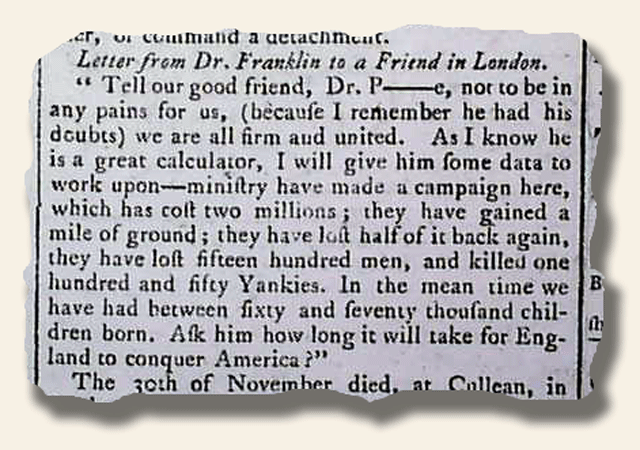
The Traveler… a ghost of a dog…
August 12, 2010 by The Traveler · Leave a Comment
 This week I did not select an issue of today’s date, instead I found the Connecticut Mirror dated August 13, 1810 instead. The front page of this issue begins with providing to the public the celebrated secret message of President Jefferson, on the 6th of December, 1805. This message was in respect of the relations of the United States with Spain and France concerning Louisiana. When I first saw this, I thought back to the 1970’s when Watergate occurred with the “missing minutes” of tape. Here they had secret messages that finally were revealed to the public five years later.
The story that was the eye-catcher was found on the back page, entitled “Ghost of a Dog”. This comes from a Dublin paper reporting of a lady who was scratched by a neighborhood dog, but she viewed it as a “breach of hospitality” that she demanded an order of execution on the dog. This was done, in a strange manner, and the dog’s body was retrieved by some friends. With some very unusual tactics over a course of about three weeks, the dog was able to run about as usual, make his rounds to visit his old friends, including meeting up with the lady he had scratched. She was so terrified that she fell into fits and at the time of the report was near death. Now… what’s the old saying… what goes around, comes around???
~The Traveler
Practice makes perfect???
August 7, 2010 by TimHughes · Leave a Comment
An interesting note in the November 14, 1857 issue of “Harper’s Weekly” only goes to show that practice doesn’t always make perfect: