
Search
The Rare & Early Newspapers Hobby

Receive the Newsletter

Buy Historic Newspapers

Significant Discovery: Horace Greeley’s “views” of Freedmen (1865)…
March 9, 2026 by GuyHeilenman · Leave a Comment
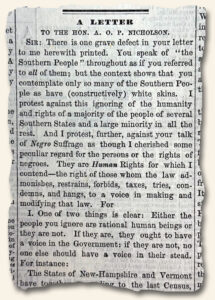
After being heavily engrossed in the rare & early newspapers collectible for over 50 years, encountering “new” discoveries within our own archives has not abated. Case in point: We recently identified a significant letter in the August 26, 1865, issue of the New York Daily Tribune that had previously gone unnoticed. Located on page 4 and signed simply “H. G.” (Horace Greeley), this letter addressed to the Hon. A. O. P. Nicholson offers a profound look into the intellectual climate of the immediate post-Civil War era. Perhaps it was the inconspicuous single column heading, “A Letter”, which was complicit in our oversight. Such “discoveries” are one of the reasons why we love this hobby.
As far as the letter itself is concerned… The exchange occurred during a pivotal window of Reconstruction. With the war concluded and the Thirteenth Amendment in the process of ratification, the nation was gripped by a debate over the “physical, intellectual, and emotional condition” of newly emancipated African Americans. While many, including Nicholson, sought to categorize or question the capabilities of the formerly enslaved through a lens of racial “fitness,” Greeley used his editorial platform to push back against these prejudices.
In this letter, Greeley argues that any perceived deficiencies in the Black population were not inherent traits, but the direct result of the “degradations” of the institution of slavery. By advocating for education and the rights of “Free Labor,” Greeley was effectively laying the groundwork for the so-called “Radical Republican” agenda that would eventually lead to the 14th and 15th Amendments.
For collectors of Civil War, Reconstruction-era, and Black-Americana ephemera, this issue serves as a primary source document and captures the exact moment the country transitioned from a military conflict to a philosophical battle over the true meaning of citizenship – a powerful step towards realizing the founding charge that all (people) are created equal.
Mike Drop from 1886… Frederick Douglass Leaves Us All Stunned…
July 25, 2022 by LauraH · Leave a Comment
The phrase “mike drop” is a trendy phrase in 2022, however, none could hold a candle to Frederick Douglass‘ address to Congress in 1886/1887. The Atlantic Monthly from December 1886 & January 1887 carried his plea, and while I would like to have something to add to his words, I believe I’ll let a portion of his address speak for itself:
“The Principle of slavery, which [The Founding Fathers] tolerated under the erroneous impression that [slavery] would soon die out, became at last the dominant principle and power at the South. It early mastered the Constitution, became superior to the Union, and enthroned itself above the law. Freedom of speech and of the press it slowly but successfully banished from the South, dictated its own code of honor and manners to the nation, brandished the bludgeon and the bowie knife over Congressional debate, sapped the foundations of loyalty, dried up the springs of patriotism, blotted out the testimonies of the fathers against oppression, padlocked the pulpit, expelled liberty from its literature, invented nonsensical theories about master-races and slave-races of men, and in due season, produced a Rebellion fierce, foul, and bloody. This evil principle again seeks admission into our body politic. It comes now in shape of a denial of political rights to four million loyal colored people. The South does not now ask for slavery. It only asks for a large degraded caste, which shall have no political rights. This ends the case. Statesmen, beware what you do. The destiny of unborn and unnumbered generations is in your hands. Will you repeat the mistake of your fathers, who sinned ignorantly?”
Some may want to join me in picking our jaws up off of the floor as we stand in awe of a man who, as a former slave, (self) educated himself to such heights, ironically, using The Columbian Orator which was also used as a textbook by other familiar names: Ralph Waldo Emerson (philosopher/poet), Harriet Beecher Stowe (author of Uncle Tom’s Cabin), and Horace Greely (editor/publisher of the New York Tribune) to name a few.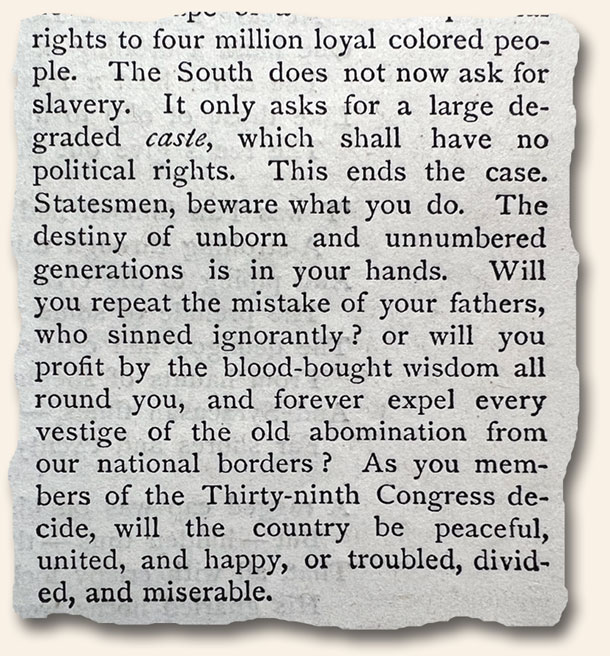
The aftermath of the Civil War… August, 1865
August 6, 2015 by GuyHeilenman · Leave a Comment
 What news was reported in August, 1865 – approximately 150 years ago? The horrors of the Civil War were now in the past, but the emotions and sorrow of the assassination of President Abraham Lincoln were still fresh. Where would the nation go from here? How would we move forward? Was unity possible?
August, 1865
The aftermath of the Civil War… July, 1865
July 9, 2015 by GuyHeilenman · Leave a Comment
 What news was reported in July, 1865 – 150 years ago? The horrors of the Civil War were now in the past, but the emotions and sorrow of the assassination of President Abraham Lincoln were still fresh. Where would the nation go from here? How would we move forward? Was unity possible?
July, 1865
The Civil War (post conflict)… June, 1865
June 5, 2015 by GuyHeilenman · 1 Comment
 What news was reported in June, 1865 – 150 years ago? Such a walk back in time through the eyes of those who read the daily and weekly newspapers of the period can be quite revealing. This is why we often say, “History is never more fascinating than when it’s read from the day it was first reported.” The following link will take you back in time to show the available newspapers from the Rare & Early newspapers website. There’s no need to buy a thing. Simply enjoy the walk back in time:
June, 1865
The Civil War (post conflict)… May, 1865
May 1, 2015 by GuyHeilenman · Leave a Comment
 quite revealing. This is why we often say, “History is never more fascinating than when it’s read from the day it was first reported.” The following link will take you back in time to show the available newspapers from the Rare & Early newspapers website. There’s no need to buy a thing. Simply enjoy the walk back in time:
May, 1865
Robert E. Lee… a touching tribute…
April 27, 2012 by GuyHeilenman · 3 Comments
Buried deep within a September 3, 1868 issue of The New-York Times is a touching tribute to Robert E. Lee. This, along with several other articles from throughout the newspaper, provide a glimpse of this difficult post-Civil War period – with Nathan Bedford Forrest’s interview, the tension over support for Ulsysses S. Grant’s run for the Presidency, and reports from both the Republic and Democratic Party’s conventions providing the backdrop for this almost overlooked intimate letter from the editor of the Fredericksburg News.