
Search
The Rare & Early Newspapers Hobby

Receive the Newsletter

Buy Historic Newspapers

Who’s Who in Newspapers? Father Thomas edition…
April 13, 2026 by Phineas Q. Wryte · Leave a Comment
The 13th installment of Who’s Who in Newspapers
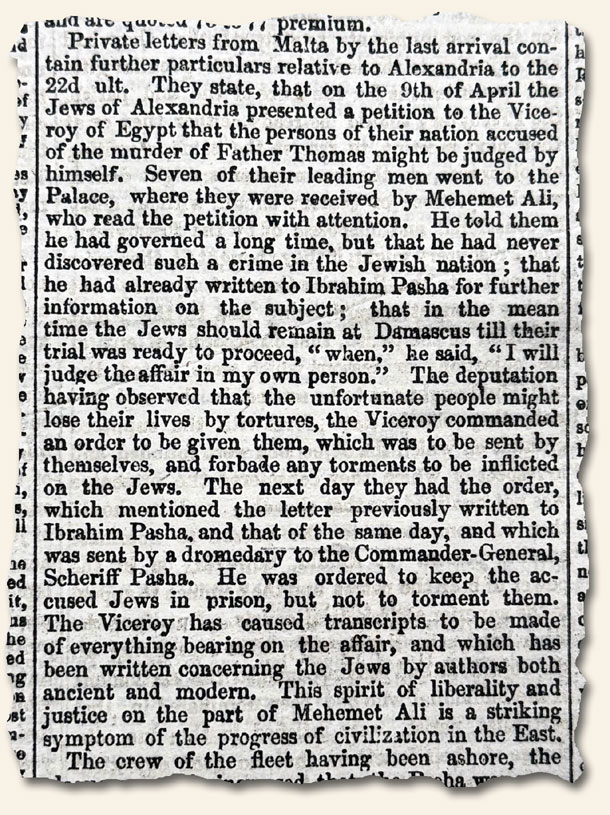
Many visitors to the History’s Newsstand Blog are familiar with the Damascus Affair of 1840 — one of the most consequential antisemitic episodes of the 19th century. Far fewer, however, know the name at the center of the storm: Father Thomas. It is his disappearance that lit the fuse, and it is his name that echoed through the newspapers of the day — including the remarkable report shown below, from our original issue of The Times (London), dated May 8, 1840.
Father Thomas: The Disappearance That Shook the World
Father Thomas of Tuscany (c. 1768–1840) was a Franciscan friar and physician serving in Damascus, Syria, then under the control of Egyptian ruler Mehemet Ali. On February 5, 1840, Father Thomas and his servant Ibrahim Amara vanished without a trace. What followed was not merely a criminal investigation — it was a catastrophe for the Jewish community of Damascus and, ultimately, for Jewish communities across the globe.
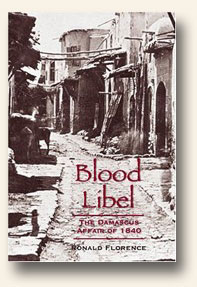
French Consul Ulysse de Ratti-Menton seized upon the disappearance to level charges against prominent local Jews, alleging that Father Thomas had been murdered as part of a ritualistic killing — the ancient and thoroughly debunked “Blood Libel” accusation, which falsely claimed that Jews used the blood of Christians in religious rites. Under torture, confessions were extracted. Several Jewish men died in captivity. Others faced execution. The affair sent shockwaves from Damascus to London, Paris, and beyond.
What makes the Damascus Affair historically significant — beyond its immediate horror — is the response it provoked. Jewish leaders in Europe, including Sir Moses Montefiore of England and Adolphe Crémieux of France, organized an international campaign on behalf of the accused, traveling to Egypt to appeal directly to Mehemet Ali. Their efforts represent one of the earliest instances of organized, international Jewish advocacy — a precursor, in many ways, to the modern human rights movement.
The report shown in full below offers a remarkable window into how the affair was unfolding in real time. Sourced from private letters arriving via Malta, the account describes how the Jews of Alexandria petitioned Mehemet Ali on April 9th, asking that those accused of Father Thomas’s murder be judged by the Viceroy himself. Seven leading men were received at the Palace, where Mehemet Ali acknowledged he had never encountered such a charge against the Jewish nation in all his years of rule. Crucially, he forbade the use of torture against the prisoners — a directive sent by dromedary to Commander-General Scheriff Pasha in Damascus. The report concludes with a notable observation: “This spirit of liberality and justice on the part of Mehemet Ali is a striking symptom of the progress of civilization in the East.”
As for Father Thomas himself — his fate was never definitively established. The accusations against the Damascus Jews were never formally dropped, though the imprisoned survivors were eventually released following the international intervention of Montefiore and Crémieux later that summer.
History has long since judged the Damascus Affair as a grotesque miscarriage of justice, fueled by antisemitism and political opportunism. The Blood Libel charge had no basis in fact — then or ever. Yet it is the name of Father Thomas that remains permanently linked to one of the 19th century’s darkest chapters: not because he caused it, but because his disappearance became the pretext for it.
This original Times of London report offers readers of today an unmediated glimpse into the unfolding events of 1840 — and is precisely what makes collecting historic newspapers so endlessly rewarding. The news, as they say, never gets old.