
Search
The Rare & Early Newspapers Hobby

Receive the Newsletter

Buy Historic Newspapers

“Telegraph” newspapers prior to 1844?
July 20, 2009 by TimHughes · Leave a Comment  Email This Post
|
Email This Post
|  Print This Post
 It is commonly known that the magnetic telegraph was developed in 1844 by Samuel Morse, so perhaps you’ve wondered—like I have—why so many newspapers had the title “Telegraph” dating long before this date? Clarence Brigham in his book “Journals & Journeymen” provides some details.
Between 1792 & 1794 several systems of telegraphic signals were developed in England & France. They were dependent upon cross-bars pivoting into difference positions at the top of high poles.
In 1795 a paper was established at Carlisle, Pennsylvania, titled “The Telegraphe”. The first issue did a history of telegraphic experiments taken from British & French periodicals, & stated it was the first paper in America to use the title. This was true, but less than a month after the Carlisle paper’s beginning the “Fells Point Telegraphe” was established at Baltimore, and shortly thereafter newspapers in Charleston, Greenfield (Mass.), and again in Baltimore changed their titles to include the word “Telegraphe”. In the next five months another 4 newspapers incorporated this word into their titles.
By 1820 forty newspapers in America had employed this word into their mastheads, but the phenomena was almost entirely American. Curiously only 2 papers in London & Paris used the word in 1794 and none after that until later in the 19th century.
If you liked this post, you may also enjoy...
- “New Series” of a newspaper…
- Maryland’s first newspapers…
- Niles’ Weekly Register, a newspaper rich in history…
- The first newspapers in Mississippi…
- The reason I collected it: The Semi-Weekly Argus from Washington Territory…
A new (old) definition of a “sacrifice hit”…
July 18, 2009 by TimHughes · Leave a Comment Email This Post
| Print This Post
 Since we are in the midst of baseball season, this little comic item from “Life” magazine of June 28, 1894 would seem appropriate.
If you liked this post, you may also enjoy...
- Not sure this one worked…
- The Peace of Christmas… An image reminiscent of my own experience…
- Here… take the shirt off my back…
- “Take Me Out to the Ball Game” – Historic Baseball Coverage…
- The Sounds of Summer and the Crack of the Bat…
A time to have fun and to gather perspective…
July 16, 2009 by GuyHeilenman · Leave a Comment Email This Post
| Print This Post
Earlier this week Timothy Hughes Rare & Early Newspapers sent a newsletter to their members which contained a fun contest and a little food for thought. Based on member feedback, we thought the History’s Newsstand subscribers might also enjoy the newsletter (especially items 1, 2, and 6).
Newsletter (sent to members on July 14, 2009)
Dear Friends of Rare Newspapers,
Welcome to the July 2009 edition of our monthly newsletter. In an effort to counter (or at least soften) the pervasively negative economic/political tone which seems to be swirling about from every direction, we’d like to offer a few diversions (see items 1, 2, and 6 below). Please enjoy!
1. A New Scavenger Hunt – The History’s Newsstand Blog exists to serve those interested in the rare newspapers collectible. For the next 7 days we would like to encourage our members to go “scavenger hunting” at the blog. We’ve placed an image (see below) at the bottom of one of the posted articles which includes a discount code below the image (as a caption). This code may be entered at checkout at www.rarenewspapers.com to receive 20% off any website order, no matter how large or small. The code, if found, may be shared with friends, but it may only be used toward website listings (not eBay or custom quotes), and it may not be used in conjunction with any other discount code (new customer, new member, premium member, etc.). Have fun! Read the articles. Enjoy!!! The image to be “unearthed” is:

(the contest image looks identical to the above image)
2. Blog Posts from History’s Newsstand with a humorous edge may be accessed at: https://blog.rarenewspapers.com/?cat=116
3. The Most Recent Offering – Catalog 164 (just released) – Over 300 newly listed hand-picked issues may be viewed/purchased at: http://www.rarenewspapers.com/list?code=supplement
4. Discounted Items – From now until July 31st, we have a selection of issues which have been discounted by 20% (price shown reflects the discount). The “theme” of these items is 20th century “Displayable” issues. They may be viewed at: http://www.rarenewspapers.com/list?code=Discounted+Issues
5. Timely eBay/website listings:
Moon Landing (on eBay)
Stock Market Crash (on the website)
Abraham Lincoln (on eBay)
Public Enemies, Gangsters, etc. (on the website)
6. Food for Thought – Concerning Our Current Economic and Political Environment (source: wikipedia):
“This too shall pass” (Hebrew: גם זה יעבור, gam zeh yaavor) is a phrase occurring in a Jewish wisdom folktale involving King Solomon. The phrase is commonly engraved on silver rings.
Many versions of the folktale have been recorded by the Israel Folklore Archive at the University of Haifa. Heda Jason recorded this version told by David Franko from Turkey:
“One day Solomon decided to humble Benaiah Ben Yehoyada, his most trusted minister. He said to him, “Benaiah, there is a certain ring that I want you to bring to me. I wish to wear it for Sukkot which gives you six months to find it.” “If it exists anywhere on earth, your majesty,” replied Benaiah, “I will find it and bring it to you, but what makes the ring so special?” “It has magic powers,” answered the king. “If a happy man looks at it, he becomes sad, and if a sad man looks at it, he becomes happy.” Solomon knew that no such ring existed in the world, but he wished to give his minister a little taste of humility. Spring passed and then summer, and still Benaiah had no idea where he could find the ring. On the night before Sukkot, he decided to take a walk in one of the poorest quarters of Jerusalem. He passed by a merchant who had begun to set out the day’s wares on a shabby carpet. “Have you by any chance heard of a magic ring that makes the happy wearer forget his joy and the broken-hearted wearer forget his sorrows?” asked Benaiah. He watched the grandfather take a plain gold ring from his carpet and engrave something on it. When Benaiah read the words on the ring, his face broke out in a wide smile. That night the entire city welcomed in the holiday of Sukkot with great festivity. “Well, my friend,” said Solomon, “have you found what I sent you after?” All the ministers laughed and Solomon himself smiled. To everyone’s surprise, Benaiah held up a small gold ring and declared, “Here it is, your majesty!” As soon as Solomon read the inscription, the smile vanished from his face. The jeweler had written three Hebrew letters on the gold band: gimel, zayin, yud, which began the words “Gam zeh ya’avor” — “This too shall pass.” At that moment Solomon realized that all his wisdom and fabulous wealth and tremendo us power were but fleeting things, for one day he would be nothing but dust.”
The phrase “This too shall pass” and the associated ring story were made popular by Abraham Lincoln in his ‘Address Before the Wisconsin State Agricultural Society, Milwaukee, Wisconsin’ on September 30, 1859.
“It is said an Eastern monarch once charged his wise men to invent him a sentence, to be ever in view, and which should be true and appropriate in all times and situations. They presented him the words: “And this, too, shall pass away.” How much it expresses! How chastening in the hour of pride! How consoling in the depths of affliction!
Best wishes,
Guy & The Rare Newspapers Staff
If you’d like to become a member of “Rare Newspapers” (free), you’re invited to sign-up at: http://www.rarenewspapers.com/memberships
If you liked this post, you may also enjoy...
- A few holiday thoughts…
- The November (2017) Newsletter from Rare & Early Newspapers…
- The October (2019) Newsletter from Rare & Early Newspapers…
- The January (2018) Newsletter from Rare & Early Newspapers…
- The April (2020) Newsletter from Rare & Early Newspapers…
Quotes defining history…
July 13, 2009 by Morris Brill · 2 Comments Email This Post
| Print This Post
When I was fourteen years old (ah, so many years ago) I acquired an interest in quotations. By the time I was twenty-one I had read the entire collection of Bartlett’s Famous Quotations and recorded each of the quotes that had significance for me. I have since added to my list of favorites.
Coincidentally, when I was twenty-one, I also bought my first collectable newspaper; The Assassination of President John F. Kennedy.
Many years ago I concluded that often a quote, paired with a specific headline, added profound meaning to the headline. The right quotation enhanced the moral or social significance of the headline. Often, the right quote was able to capture the ‘essence’ of the headline.
Quotes, like newspapers, unite us with the past. They provide us with the thoughts of those who came before us. Additionally, within a newspaper, you may find text that contains a statement that later becomes a famous quote.
For instance: the Boston Gazette of December 26, 1805 contains a report on the Battle of Trafalgar. The article quotes British Admiral Horatio Nelson as saying, “England expects that every man will do his duty.” And we all know of President Franklin Roosevelt’s quote in his inaugural acceptance speech in 1933, “There is nothing to fear but fear itself,” which can be found on the front page of many newspapers of the time.
Of course, each individual would select different quotes to pair with a headline. I believe that the quotes a person prefers are a reflection of that person’s personal social background, religious background, education, and political persuasion.
With that said, and with your indulgence, I would like to share with you a very small sample of my pairings.
“It is loneliness that makes the loudest noise. This is true of men as of dogs.” – Eric Hoffer
Headline: Treaty of Peace – Pennsylvania Packet – 11/08/1783
Quote: “What a free society offers to the individual is much more than what he would be able to do if only he were free.” – F.S. Hayek
Headline: Death of Benjamin Franklin – The Gentleman’s Magazine – 06/01/1790
Quote: “It is sweet to serve one’s country by deeds, and it is not absurd to serve her by words” – Sallust
Headline: Death of President Washington – The True American – 01/01/1800
Quote: “A patriot must always be ready to defend his country against his government” – Edward Abbey
Headline: Queen Victoria Coronation – Main Farmer/Journal of Useful Arts – 08/07/1838
Quote: “Uneasy is the head that wears a crown” – William Shakespeare
Headline: This “Flying Machine” Flies – Philadelphia Press – 12/19/1903
Quote: “I think for months and years. Ninety-nine times, the conclusion is false. The hundredth time I am right” – Albert Einstein
Headline: Life Terms in Prison for Leopold and Lobe – Los Angeles Evening Herald – 02/04/1924
Quote: “Being brilliant is no great feat if you respect nothing” – Johann Wolfgang von Goethe
Headline: Death Takes Stalin’s Reign – Syracuse Herald-Journal – 06/06/1954
Quote: “O, it is excellent to have a giant’s strength! But it is tyrannous to use it like a giant.” – William Shakespeare
Headline: Eichmann Convicted – Los Angeles Mirror – 12/11/1961
Quote: “The belief in a supernatural source of evil is not necessary; men alone are quite capable of every wickedness.” – Joseph Conrad
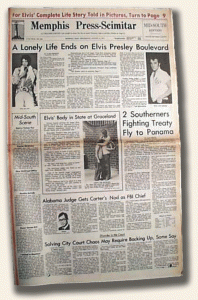
Headline: A Lonely Life Ends on Elvis Presley Boulevard – Memphis Press Scimtar – 08/17/1977
Quote: “It is loneliness that makes the loudest noise. This is true of men as of dogs.” – Eric Hoffer
Thank you for attention and interest.
Morris Brill
If you liked this post, you may also enjoy...
- The Traveler… the verdict… the change… yeah, yeah, yeah…
- Contrasting pairs of historic newspapers: another way to collect…
- They put it in print… Castro given a year or less…
- A Time of Transition… Washington’s Funeral…
- One More Reason to Love Collecting Historical Newspapers… Revisiting 9/11…
Darwin’s “other” sons…
July 11, 2009 by TimHughes · Leave a Comment Email This Post
| Print This Post
 The Ogden Junction newspaper from Utah, dated September 6, 1873, includes this small comic tidbit making light of Darwin’s theory of evolution.
If you liked this post, you may also enjoy...
- How things have changed…
- Interesting comments on Jesse James…
- Definition of “half drunk” and “whole drunk”…
- The first newspaper in Utah…
- Print date for the Gentleman’s Magazine…
My Collecting Story… Brendan Dwyer…
July 9, 2009 by GuyHeilenman · Leave a Comment Email This Post
| Print This Post
Here is my antique newspaper collecting story. Not how I got started, but in the middle:
 —–I moved to Nantucket [see 19th century image] in 1997 and fell in love with it’s rich history—-whaling, Quakers, isolation, American Revolution neutralism, etc.—Well–in 1795 a bank robbery occurred here where around $20,000 was taken in various international currency ( keep in mind the date and the world travels of the whaling industry). This robbery shocked and shucked the town whereby feuds developed and lasted for generations. All very interesting. Well, I found out the court dates of the accused robbers and the newspapers which covered the proceedings. I had been buying antique newspapers from [Timothy Hughes Rare & Early Newspapers] for a number of years, so I searched [the] site and found several of the newspapers which covered the court proceedings.
Keep in mind this was from 1795!!!!! Just amazing!!!!!!!!!!!!!!!!!!!
– – – – – – – – – – – – – – – – – – – – – – – – – – – – – – – – – – – – – – – – – –
Thanks for sharing your story Brendan. If you would like to share your story of how you became interested in collecting rare and/or historic newspapers, e-mail it to guy@rarenewspapers.com and place “My Story” in the subject field. Although not necessary, feel free to include an image. Please do not include your e-mail address or a personal website as part of the text of your story. We will post collector stories every few weeks and will send you a notice when your story appears. Thank you for your contribution to the community.
If you liked this post, you may also enjoy...
- My Collecting Story… Robert (Bob) Cassidy…
- My Collecting Story… David Cunningham…
- My Collecting Story… Paul Sarna…
- My Collecting Story… Brent Lacy…
- My Story… Carl Aspler…
An early attempt at preserving newspapers…
July 6, 2009 by TimHughes · 2 Comments Email This Post
| Print This Post
 You may have noted many of our descriptions of the New York Times from the 1927-1953 period are described as the “rag edition”.
Fellow collector Paul Sarna passed along the following information taken from “News-Week” magazine of Oct. 28, 1933. It’s an interesting report from 76 years ago of the creation of the “rag edition” as a means of preserving newspapers for posterity, which remain a concern for present-day institutions as well.
A brief piece from this 1933 magazine tells of its beginning:
“To preserve valuable newspapers, libraries from time to time have resorted to sprays, rejuvenators, and glassine covers. But none has been to successful. With an eye on this problem the New York times, in 1927, began printing an edition on enduring rag paper. the idea had two disadvantages: the subscription price of the rag edition was $170 annually, and it filled about 870 ft. of new shelf space each year.”
The rag edition was produced on a very high quality newsprint, with a high percentage of cotton & linen content allowing the issues to remain very white & sturdy many years into the future. Given the subscription cost it is not surprising that libraries rather than individuals were the primarily subscribers. We have never seen a never-bound rag edition of the Times although they might exist.
The Times discontinued the rag edition in 1953. A few other newspapers also produced a rag edition during the early part of the 20th century as we’ve encountered a run of Detroit News in rag edition. Is anyone aware of other titles?
If you liked this post, you may also enjoy...
- “Rag paper” allowed newspapers to pass the test of time…
- To repair or not to repair?
- Veterans – War’s end is rarely met with the end to their battles…
- Print date for the Gentleman’s Magazine…
- A quiet title…
Definition of “half drunk” and “whole drunk”…
July 4, 2009 by TimHughes · Leave a Comment Email This Post
| Print This Post
 The Massachusetts Spy newspaper of Worcester, dated July 21, 1830, includes in interesting tidbit on the intoxication levels of four young surgeons in London.
If you liked this post, you may also enjoy...
- The Traveler… interesting information on the Mormons…
- How Sitting Bull got his name…
- The time lag in news reporting, 1776…
- How bad do you have to dress to offend a horse?
- A “little” comic relief…
Encouraging newspaper collecting in 1862…
July 2, 2009 by TimHughes · Leave a Comment Email This Post
| Print This Post
An article in the “Charleston Mercury” of June 13, 1862 has a curious item concerning the collecting of early newspapers, and even includes a statement about the value in keeping current (meaning 1862) issues for future posterity:
“NEWSPAPERS—Many people like newspapers but few preserve them; yet the most interesting reading imaginable is a file of old newspapers. It brings up the past age with all its bustle and every day affairs, and marks its genius and its spirit more than the most labored description of the historian. Who can take up a paper half a century old without the thought that almost every name there printed is now upon a tombstone at the head of an epitaph? The newspaper of the present day will be especially interesting years hence, as containing the current record of events fraught with tremendous import to the cause of freedom in all the civilized world. We therefore would urge upon all the propriety of preserving their papers. they will be a source of pleasure and interest to them hereafter.”
If you liked this post, you may also enjoy...
- Tombstone was about to fade away…
- Concern for preserving newspapers in 1849…
- #20 – Thoughts on the most historic 19th century report… (*revisited)
- 19th century newspapers… revisited…
- Likely a one-of-a-kind newspaper from the private collection…
Hobby trivia: most used newspaper titles…
June 29, 2009 by TimHughes · 1 Comment Email This Post
| Print This Post
 By far the most common of early titles were “Gazette” and then “Advertiser“. Between 1704 and 1820 “Gazette” was used either by itself or as part of a newspaper title 488 times. This was closely followed by “Advertiser” with 440 times, showing the deference which publishers paid to their advertisers who made up the greater part of a newspaper’s profit.
These two titles were followed by “Herald” with 115 times, “Journal” 114, “Intelligencer” 104, “Register” 86, “Republican” 77, “Chronicle” 75, “Patriot” 57, “Centinel” or “Sentinel” 56, and “Courier” 45.
Titles frequently used, but in lesser number, were “Eagle“, “Mercury“, “Messenger“, “Monitor“, “Museum“, “Observer“, “Post“, “Recorder“, “Repository“, “Star” and “Times“.
It is curious that “Times” was rarely used before 1820, and there is no mention whatever of “Tribune” or “Transcript“, all somewhat common within newspaper titles today.
(The above is excerpted from the book “Journals and Journeymen” by Clarence Brigham)
If you liked this post, you may also enjoy...