
Search
The Rare & Early Newspapers Hobby

Receive the Newsletter

Buy Historic Newspapers

The American Dream at Work…
June 10, 2021 by LauraH · Leave a Comment
What is the American Dream? We often hear that phrase bantered about but people seem to have differing views of just what it means. I was recently reading an article by a young woman in her early thirties with 2 small children. She and her husband had decided to move to Hawaii for a simpler life… a life not cluttered with as many things or as many stresses. Her final words on the subject were, “we chose to give up the American Dream”. WHAT !?! She had me until that final statement. Is it possible she could have grown up in this country and not actually know what the American Dream is !?! Could she have been deluded to believe the American Dream is about things and schedules and the size of your home? Ok … I’ve taken a breath and calmed down a bit. One of the blessings we have as students of American History is a foundational knowledge of what our Founders believed the American Dream was. Let me allow them to speak for themselves:
 “We hold these truths to be self-evident, that all men are created equal, that they are endowed by their Creator with certain unalienable Rights, that among these are Life, Liberty and the pursuit of Happiness.”
The pursuit of Happiness … very different from guaranteed happiness. In many ways, the ability to pursue something is a far greater gift than it being given to you. There is often joy and a deep sense of accomplishment in the striving. Being handed something on a silver platter lacks the ability to give the same growth and satisfaction.
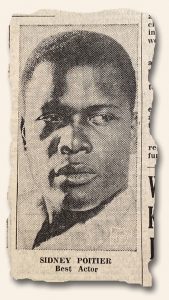
On April 14, 1964, The Leominster Enterprise wrote a front page article covering the Academy Award winners from the night before. One of these stars was Sidney Poitier, “who struggled from the poverty of a Caribbean tomato farm … Poitier, who was born in Florida, but who was raised on a tomato farm in Nassau, was unable to addend school until he was 11 years old. Two years later he was forced to help support his family. When he was 16 he moved to New York City with a series of odd jobs, including ditch digger, store clerk, pin-boy in a bowling alley and longshoreman. He finally joined the American Negro Theater and worked as a janitor in exchange for acting lessons. He advanced to small roles and moved on to stage parts…”.
Now there is the American Dream at work!
PS. That evening, Sidney Poitier became the 1st black man to win an Academy Award – all due to his PURSUIT of the American Dream.
History’s Hidden Gems… President Lincoln, July 4th, 1861…
June 7, 2021 by LauraH · Leave a Comment
“Those who cannot remember the past are condemned to repeat it.” ~ George Santayana or, as we history buffs like to say, “Those who don’t know their history are doomed to repeat it”.
Lately, I have developed a bit of an obsession with Abraham Lincoln. I am sure there are many who would chuckle and say, “what took her so long?” Granted, I knew all the Lincoln Basics. I have helped my 6 children memorize the Gettysburg Address. I have stood more than once, for more time than my companions were comfortable, gazing in awe at each word on the Lincoln Memorial. But most recently I’ve been struck with wonder when I come across the more obscure, hidden treasures of our 16th President. . . overcome with a sense that his insights into his times may be equally applicable to mine. This last week I heard someone mention a portion of President Lincoln’s speech before Congress on July 4th, 1861. I have shared a portion of it below so you can make your determination as to whether his call to see beyond the surface events, to the heart of the matter, is as relevant today as it was then. If you agree, then we should be a people who remembers our past so we do not repeat it and for those fellow Lincoln lovers out there, let’s keep digging for his more obscure hidden gems.
“It might seem at first thought to be of little difference whether the present movement at the South be called “secession” or “rebellion.” The movers, however, well understand the difference. At the beginning they knew they could never raise their treason to any respectable magnitude by any name which implies violation of law. They knew their people possessed as much of moral sense, as much of devotion to law and order, and as much pride in and reverence for the history and Government of their common country as any other civilized and patriotic people. They knew they could make no advancement directly in the teeth of these strong and noble sentiments. Accordingly, they commenced by an insidious debauching of the public mind. They invented an ingenious sophism, which, if conceded, was followed by perfectly logical steps through all the incidents to the complete destruction of the Union. The sophism itself is that any State of the Union may consistently with the National Constitution, and therefore lawfully and peacefully , withdraw from the Union without the consent of the Union or of any other State. The little disguise that the supposed right is to be exercised only for just cause, themselves to be the sole judge of its justice, is too thin to merit any notice.
With rebellion thus sugar coated they have been drugging the public mind of their section for more than thirty years, and until at length they have brought many good men to a willingness to take up arms against the Government the day after some assemblage of men have enacted the farcical pretense of taking their State out of the Union who could have been brought to no such thing the day before .” ~ Abraham Lincoln, July 4th, 1861
Love of History Takes Many Forms…
May 27, 2021 by LauraH · Leave a Comment
 I firmly believe that a love of history in one area often seeps into many other areas as well – that it is possible to be completely enthralled with each battle of the Revolutionary War and Vintage Ads for Cream of Wheat or Firestone Tires at the same time. With this in mind, I put out the following “all call”…
Calling all Disney fans !!!!!
Those of us who are Disney lovers in any form and specifically Disney Park lovers may find the following interesting in light of the upheaval the Disney parks have faced over the last year+. On June 14, 1981, the Los Angles Times had the ad shown in the photo. Disneyland was beginning their shift from individual ride tickets to all-day passes. Later, they would move to annual passes which allowed locals to come and go at will, making Disneyland a part of their everyday life. What a memorable moment in Disney history for Disney Park fans.
You’ve Come A Long Way Baby…
May 20, 2021 by LauraH · 2 Comments
 Oftentimes, when I see a headline or an issue here at Rare Newspapers, some old fashioned turn of phrase or idiom comes to mind and today was no exception. As I leafed through a volume of Harper’s Weekly’s looking for a customer request, I glanced through the issue dated one week earlier. “You’ve come a long way baby” sprang to mind as I paused to pour over the vintage automobile and tire ads in Harper’s Weekly’s “Annual Automobile Number” issue. Ironically, the front color cover had a baby in a 1912 car barely missing 1911, represented by an old man trudging across the road. These new cars must have seemed a tremendous upgrade from Henry Ford’s Model T in 1908 and may have caused a pedestrian on the curb to murmur, “We’ve come a long way baby”, however, I am sure their jaw would drop at the thought of electric and self-driving options 100+ years later. These are the things Jules Verne dreamed of as he put pen to paper. I like to imagine that someday, a 100+ years from now, another person may very well see a newspaper from today with the headline: “Tesla’s Autopilot Technology Faces Fresh Scrutiny”(NYT) and quip, “We’ve come a long way baby”, as they climb into their hover car.
From Dream to Dream…
May 14, 2021 by LauraH · Leave a Comment
I can’t speak for anyone else but, at this moment… I’m over with bad news. I long for news stories that make me smile … that bring to mind sweeter times. Today, in the subtlest of news stories, my wish came true and a huge smile spread over my face. On June 30, 1905, the Springfield Republican published their issue for the day. I am sure no one in the editor’s office had a clue that on the sports page there was one line in the box score that would, 80+ years later, inspire one of my favorite movie moments of all time. Allow me to borrow a paragraph from our RareNewspapers website’s description for this Springfield issue…
 “Spoiler alert: Anyone who has viewed the *movie-classic, “Field of Dreams,” starring Kevin Costner, has been touched by Archie “Moonlight” Graham (played by Burt Lancaster). The poor fellow simply cannot catch a break. When this doctor, who had given up baseball after only 1 professional appearance in order to care for people via his physician training, was given (in the movie) a 2nd chance to get on the magical “field of dreams,” he was almost immediately faced with the choice between either leaving the field (never to return) in order to save an injured young fan from near-certain death, or stay on the field and enjoy the game he had always loved.”
Although Field of Dreams mixes fantasy and reality, this peek into a “real life person” made me dig a bit deeper. Wikipedia sums him up as follows: “”Doc” Graham, as he became known after his career as a ballplayer, served the people of Chisholm (MN) for fifty years. From 1909 to 1959, Graham was the doctor for the Chisholm schools. For many years, “Doc” Graham made arrangements to have used eyeglasses sent to his Chisholm office. On Saturdays, he would have the children of the Iron Range (Minnesota) miners, from Grand Rapids to Virginia, come to his office, have their eyes checked and then fit them with the proper set of glasses, all free of charge.”
Wrapped up in this good news from the past is also a reminder that sometimes, when one dream ends, a better one begins.
One Hit Wonders Can Still Pack an Emotional Punch…
May 10, 2021 by LauraH · Leave a Comment
Today I was doing some research for a customer. This particular customer loves to collect obituaries from music and film stars of a bygone era. As I worked through his want list, I came upon a singer named Bobby Fuller. Unlike other stars on this want list, I had never heard of  Bobby… or so I thought. Upon further research I discovered he was a “1 hit wonder” from 1966 and had released the song, “I Fought the Law and the Law Won”. As soon as I saw the title, a big smile formed. I am not sure where I had 1st heard the song… after all, I would have only been 2 on it’s release date however, somewhere in my earliest memories my parents must have played it or I heard it on a passing radio station. However it happened, the song left an indelible imprint on my young mind and those happy feelings came flooding back. I grabbed my i-phone and quickly brought up the song on my Spotify account and for a few moments was transformed to a simpler time. I am sure I’m not the only one who spent time growing up listening to music with their parents or watching old movies with their Mam Maw. For those of you who delight in those old memories as much as I do, here is a quick search of some of the issues we have with Stars of Past. Feel free to peruse my list or start a personal favorites search to create your own.
Many Thanks to Give…
May 3, 2021 by LauraH · Leave a Comment
 My family often jokes with me (maybe about me ) when they say, “she can use Disney World as an example for anything.” They aren’t wrong and have accurately pegged me as a bit of a Disney fanatic. I won’t bore you with all the reasons I have for loving this place but I will tell you how it came to mind today as I was perusing an issue published by Frederick Douglass. For those of you who have visited Disney World or more specifically Epcot, I hope you have experienced Spaceship Earth. I never tire of riding this attraction and hearing Dame Judy Dench recount mankind’s history of communication to me as I gaze at the vignettes on each side of my “time machine”. At one point, she is describing how, since the invention of papyrus, knowledge is able to be kept and shared more easily and so civilization advances more rapidly until …
“Rome falls, and the great Library of Alexandria in Egypt is burned. Much of our learning is destroyed—lost forever… or so we think. It turns out there are copies of some of these books in the libraries of the Middle East, being watched over by Arab and Jewish scholars. Call it the first backup system. The books are saved, and with them our dreams of the future.”
I get shivers every time I hear those words… so much knowledge… so much history… so many pages. Just now, as I pause to admire this precious Frederick Douglass paper lying on my desk, I am overwhelmed with gratitude for all the people we, the collectors of historic newspapers, have to thank for watching over the issues that later end up in our hands. Precious treasures of knowledge and history handed off to us, if even for a moment, to guard for future generations.
I Would Love to Have Them All…
April 22, 2021 by LauraH · Leave a Comment
 As you can imagine, working here at the RareNewspapers office can be a bit like a kid working in a candy shop. Almost daily I push the thought, “Maybe I should buy this one for myself”, to the back of my mind. Sometimes it is because of the historic impact of the content I am seeing and the deep desire to personally protect it for posterity. Sometimes it is because the issue triggers a fond memory and whisks me away to another day. Last week this thought would not stay in the back of my mind but continued to crash to the forefront over and over. Finally, with my many rationalizations in hand, I pulled out my credit card and purchased the issue. Feelings of nostalgia of a simpler by gone era washed over me as I paged through my new treasure. This treasure is mine however, if you are ever drawn to that same simpler time, we here at the RareNewspapers office have other options for you to consider. There is truly something for everyone. I may have been drawn to the vintage ads, drawings, paper dolls and old stories, but there is so much more. Take a moment to step back in time. Sometimes those brief moments are all that are needed to add a bit of perspective to the “thoroughly modern” life we currently live.
Snapshot July,1814… The war of 1812 ends nearly a year earlier than we thought…
April 19, 2021 by GuyHeilenman · Leave a Comment
While for years most of us were taught that The War of 1812 ended in February, 1815, we just unearthed a reliable source which makes it obvious we’ve been sold a bill of goods. How do we know? The highly respected Columbian Centinel, printed in Boston from 1790 through 1840, obtained a Proclamation from President James Madison declaring the war to be over and printed it in their July 2, 1814 newspaper. Furthermore, this announcement was signed in block type by the President himself – confirming its authenticity. Knowing this would be met with a degree of skepticism, we’ve included the evidence for all to see:
However, whenever something doesn’t pass the smell test from a few inches away, it’s often wise to pull back and take a whiff from a greater distance…
Perspective beyond the end of our own noses can change everything!
Flawed Greatness…
April 9, 2021 by LauraH · Leave a Comment
A very, very, very, very… wise Man once said, “Let any one of you who is without sin cast the 1st stone.” As was often the case, this Sage was addressing the situation at hand as well as the next 2000+ years of human history. Fast forward to today when we all feel as if we are in a constant state of ducking as stone after stone whizzes past our heads. Sometimes they are aimed at us… sometimes at the person next to us… sometimes at our favorite podcast host… sometimes at the history pages from 250 years ago. With this in mind, may I share a few inspirational words from one of those among us who was, like us all, flawed and with sin but, in moments of divine inspiration, lead with greatness as so many of our Founding Fathers did.
 On March 4, 1797, John Adams, 2nd president of the United States, took up the mantle of George Washington and penned the words below as part of his Inaugural Speech. At such a pivotal moment in our countries history, with the transition from our 1st President to our 2nd, everything was on the line … freedom, democracy and our nation’s ability to continue grow and throw off any national “sins that so easily entangle”. What began with our Constitution would make a giant leap forward 100 years later and continue to progress for the 100 years after that. Listen to John Adams as he shares the passion of his heart for this country.
“… Employed in the service of my country abroad during the whole course of these transactions, I first saw the Constitution of the United States in a foreign country. Irritated by no literary altercation, animated by no public debate, heated by no party animosity, I read it with great satisfaction, as the result of good heads prompted by good hearts, as an experiment better adapted to the genius, character, situation, and relations of this nation and country than any which had ever been proposed or suggested. In its general principles and great outlines it was conformable to such a system of government as I had ever most esteemed, and in some States, my own native State in particular, had contributed to establish.
…With this great example before me, with the sense and spirit, the faith and honor, the duty and interest, of the same American people pledged to support the Constitution of the United States, I entertain no doubt of its continuance in all its energy, and my mind is prepared without hesitation to lay myself under the most solemn obligations to support it to the utmost of my power.
And may that Being who is supreme over all, the Patron of Order, the Fountain of Justice, and the Protector in all ages of the world of virtuous liberty, continue His blessing upon this nation and its Government and give it all possible success and duration consistent with the ends of His providence.”