
Search
The Rare & Early Newspapers Hobby

Receive the Newsletter

Buy Historic Newspapers

A few holiday thoughts…
December 22, 2010 by GuyHeilenman · Leave a Comment
Dear Friends of Rare & Early Newspapers,
While the holiday season is a time of celebration and joy for most, it is also a time of sadness and depression for others – as they reflect on the loss of loved ones, their own difficult  circumstances, and/or the troubles of friends and relatives. A few years ago, on the heals of the “Great Fall” of 2008, we posted a few thoughts on life. As we glide, saunter, and/or stumble (for some) through the holiday season, please enjoy reflections on this past post:
“This too shall pass” (Hebrew: גם זה יעבור, gam zeh yaavor) is a phrase occurring in a Jewish wisdom folktale involving King Solomon. The phrase is commonly engraved on silver rings.
Many versions of the folktale have been recorded by the Israel Folklore Archive at the University of Haifa. Heda Jason recorded this version told by David Franko from Turkey:
“One day Solomon decided to humble Benaiah Ben Yehoyada, his most trusted minister. He said to him, “Benaiah, there is a certain ring that I want you to bring to me. I wish to wear it for Sukkot which gives you six months to find it.” “If it exists anywhere on earth, your majesty,” replied Benaiah, “I will find it and bring it to you, but what makes the ring so special?” “It has magic powers,” answered the king. “If a happy man looks at it, he becomes sad, and if a sad man looks at it, he becomes happy.” Solomon knew that no such ring existed in the world, but he wished to give his minister a little taste of humility. Spring passed and then summer, and still Benaiah had no idea where he could find the ring. On the night before Sukkot, he decided to take a walk in one of the poorest quarters of Jerusalem. He passed by a merchant who had begun to set out the day’s wares on a shabby carpet. “Have you by any chance heard of a magic ring that makes the happy wearer forget his joy and the broken-hearted wearer forget his sorrows?” asked Benaiah. He watched the grandfather take a plain gold ring from his carpet and engrave something on it. When Benaiah read the words on the ring, his face broke out in a wide smile. That night the entire city welcomed in the holiday of Sukkot with great festivity. “Well, my friend,” said Solomon, “have you found what I sent you after?” All the ministers laughed and Solomon himself smiled. To everyone’s surprise, Benaiah held up a small gold ring and declared, “Here it is, your majesty!” As soon as Solomon read the inscription, the smile vanished from his face. The jeweler had written three Hebrew letters on the gold band: gimel, zayin, yud, which began the words “Gam zeh ya’avor” — “This too shall pass.” At that moment Solomon realized that all his wisdom and fabulous wealth and tremendous power were but fleeting things, for one day he would be nothing but dust.”
The phrase “This too shall pass” and the associated ring story were made popular by Abraham Lincoln in his ‘Address Before the Wisconsin State Agricultural Society, Milwaukee, Wisconsin’ on September 30, 1859.
“It is said an Eastern monarch once charged his wise men to invent him a sentence, to be ever in view, and which should be true and appropriate in all times and situations. They presented him the words: “And this, too, shall pass away.” How much it expresses! How chastening in the hour of pride! How consoling in the depths of affliction!
As we look back on the previous 2+ years, we see much has occurred since this posting. While we’ve lost loved ones, lost faithful collector friends, and observed many succumb to the realities of the economy, we’ve also enjoyed the strength that comes from weathering shared troubles, the joy of meeting new friends, and the quiet confidence that comes from seeing God’s hand in action in an endless number of circumstances. It is times of difficulty which encourage us to value the important things in life and to grasp the reality of “This Too Shall Pass” as we endeavor to store up treasures in heaven where moth and rust do not destroy. Please know that YOU, our dear friends, are such treasures. Thank you for your ongoing friendships.
Merry Christmas (and Happy Hanukkah to our Jewish family),
Your Friends at Timothy Hughes Rare & Early Newspapers
(Guy, Tim, Doreen, Brian, Mike, Gerry, Hannah, Sarah, Rebekah, Joshua…)
Timothy Hughes Rare & Early Newspapers . . .
. . . History’s Newsstand
“…desiring to conduct ourselves honorably in all things.” Hebrews 13:18b
Cigarettes do not cause cancer…
December 18, 2010 by TimHughes · 1 Comment
Hindsight means everything when it comes to history, and browsing through the pages of newspapers from years ago can often turn up reports which now are almost humorous in their inaccuracy. One item: “Clears Cigarettes As Cancer Source”, which appeared in the July 10, 1928 issue of the “New York Times“, provides some interesting reading in light modern scientific research about the effects of cigarette smoking and cancer.
What could happen to a rumor…
December 9, 2010 by TimHughes · Leave a Comment
“The Daily Journal” newspaper of August 20, 1861 from Wilmington, North Carolina, a Confederate publication, printed an interesting series of dispatches of a fictitious assassination attempt upon President Lincoln (see below). They provide an interesting perspective on how a dramatic event could be much less so once more trustworthy news reports found their way to the press.
The reliability of news reports was a big problem in the 18th & 19th centuries during the pre-telegraph, pre-wire service days when word of mouth was often the source of what made it into the newspaper. This somewhat comical piece illustrates a quandary likely dealt with by most newspaper publishers of the day.
Patrick Henry… A mid-19th century view…
November 30, 2010 by GuyHeilenman · Leave a Comment
Although much has been written about Patrick Henry, a December 18, 1840 issue of the Citizen Soldier, Vermont, gives us a glimpse as to how he was viewed within less than 50 years of his death. The end of the biography has a few extra treats as well. Although quite lengthy… please enjoy:


Don’t tell the kids…
November 27, 2010 by GuyHeilenman · Leave a Comment
An article in the August 14, 1840 issue of The Citizen Soldier, Vermont, yields at least one perspective on how to be a successful student. Kids, please don’t try this at home. What does the phrase “having cold feet” mean anyway?
With the holiday season upon us… thanks Bing!
November 25, 2010 by GuyHeilenman · Leave a Comment
With the holiday season upon us it is time to dig out and dust off our collections of holiday-themed videos (movies??? Dvd’s???) for their annual viewing. One of our family favorites is Holiday Inn. Who can forget Bing Crosby’s vision:
Lazy
I want to be lazy
I want to be out in the sun
With no work to be done
Under that awning
They call the sky
Stretching and yawning
And let the world go drifting by…
However, before we sell all we have in our quest for the easy life running a New England Inn, or simply immobilize ourselves with longings for the lazy hazy days of Summer, an article we found in the September 4, 1840 issue of The Citizen Soldier (oddly enough – from Vermont) has a different perspective on laziness – providing ample food for thought:
Here’s to good health…
November 20, 2010 by GuyHeilenman · Leave a Comment
An article the the September 4, 1840 issue of The Citizen Soldier, Vermont, provides a mid-19th century perspective (advice) for how to acquire good health. Try to imagine the follow-up letters to the editor in response had this appeared within this morning’s paper. Please enjoy:
Thoughts on titles in America…
September 18, 2010 by TimHughes · Leave a Comment
The date was July 8, 1789, and the government of the “United States of America” was but a few months old when the “Massachusetts Centinel” printed this article: “Thoughts Upon Titles”. Given the only experience at the time was the European model when it came to titles for those in leadership positions, it would not have been unusual for the topic to be raised as to what titles should be used for America’s governmental officials. This piece offers some interesting insight into the thoughts of the day:
The influence of newspapers…
August 16, 2010 by GuyHeilenman · 2 Comments
I’m sure we would all agree with Edward Bulwer-Lytton (1839) that “the pen is mightier than the sword”. What about the pen as wielded via the text of a newspaper? Napoleon’s view was that “Four hostile newspapers are more to be feared than a thousand bayonets”. Interesting comment from one of history’s infamous (famous?) sword bearers. The following editorial note found on the front page of the June 17, 1867 issue of the Bethlehem Daily Times (PA) provides affirmation of this view:
However, lest we become overly fearful of the devastation such influence has upon our thinking, Erasmus (1571) provides us with a word of encouragement to the contrary: “There is no sword to be feared more than the Learned pen”. Perhaps we are safe. 🙂
Did you notice the 1867 price for the issue shown at the top of the image? Apparently, if the average person was inclined to be paid “a penny for their thoughts”, newspaper editors believed their thoughts were worth double.
With the ever-decreasing circulations of newspapers, I wonder what the equivalent form of influence is today… and will be 10 years from now???
Recommended reading…
June 26, 2010 by GuyHeilenman · Leave a Comment
 Jim Wheeler, one of our “rare newspaper” friends, recently sent us an e-mail with the following recommendation for our summer reading list:
The Constitutional Convention: A Narrative History from the Notes of James Madison, by Edward J. Larson & Michael P. Winship, ISBN 0-8129-7517
This book essentially condenses and annotates Madison’s notes taken throughout the Convention so that the language and the important concepts that were discussed can be understood today. The book includes a list of those attending the convention and their respective states. When you keep a 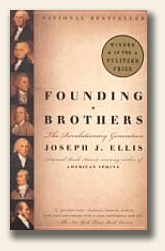 copy of this list handy while reading the notes, you can get a clear picture of the regional motives behind the discussion as the constitution was developed. This book, in conjunction with The Founding Brothers, John Ellis, were both extremely helpful in developing a working understanding of what I consider to be one of the most interesting 10 to 20 year time period in US history.
I thought that in addition to all of your other reading, these two items may be interesting and helpful.
Thanks for your suggestions Jim. To the readers of this post: “If you have a chance to read either of these (or have already done so), the community would love to hear your reactions as well.