
Search
The Rare & Early Newspapers Hobby

Receive the Newsletter

Buy Historic Newspapers

Campaign newspapers: a hobby within a hobby…
January 19, 2009 by TimHughes · Leave a Comment
Before the days of television, radio and certainly the internet, how did Presidential candidates get their platforms across the the electorate? Daily newspapers could not be counted upon as most were politically aligned with one of the parties so reporting had an obvious bias.
“Campaign newspapers” were one vehicle for candidates. Rather than rely on the ethics of the local publisher, parties produced their own newspapers during the campaign with the emphasis on the platform of the candidate. Logically such newspapers were short-lived and are relatively rare today as a result.
William Miles did a book titled: “The People’s Voice: An Annotated Bibliography of American Presidential Campaign Newspapers, 1828-1984” which lists chronologically and by party over 700 titles. The following is excerpted from his Preface:
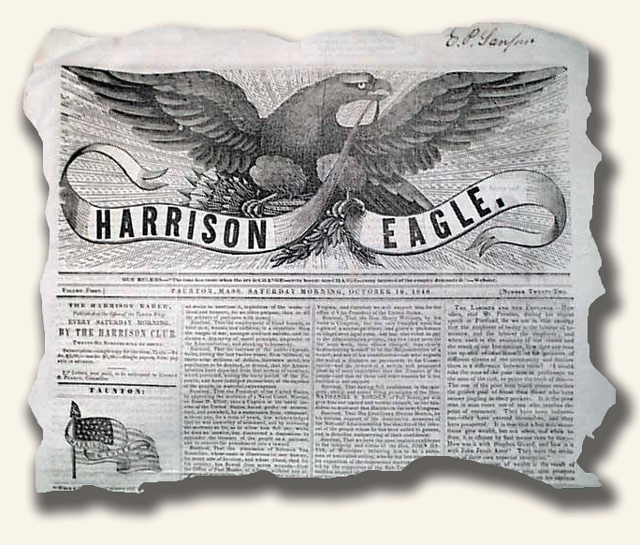 “Every four years since at least 1828 the campaign newspaper, like the campaign biography, song, poster, and similar election paraphernalia, has reappeared as a familiar part of the American presidential electoral process. Unlike the general party or partisan newspaper, these sheets were published specifically to support the cause of an aspiring candidate or an officially nominated ticket. Usually issued only during the period of the campaign itself, they were the campaign documents that emphasized the strengths and the importance of political organization at all levels; and to attack, generally in vitriolic language, the opposition. No matter if established and issued by party committees or by committed private individuals, or as “extras” and subsidized papers by already established partisan journals, the purpose was the same: organize the party faithful to work on behalf or electing the national, and by extension, the state and local tickets.”
Such elusive titles do provide an interesting array of titles including “Hickory Sprout” “Coon Hunter” “Harry Of The West” “Rebel Youth” “Hickory Tree” “On Our Way” “Rail Splitter” “Sober Second Thought” “Soup-Spiller” “Magician” “Grape Shot” “Rough & Ready” “Barnburner” “Dirty Shirt” “Kickapoo” and “Straight-Out Harrisonian” to name but a few.
Collecting campaign newspapers can be a fascinating hobby within a hobby, if only for the variety of titles available. Do you have any great-named campaign newspapers in your collection? Feel free to share.
An institutional need…
January 19, 2009 by TimHughes · Leave a Comment
One of our fellow collectors recently made the following inquiry seeking missing issues of an African-American newspaper from North Carolina. Not having any magical answers for him, I offer his request to all our customers in hopes someone might have a lead or suggestion. Feel free to respond through this blog.
African-American Newspaper–Durham, North Carolina
I’ve been casually interested in old newspapers and magazines for a number of years, and have regularly used them in my university classes (I recently retired as a professor of environmental policy at Duke, and often used them to document early conservation struggles.)
A few weeks ago, I got involved in a volunteer project at the historical collection of the Durham, NC county library, indexing microfilmed copies of a weekly African-American newspaper called the Carolina Times, published between 1927 and the present.
The content, especially in the 1930s and 1940s, is amazing. I had known a fair amount of Durham history, but was taken aback by the many specific injustices documented even here (supposedly one of the South’s most progressive cities) in the Jim Crow era. There is much original research still to be done, and the newspaper provides a vivid counterpoint to the local white media, which are also available.
Unfortunately, our microfilm lacks all issues between 1927 to 1937 and 1944-48. Also missing is the early version of the paper, the Durham Standard Advertiser, 1919-1927. Extensive searching reveals that no other library in the country has these issues, in any format (everyone has the same, incomplete, microfilm). I’ve used all my research skills to try to track them down, without success.
It would be a real contribution to both Durham history and African-American history to make this missing material available to scholars and others. Might you have any ideas? Private collectors? Archives that would not show up in the usual searches of libraries or internet troves. Peak circulation was 20,000 (in the 1940s) so it is not a completely obscure title. The paper’s offices burned in 1975, so the original archive was lost.
I can really recommend this kind of material to anyone interested in modern history. Any help with my own quest would be appreciated.
Rare Newspaper Collections Within Collections…
January 14, 2009 by GuyHeilenman · 3 Comments
From our guest contributor, *Morris Brill:
A significant segment of my newspaper collection is American and International Politics. This segment focuses on Presidents, World Leaders, Wars, Treaties, and Legislation.
Recently, while reviewing my collection of historic newspapers, covering the span of the past two centuries, I noticed I owned numerous newspapers referencing one world leader whose exploits spanned twenty-two years and whose name is one of the most recognizable in world history.
His fame is owed not only to his charismatic leadership but to the specific historic events with which he is associated.
Few world leaders can lay claim to a greater body of history than this leader, and collecting newspapers about this one man, alone, could occupy a collector’s time and interest for many years.
The story of this leader starts in 1789 with events leading up to his assumption of power on November 9, 1799 and continuing thereafter until his death in 1821.
NAPOLEON BONAPARTE stands monumental in history and the events he is associated with are among the most famous in military conflict.
My collection starts in 1791 when King Louis XV1, and his Queen Marie Antoinette, attempted to flee Paris dressed as servants to free themselves from captivity during the French Revolution. (The Mail; or, Claypoole’s Daily Advertiser – August 24, 1791)
This event is followed by the beheading of King Louis XV1, as reported in the Gazette of the United States of March 10, 1793.
 The following year Queen Marie Antoinette was beheaded as reported in the Courier of New Hampshire of March 6, 1794. This newspaper contains one of the most tender reports I have had the pleasure of reading in any newspaper of any event, and I attach it here for your reading pleasure.
http://www.newspapercollections.com/marieantoinettedeath.htm
The Boston Gazette of December 26, 1805 reports on the Battle of Trafalgar fought between the naval forces of England against the combined naval forces of France and Spain. It was during this battle that Horatio Nelson, England’s most revered naval commander, lost is life and left to posterity his famous words, “England expects that every man will do his duty.”
On March 9, 1813, as reported in the Salem Gazette, we read of Napoleon’s Retreat from Russia representing one of the most lethal military operations in world history. “Its sustained role in Russian culture may be seen in Tolstoy’s War and Peace and the Soviet identification of it with the German invasion of 1941-1945.”
The Weekly Messenger of June 6, 1814 tells the story of Napoleon’s Exile to Elba. This is followed by Napoleon’s Return From Elba as recorded in the Daily National Intelligencer of May 2, 1815.
 On August 25, 1815 the Weekly Messenger reported on what has become synonymous to a ‘final undoing’ The Battle of Waterloo. The Duke of Wellington, in reference to Napoleon, is quoted as saying: “I consider Napoleon’s presence in the field equal to forty thousand men in the balance.”
The Vermont Intelligencer of August 27, 1821 tells the final chapter with its report on The Death of Napoleon Bonaparte.
My collection of Napoleon Bonaparte related newspapers is certainly not comprehensive. I have used this example to illustrate that within a collection the collector can find eras that are worthy of a collection of their own.
Perhaps you have a collection of George Washington, Adolf Hitler, Winston Churchill, Franklin D. Roosevelt, Robert E. Lee or any of numerous other leaders whose names have been recorded in the annuals of history.
Please share with us your special interest and collection.
Morris Brill
* Background:
Morris Brill has been collecting newspapers for 45+ years with an emphasis on Political History, Air and Space, Famous and Infamous People, and Americana.
Morris possesses a Bachelor of Science Degree in Business Administration and History.
During an interview conducted by his hometown newspaper Morris was asked “What have you learned by collecting newspapers.”
Morris replied with the following:
“In essence I have learned that joy and sorrow walk hand in hand and that which we celebrate today may be the cause of our tears tomorrow, and yet, while we weep, the future is ready to bring us further elation.”
Thank you Morris. Your insight and contributions to the hobby are greatly appreciated.
Collecting statehood newspapers…
January 12, 2009 by TimHughes · 3 Comments
There are many “series” of historical significance which lend themselves nicely to the hobby of collecting newspapers. Reports of presidential elections, presidential inaugurations, major military battles, state-of-the-union addresses, and an issue from every possible decade are but a few ways to create a collection with a common theme.
 Statehood newspapers are a logical theme for collecting as well. With states joining the union from 1787 until the mid-20th century a very wide range of dates and reporting styles are evident. The earliest official statehood events were when each ratified the Constitution and can be challenging finds, although we’ve offered most if not all through the years. Later statehood entries were typically inconspicuous and brief, which adds to the quaintness of reporting styles of the 19th century given their historical significance.
Of recent attention is the 50th anniversary of Alaska statehood which happened on January 3, 1959. Later this summer we will celebrate the 50th anniversary of Hawaii, the last state to Join the Union.
The search can turn up some interesting tidbits and provide some trivia facts which would surprise most. Do you realize that five states joined the Union in the 20th century? (Oklahoma, New Mexico, Arizona, Alaska, Hawaii). What was the last of the 48 contiguous states to join? (Arizona: Feb. 14, 1912). What was the first state beyond the original 13 to join the Union? (Vermont: 1791). What was the only state to join the Union during the Civil War? (West Virginia: 1863). What was the first state to join in the 19th century? (Ohio: 1803).
Search for such issues can be fun and interest will grow with each statehood report found.
What other “series” of events have you found interesting?
Ways to collect: beautiful mastheads…
January 8, 2009 by TimHughes · Leave a Comment
 When I started collecting early newspapers many years ago, beyond the intrigue of something printed hundreds of years ago I was struck by the engravings found in the mastheads of many newspapers. I am still intrigued today, and I’ll admit that many of the newspapers found in our private collection are there because of their masthead engravings, not for their historic content. As a dealer one of my frustrations in the early years was publishing a catalog which did not accommodate photos. Later editions had a select few (most still do) but now many of our pricier catalog issues can be viewed online. And of course any newspaper we sell on our website or our eBay Store has multiple photos, allowing us to share the beauty of masthead engravings of centuries past.
 Eagle engravings are a favorite of mine and the variety available from the 18th & 19th century has to number well into the hundreds. The photo shows an issue of the “The Eagle”, the title apparently so obvious that the words never appeared in the masthead (but see the top of the first column). This is a rare title from Castine, Maine which lasted for only two years.
Themes in masthead engravings have been a focus of many of our customers. One man only buys newspapers with engravings of people shaking hands, and surprisingly I was able to find several for him.
What masthead engravings intrigue you? Do you have a favorite?
Collecting spurs research, spurs “neat stuff”…
December 26, 2008 by TimHughes · 1 Comment
As all of you know reading old newspapers can provide an interesting perspective on history, and cause one to question what we remember from history class of long ago. And with the advent of the internet, verifying some “facts” as reported 100+ years ago can lead to even more intriguing footnotes to history which we’d otherwise miss.
One interesting tidbit came to light earlier today and is worth sharing. The NEW YORK TRIBUNE of Feb. 28, 1862 includes on the backpage a printing of the words and music with a heading: “A Song That Is Now Rather Popular”. I recognize the music as the “Battle Hymn of the Republic”, and was aware of the lyrics which began: “John Brown’s body lies a mould’ring in the grave…” and of course the well known chorus (see photos). I was also aware that Julia Ward Howe wrote the words to “Battle Hymn…” but a website provided an interesting backdrop:
 “In 1861, after a visit to a Union Army camp, Julia Ward Howe wrote the poem that came to be called “The Battle Hymn of the Republic.” It was published in February, 1862, in The Atlantic Monthly.
Howe reported in her autobiography that she wrote the verses to meet a challenge by a friend, Rev. James Freeman Clarke. As an unofficial anthem, Union soldiers sang “John Brown’s Body.” Confederate soldiers sang it with their own version of the words. But Clarke thought that there should be more uplifting words to the tune.
Howe met Clarke’s challenge. The poem has become perhaps the best-known Civil War song of the Union Army, and has come to be a well-loved American patriotic anthem.”
Equally as interesting was another site concerning the “John Brown” mention, which I always presumed to be a reference to John Brown of Harper’s Ferry fame. Apparently not so:
“During a visit to Washington in the autumn of 1861, poet Julia Ward Howe attended a public parade and review of Union troops. On her way back to Willard’s Hotel she found her carriage delayed by marching regiments. To spend some time, she and her cohorts in the carriage sang a few of the war songs so popular those days, among them, “John Brown’s Body,” which contained the provocative words, “John Brown’s body lies-a-mouldering in the ground…. His soul is marching on.”
Howe would have assumed that the John Brown of the song was the famous abolitionist. But the song belonged to a young Scotsman in the Massachusetts Volunteer Militia who shared Brown’s name.
The Scotsman was well aware of John Brown the abolitionist. Having the same name made him a prime target for many good-natured jokes. As the soldiers marched, they would hammer out, in folk-song fashion, the tune that Julia Ward Howe would later hear. Lines like “His Soul’s Marching On” were meant to tease the Scotsman. But as the catchy verse traveled to other units, it was known only as a song about the John Brown who was captured at Harpers Ferry. New verses were constantly added:
Old John Brown’s body is a-mouldering in the dust,
Old John Brown’s rifleís red with blood-spots turned to rust,
Old John Brown’s pike has made its last, unflinching thrust,
His soul is marching on!
The morning after hearing the song, Julia Ward Howe wrote her own words to the tune. Soon after, it was published in the “Atlantic Monthly” as “The Battle Hymn of the Republic.”
John Brown the Scotsman would not live to hear this version. He died early in the war, drowned in the Shenandoah River at Front Royal, Virginia.”
Just a few of the interesting tidbits of history one learns by reading old newspapers!
Most Historic 19th Century post-Civil War Headline… revisited…
November 22, 2008 by Historys Newsstand · Leave a Comment
 Although I think Tim’s choice was a good one (see his post), my choice for the most important event of the nineteenth century, post-Civil War is the invention of the first practical incandescent light bulb by Thomas Edison. His creation of this light bulb as well as his other inventions make him the most recognized inventor of the nineteenth century and perhaps of all time. In fact, reports about his most significant inventions were featured in several nineteenth century issues of Scientific American, more than any inventor of the era.
Newspapers, however, were slow but not reluctant to recognize Edison’s  achievements. As a result, there is no single report that marked his most famous invention. The reports were usually topical ones written by staff writers who visited Menlo Park, witnessed demonstrations of his inventions, or interviewed Mr. Edison. Images and a description were featured in the Scientific American issue dated March 22, 1879. Nevertheless, the impact of Thomas Edison’s incandescent light bulb and his other inventions are immeasurable and far-reaching. They continue to play a role in our daily lives and make the world a better place for all mankind.
I’d love to hear your thoughts.
Note: Images with a supporting article were featured in the March 22, 1879 issue of Scientific American.
Most historic Civil War event…
November 18, 2008 by TimHughes · 1 Comment
Continuing with our discussion on the “most historic” reports to be found in newspapers, we have been discussing the events of American history by era, the last being the post-Civil War 19th century. This post will discuss the Civil War era of 1861 – 1865.
Of the many events of the 19th century which changed the course of American history few would argue that the Civil War was the most significant. But what single event during the Civil War would rank as the most significant? If you could only have one newspaper from the Civil War in your collection, what one event would you most desire?
There are a number of events to consider:
1) The election of Abraham Lincoln. Although it happened in late 1860 and not technically from the war, this event would would set the tone of American politics which would lead to the war. What would have happened had he not been elected?
2) The beginning of the Civil War in April, 1861, for obvious reasons.
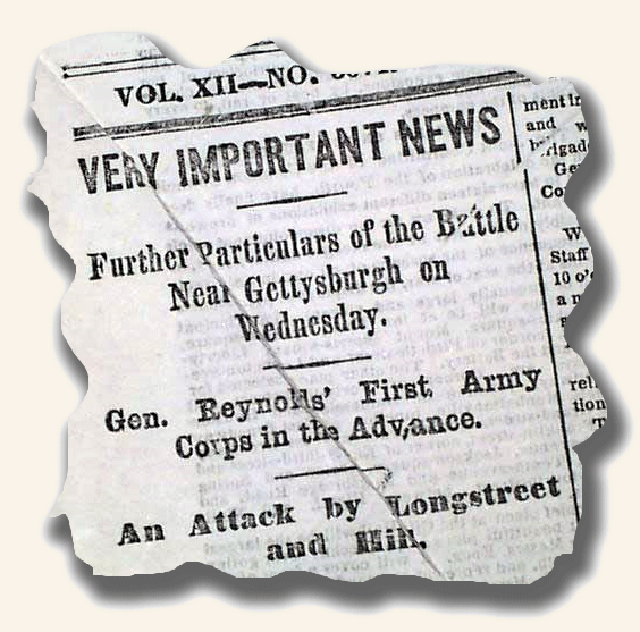 3) The Emancipation Proclamation of September, 1862, providing freedom to all slaves in all states, although more in theory than practicality.
4) The battle of Gettysburg, as the turning point of the Civil War.
5) The assassination of Lincoln: how would the country been different had he not been assassinated and served out his 2nd four year term?
Perhaps other events should be considered as the most historically significant. What are your thoughts?
My vote would be for the battle of Gettysburg. If it was a given that a war was inevitable to settle the political, cultural & economic divide between the North & South, it’s arguable that the war’s end was decided at Gettysburg. The tide had turned in favor of the North and at that point it was just a matter of when it would end and not who would win.
What’s your thought?
Rick Brown & HistoryBuff.com – Featured Website!
November 17, 2008 by GuyHeilenman · 1 Comment
Rick’s entry into the hobby took a path similar to Timothy Hughes’. He started collecting historical newspapers in 1965 when he purchased a Philadelphia Inquirer for the capture and death of John Wilkes Booth. As he held his new purchase in his hands, he was suddenly struck by what many since him have come to realize: “History is never more fascinating than when it’s read from the day it was first reported”. He describes this first encounter with historic newspapers himself…
“Reading the emotion-filled accounts from actual witnesses suddenly opened a new door for me. Before, my viewpoint of history was that it was just a series of dates, names and events. Reading the actual eyewitness accounts made the names and events come to life. Imagine, being able to hold something in your hands that was “alive” when the event happened — 100, 200 or even 300 years old. For the next four years I literally purchased every old newspaper I could find. By 1969 I realized that I was running out of storage room…”
By 1969 he became a mail order dealer in historic newspapers. In 1984 he started a publication for newspaper collectors, “Collectible Newspapers”, which featured journalism history articles.
Tim fondly remembers the publication and the extraordinary efforts of Rick to bring together newspaper collectors from all corners of the country–and across the globe as well.
“Rick was a true hobbyist. He expended much effort and money to provide a channel to bring together all collectors under a common banner–the Newspaper Collector Society of America (NCSA). Never was he motivated to profit by the hobby. In more ways then he might admit, Rick did much to help the fledgling hobby grow. Rick’s a terrific guy and remains an extremely valuable resource for the hobby” says Tim.
In 1995 he discovered the internet, and by October 1995, Rick had a small website utilizing articles he had first printed in “Collectible Newspapers.” By January 1997, the site was getting 25,000 hits per month, and he could no longer justify the publishing costs for 25,000 people, so he ceased publishing the print version with the April 1997 issue.
Now, thirteen years later, HistoryBuff.com is reaching nearly 90,000 unique viewers AND 500,000+ PAGE VIEWS monthly. In October 2003, HistoryBuff.com was granted nonprofit status at both the federal and state level. While donations help keep HistoryBuff.com online, Rick fills in with money of his own. As with most nonprofits, financing is always a chore and there is seldom enough to keep it going. He has never taken pay for his work; truly a labor of love.
The HistoryBuff.com website provides a wealth of historical information beneficial to both novice and well-seasoned historians. It describes itself as:
“…a nonprofit organization devoted to providing FREE primary source material for students, teachers, and historybuffs. This site focuses primarily on HOW news of major, and not so major, events in American history were reported in newspapers of the time. In addition, there is information about the technology used to produce newspapers over the past 400 years.”
A sampling of resources provided at HistoryBuff.com includes:
-
- Reference Library (articles from Collectible Newspapers)
- Historic Panoramas (30 and counting)
- Newspaper Collecting
- Online Newspaper Archive
- Newsletter Archives
The most recent addition to the website is panoramas of historic sites in America. Upon entering, you will be treated to a guided tour of more than a dozen well-known historic sites.
Whether your primary interest is history or the collection of “History in Your Hands” via newspapers, the resources available through these links will prove to be invaluable. As a former educator, I particularly appreciate the access to Rick’s Interactive Quizzes. Subscriptions to the monthly EMAILED newsletter are available at no cost.
If you have yet to browse through the pages at HistoryBuff.com, a treat awaits. Warning: Before visiting, make certain you’ve cleared your schedule for a few hours. Walking through history is a trek worth savoring. Thanks Rick!
Feel free to comment on your visit (or more likely… visits) to HistoryBuff.com.
Historic newspapers: the “crossover” collectible…
November 13, 2008 by TimHughes · 4 Comments
Stepping beyond the hobbyists who collect newspapers specifically, one collector which has become a mainstay of our business has been the person looking for a newspaper report relating to their own hobby. For example, antique car collectors have purchased Detroit newspapers featuring advertisements when a specific model they own was first introduced. Imagine owning a 1964 mustang and the thrill in finding a Detroit newspaper with an ad announcing the car–what a perfect companion piece for a car buff!
Coin collectors have often come to us with specific dates of when new coin designs were created, and it was not uncommon for detailed reports to be found in period newspapers. Whether it was the introduction of the Morgan silver dollar, the Barber nickel, dime, quarter or half dollar–or any of the 100’s of designs produced by the United States mint since 1792–collectors of those coins have cherished newspaper accounts of those new designs as a way of enriching their collection and enhancing the appeal of significant coins they cherish as collectors.
One example which comes to mind is the copper-nickel flying eagle penny introduced in 1857 (a small number of “pattern” coins exist from 1856), which was a dramatic departure from the much larger, all copper “large cents” of the previous decades. Its introduction was announced in the February 7, 1857 issue of Harper’s Weekly, actually a few weeks before the formal Act of February 21, 1857 which authorized the coin’s creation. The report even includes images of both the obverse & reverse of the coin.
The report is very intriguing. Included is: “…Provided the act of Congress, which establishes the new cent, becomes a law, which it has not as yet, we think the public will be a gainer by the new coin. Its smaller size makes it much more convenient for handling…” and “…We will lose an American proverb, now widely circulated, by the issue of the new coin. ‘He’s not worth a red cent’ will be of such general application that it will not have any specific meaning & will be of course dropped, for the new cent is not red, being of a gray, silvery aspect.” with more.
The field is wide open for “crossover” collectibles. Virtually any collectible produced in the last 300 years may well have a newspaper account of its creation or development. The thrill of the search is in finding it!
Are you aware of newspaper reports which relate to other collectibles you have? Feel free to share.