

Search
The Rare & Early Newspapers Hobby

Receive the Newsletter

Buy Historic Newspapers

Curiosities are fun to collect…
December 4, 2008 by TimHughes · Leave a Comment
 The strange and the unusual make interesting additions to a newspaper collection, not only in the reports within the newspaper but the newspaper’s appearance as well.
 One issue from our private collection is significant for not only being a desirable title from Deadwood City in the
  “Black Hills” as noted in the dateline, but the front page and back pages have the columns printed alternately in red and blue ink. From what I can gather by the front page text they seem to be celebrating Washington’s birthday in a very creative way. It certainly makes for an unusual presentation. We have found that many newspapers from the Old West included unusual formats, likely due to the difficulties of printing so far from the metro areas of the East Coast.
Have you found some similarly unsual newspapers which are now in your collection? If so, what might they be?
Beginning of the Corvette era…
December 1, 2008 by TimHughes · Leave a Comment
A few weeks ago I did a post concerning cross-over collectibles; newspapers with significant content relating to another hobby.
Recently a terrific item came to light from our inventory which to many may seem interesting, but to the thousands of Corvette enthusiasts would be a cherished addition for their collection and a great display piece for the back seat of their 1953 Chevrolet Corvette.
The newspaper is the July 1, 1953 issue of THE DETROIT NEWS, with page 53 containing a photo captioned: “First fiber glass Corvette–Chevrolet’s first production model fiber glass Corvette sports car rolls off the company’s assembly line.” Plus there is a related article beneath the photo headed: “Production Line Starts: Plastic Corvette Begins to Roll“.
With Detroit being the automobile capital of the country–if not the world at that time–it is likely little if any coverage would have appeared in newspapers elsewhere, making this a particularly interesting issue. Imagine what a great collection of newspapers could be created by a car enthusiast: a Detroit newspaper announcing the beginning of all the classic automobiles so desirable today!
Just another great example of how old newspapers can find their way into many other hobbies.
Weaponry in the 17th century… distant cousin of the modern hand grenade…
November 28, 2008 by Historys Newsstand · Leave a Comment
 One of the key issues featured in our latest catalog is a newsbook of the Mercurius Politicus, from London, dated March 24, 1659. Newsbooks, for those unfamiliar with the term, were the forerunners of newspapers. This particular newsbook measures about 8 1/2 by 6 3/4 inches and has 16 pages. While looking for interesting content to describe, I noticed a report datelined “Marienburgh, March 5”, that contained details about a military engagement. In the report is word that: “..Colonel Drake came with a party back, fetching from hence Morter pieces, Balls, Handgranadoes, and other amunition, and is gone back to the army which lyeth near Rysenburgh…” In reading this passage I was fascinated by the term “Handgranadoes“. I did some research and discovered that the concept of “throwing” grenades may date to the Ming Dynasty in China, although the first known use of grenades occurred during the early to middle part of the 8th century. The research also suggested that some “Medieval petards” were small enough to be considered primitive hand grenades. Later, during the Song Dynasty, Chinese soldiers began to pack gunpowder into ceramic and metal containers, resulting in what one expert determined to be the prototype of the modern hand grenade. Variations of this prototype eventually appeared in Europe during the late 1460’s. About 200 years later,
  “Grenadoes”, according to a Wikipedia source, were used during the English Civil War (1642-1651). The source also says: “The word ‘grenade’ originated in the Glorious Revolution (1688), where cricket ball-sized iron spheres packed with gunpowder and fitted with slow-burning wickets were first used against the Jacobites in the battles of Killiecrankie and Glen Shiel. These grenades were not very effective….and, as a result, saw little use.” Obviously the mention of “handgranadoes” in the newsbook report confirms the use of such a weapon during the mid 1600’s. More importantly, this may be one of the earliest references to a distance cousin of the modern hand grenade to appear in newsprint. Note: The term “grenadier”, which is derived from the word grenade, was a classification given to soldiers in the 17th century with the specific role of throwing grenades. You simply never know what you might find while perusing collectible newspapers (and newsbooks).
Framing newspapers…
November 24, 2008 by TimHughes · 2 Comments

Tim Hughes, founder
One of the joys of collecting newspapers is sharing with others, but sharing can be problematic given the fragile nature of early paper.
Certainly 20th century newspapers offer the largest & most dramatic headlines–some taking the entire front page–but 18th and 19th century issues can be displayable as well. Civil War era newspapers occasionally had large front page maps, and others included graphic devices which draw much attention. And Harper’s Weekly and Leslie’s Illustrated issues of the 19th century offer a wealth of displayable prints. Even some 18th century newspapers have graphically appealing mastheads which make them perfect for display, not to mention many with wide, black “mourning rules” signifying the death of someone of prominence. But smaller headlines–typically just one column wide–and major content often appearing on inside pages do present challenges for proper display, but can be done. Such headlines on inside pages can be creatively folded, matted and framed in such a way to feature a somewhat small yet very significant report.
This relates to one of the common question received from customers: can historic newspapers be framed? The short answer is yes, in fact many of our issues are framed and hanging on walls in our office. But care must be taken to use only archival materials when selecting mat boards and backing boards so no acids transfer from the framing material to the newspaper. Virtually all professional framers use archival material today so this warning is more for those who choose to do their own work.
UV glass is important as well, and again is typically available through professional frame shops. This glass will filter out much of the harmful ultraviolet rays which may, in time, do damage to the newspaper if exposed to sunlight. But just to be sure I take care to hang newspapers in locations where little or no sun will touch the frame throughout the day.
So for those beautiful headlines in your collection which beg to be displayed, feel free to do so–but include some common sense as well.
Do you have newspapers from your collection framed? Feel free to share.
Most Historic 19th Century post-Civil War Headline… revisited…
November 22, 2008 by Historys Newsstand · Leave a Comment
 Although I think Tim’s choice was a good one (see his post), my choice for the most important event of the nineteenth century, post-Civil War is the invention of the first practical incandescent light bulb by Thomas Edison. His creation of this light bulb as well as his other inventions make him the most recognized inventor of the nineteenth century and perhaps of all time. In fact, reports about his most significant inventions were featured in several nineteenth century issues of Scientific American, more than any inventor of the era.
Newspapers, however, were slow but not reluctant to recognize Edison’s  achievements. As a result, there is no single report that marked his most famous invention. The reports were usually topical ones written by staff writers who visited Menlo Park, witnessed demonstrations of his inventions, or interviewed Mr. Edison. Images and a description were featured in the Scientific American issue dated March 22, 1879. Nevertheless, the impact of Thomas Edison’s incandescent light bulb and his other inventions are immeasurable and far-reaching. They continue to play a role in our daily lives and make the world a better place for all mankind.
I’d love to hear your thoughts.
Note: Images with a supporting article were featured in the March 22, 1879 issue of Scientific American.
America’s first newspaper… Check your attics.
November 20, 2008 by TimHughes · Leave a Comment
The very first newspaper printed in the American colonies was published in Boston in 1690 and titled “Publick Occurrences Both Forreign and Domestick”. It was a little paper with three pages of text. The fourth page was left blank for others to write handwritten pieces of news before being passed on to others. It was published by Benjamin Harris who had experience in publishing another newspaper in London several years prior to his arrival in the colonies, titled “Domestick Intelligence, Or News Both from City & Country”.
His Boston effort focused on local news but it also included gossip and unflattering reports. One account notes it contained: “…affections of a very high nature: As also sundry doubtful and uncertain Reports…”. The mixture of doubtful and uncertain reports, as well as a ban on printing without a license which Harris did not have, caused his first issue to also be his last. Reports note that the royal governor had the printing press destroyed and all known issues of that one date of September 25, 1690 confiscated.
To this day only one genuine issue of the newspaper is known to exist, and unfortunately it’s not in the United States: it is in the Public Records office in London. Some years ago it was loaned to The Newseum in Washington, D.C. (then located across the Potomac in Virginia) for a period of time, but I believe it has been returned to London.
The intriguing part of this story is that “all known issues were confiscated and destroyed”. But exactly when did this happen? Was it done several hours since it was printed, or a few days later? It was intended to be a monthly publication. Certainly the possibility exists that a few issues were not found & confiscated, and with the owners knowing of the search they may have purposely hidden them away.
Could an issue or two still exist in a Boston attic somewhere? Is there a private library where an issue was hidden among the pages of a book in hopes of not being confiscated? Could a renovation project to a Boston area home reveal an issue tucked within its walls over 300 years ago? It is fascinating to think that some examples could be found so long after being published. But to this date none have surfaced.
Speculation runs wild as to the value of an issue should it surface. It’s America’s very first newspaper, and none exist in America. What sort of price could be set on such an issue? What should be the future home of an issue should it be found?
Feel free to comment!
Most historic Civil War event…
November 18, 2008 by TimHughes · 1 Comment
Continuing with our discussion on the “most historic” reports to be found in newspapers, we have been discussing the events of American history by era, the last being the post-Civil War 19th century. This post will discuss the Civil War era of 1861 – 1865.
Of the many events of the 19th century which changed the course of American history few would argue that the Civil War was the most significant. But what single event during the Civil War would rank as the most significant? If you could only have one newspaper from the Civil War in your collection, what one event would you most desire?
There are a number of events to consider:
1) The election of Abraham Lincoln. Although it happened in late 1860 and not technically from the war, this event would would set the tone of American politics which would lead to the war. What would have happened had he not been elected?
2) The beginning of the Civil War in April, 1861, for obvious reasons.
 3) The Emancipation Proclamation of September, 1862, providing freedom to all slaves in all states, although more in theory than practicality.
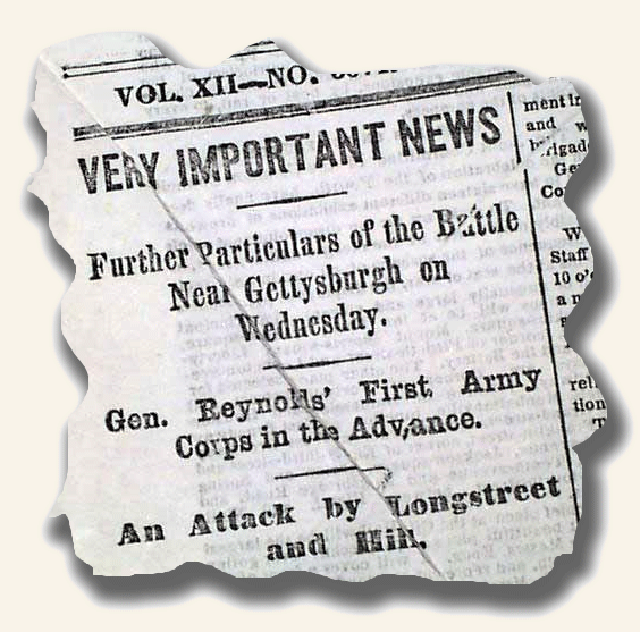
4) The battle of Gettysburg, as the turning point of the Civil War.
5) The assassination of Lincoln: how would the country been different had he not been assassinated and served out his 2nd four year term?
Perhaps other events should be considered as the most historically significant. What are your thoughts?
My vote would be for the battle of Gettysburg. If it was a given that a war was inevitable to settle the political, cultural & economic divide between the North & South, it’s arguable that the war’s end was decided at Gettysburg. The tide had turned in favor of the North and at that point it was just a matter of when it would end and not who would win.
What’s your thought?
Rick Brown & HistoryBuff.com – Featured Website!
November 17, 2008 by GuyHeilenman · 1 Comment
Rick’s entry into the hobby took a path similar to Timothy Hughes’. He started collecting historical newspapers in 1965 when he purchased a Philadelphia Inquirer for the capture and death of John Wilkes Booth. As he held his new purchase in his hands, he was suddenly struck by what many since him have come to realize: “History is never more fascinating than when it’s read from the day it was first reported”. He describes this first encounter with historic newspapers himself…
“Reading the emotion-filled accounts from actual witnesses suddenly opened a new door for me. Before, my viewpoint of history was that it was just a series of dates, names and events. Reading the actual eyewitness accounts made the names and events come to life. Imagine, being able to hold something in your hands that was “alive” when the event happened — 100, 200 or even 300 years old. For the next four years I literally purchased every old newspaper I could find. By 1969 I realized that I was running out of storage room…”
By 1969 he became a mail order dealer in historic newspapers. In 1984 he started a publication for newspaper collectors, “Collectible Newspapers”, which featured journalism history articles.
Tim fondly remembers the publication and the extraordinary efforts of Rick to bring together newspaper collectors from all corners of the country–and across the globe as well.
“Rick was a true hobbyist. He expended much effort and money to provide a channel to bring together all collectors under a common banner–the Newspaper Collector Society of America (NCSA). Never was he motivated to profit by the hobby. In more ways then he might admit, Rick did much to help the fledgling hobby grow. Rick’s a terrific guy and remains an extremely valuable resource for the hobby” says Tim.
In 1995 he discovered the internet, and by October 1995, Rick had a small website utilizing articles he had first printed in “Collectible Newspapers.” By January 1997, the site was getting 25,000 hits per month, and he could no longer justify the publishing costs for 25,000 people, so he ceased publishing the print version with the April 1997 issue.
Now, thirteen years later, HistoryBuff.com is reaching nearly 90,000 unique viewers AND 500,000+ PAGE VIEWS monthly. In October 2003, HistoryBuff.com was granted nonprofit status at both the federal and state level. While donations help keep HistoryBuff.com online, Rick fills in with money of his own. As with most nonprofits, financing is always a chore and there is seldom enough to keep it going. He has never taken pay for his work; truly a labor of love.
The HistoryBuff.com website provides a wealth of historical information beneficial to both novice and well-seasoned historians. It describes itself as:
“…a nonprofit organization devoted to providing FREE primary source material for students, teachers, and historybuffs. This site focuses primarily on HOW news of major, and not so major, events in American history were reported in newspapers of the time. In addition, there is information about the technology used to produce newspapers over the past 400 years.”
A sampling of resources provided at HistoryBuff.com includes:
-
- Reference Library (articles from Collectible Newspapers)
- Historic Panoramas (30 and counting)
- Newspaper Collecting
- Online Newspaper Archive
- Newsletter Archives
The most recent addition to the website is panoramas of historic sites in America. Upon entering, you will be treated to a guided tour of more than a dozen well-known historic sites.
Whether your primary interest is history or the collection of “History in Your Hands” via newspapers, the resources available through these links will prove to be invaluable. As a former educator, I particularly appreciate the access to Rick’s Interactive Quizzes. Subscriptions to the monthly EMAILED newsletter are available at no cost.
If you have yet to browse through the pages at HistoryBuff.com, a treat awaits. Warning: Before visiting, make certain you’ve cleared your schedule for a few hours. Walking through history is a trek worth savoring. Thanks Rick!
Feel free to comment on your visit (or more likely… visits) to HistoryBuff.com.
Historic newspapers: the “crossover” collectible…
November 13, 2008 by TimHughes · 4 Comments
Stepping beyond the hobbyists who collect newspapers specifically, one collector which has become a mainstay of our business has been the person looking for a newspaper report relating to their own hobby. For example, antique car collectors have purchased Detroit newspapers featuring advertisements when a specific model they own was first introduced. Imagine owning a 1964 mustang and the thrill in finding a Detroit newspaper with an ad announcing the car–what a perfect companion piece for a car buff!
Coin collectors have often come to us with specific dates of when new coin designs were created, and it was not uncommon for detailed reports to be found in period newspapers. Whether it was the introduction of the Morgan silver dollar, the Barber nickel, dime, quarter or half dollar–or any of the 100’s of designs produced by the United States mint since 1792–collectors of those coins have cherished newspaper accounts of those new designs as a way of enriching their collection and enhancing the appeal of significant coins they cherish as collectors.
One example which comes to mind is the copper-nickel flying eagle penny introduced in 1857 (a small number of “pattern” coins exist from 1856), which was a dramatic departure from the much larger, all copper “large cents” of the previous decades. Its introduction was announced in the February 7, 1857 issue of Harper’s Weekly, actually a few weeks before the formal Act of February 21, 1857 which authorized the coin’s creation. The report even includes images of both the obverse & reverse of the coin.
The report is very intriguing. Included is: “…Provided the act of Congress, which establishes the new cent, becomes a law, which it has not as yet, we think the public will be a gainer by the new coin. Its smaller size makes it much more convenient for handling…” and “…We will lose an American proverb, now widely circulated, by the issue of the new coin. ‘He’s not worth a red cent’ will be of such general application that it will not have any specific meaning & will be of course dropped, for the new cent is not red, being of a gray, silvery aspect.” with more.
The field is wide open for “crossover” collectibles. Virtually any collectible produced in the last 300 years may well have a newspaper account of its creation or development. The thrill of the search is in finding it!
Are you aware of newspaper reports which relate to other collectibles you have? Feel free to share.
Contrasting pairs of historic newspapers: another way to collect…
November 11, 2008 by TimHughes · 2 Comments
The recent election, reflecting the great strides made socially & politically by the African-American community, brought to mind another opportunity in newspaper collecting not thought of by most. In preparing issues for a future Supplement the “Detroit Free Press” of June 12, 1963 struck me as a interesting contrast to the election of just a few days prior. The headline proclaimed: “NEGROES ENROLL AT ‘BAMA”, noting the struggles African-Americans had just to enroll in universities across the country during the 1950’s and 1960’s. Zoom forward just 45 years and the headline of the “USA Today” read “America Makes History – OBAMA WINS” noting America’s first African-American president. (We have this pair listed on eBay. Click here to view.) I don’t believe it’s a stretch to say that in 1963 the thought of an African-American president in any person’s lifetime was considered a serious possibility, yet it happened, and indeed America did make history.
Carrying forward with this “contrasting pairs” idea, a fascinating collection of newspapers could be built around this theme. How about a December, 1903 issue report on the Wright brothers’ first flight alongside  an issue of July 21, 1969 announcing man landing on the moon? How about an 1844 newspaper on the first successful telegraph transmission alongside an issue announcing the launching of the Telstar satellite, noting the achievements in distance communication? How about a 1920 newspaper reporting the ratification of the Suffrage Amendment giving women the right to vote, along side an issue just 64 years later reporting Geraldine Ferraro as the first female Vice Presidential candidate representing a major American political party? Consider the contrast in perspectives of having both a Yankee and Confederate newspaper for the same Civil War date. The advantage that newspapers offer to this interesting theme is they offer physical evidence of achievements & accomplishments…one can display such headline issues side by side.
What other “contrasting pairs” do you believe would be intriguing additions to an historical newspaper collection, and why?