

Search
The Rare & Early Newspapers Hobby

Receive the Newsletter

Buy Historic Newspapers

Numbering an issue….how was it done?
April 6, 2009 by TimHughes · Leave a Comment
 The numbers noted at the top of the front page of a newspaper, typically at the far left and right of the dateline, may seem a bit confusing so I’ll try to explain what they mean.
Most newspapers had two sets of numbers: 1) the issue & volume numbers, and 2) the whole number.
The issue & volume number often appear such as “Vol. 5 num. 237” which means this is the 237th issue from the fifth year of the newspapers existence. Newspapers would assign a volume number to their publication which would increase by one on the anniversary of its beginning, so if a newspapers published it’s first issue on March 5, 1837, volume two would begin with the first publication after March 5, 1838. The issue number notes the issue from within that volume, meaning that issue “Vol. 5 num. 313” might be followed by issue “Vol. 6 num. 1” if the newspaper published 6 days a week (365 days less 52 Sundays = 313 published issues in the year).
 But to many the more mysterious number is the “whole number”. Essentially it indicates how many issues have been published since the founding of the paper, and can be a very large number if the paper has been in publication for many years.
Using the above example of “vol. 5 num. 313” the “whole number” of this issue would likely be 1565 (313 issues per year x 5 years = 1565). And the very next issue, noted as “vol. 6 num 1” would be whole number 1566.
 The tricky thing is that when some newspapers were sold, reorganized, changed their name, or merged with another they might begin a “new series” and the volume/issue numbers would begin afresh, and the whole number may or may not start over with number 1, depending on the whim of the publisher. So these numbers cannot be depended upon to give an accurate reflection of how old the newspaper is, nor the number of issues that were printed since its inception. Niles’ National Register did this at least twice in its 40 years’ existence.
Don’t tell the Chamber of Commerce…
April 4, 2009 by TimHughes · Leave a Comment
 A brief piece in the “Niles’ National Register” newspaper of Baltimore, January 14, 1843, obviously came from a disgruntled visitor to the West:
“Capt. Kendall, in describing Santa Fe, says it is a little mud-built city, that stands between civilization and the jumping off place.”
If you’ve visited Sante Fe, New Mexico recently, you can certainly attest to the significant improvements which have been made since 1843.
Red (British) tax stamps… They appear to be random…
April 2, 2009 by GuyHeilenman · Leave a Comment
 Recently a member inquired as to why the red-ink British tax stamps seemed to appear randomly within an issue – sometimes on the frontpage, sometimes on the backpage, and at other times somewhere within the issue. Although we had our thoughts on the subject, we called upon a collector of red-ink stamp issues, Randall Burt. His thought substantiated our “hunch”:
“These newsprint publishers bought their stock from the
paper makers, and then were required by law to pay the paper tax on it at the gov’t
house where the paper was taxed at current rates. The stamp was applied on
the blank sheets [pre-printing], then taken to their newspaper office where the news was added.
 These tax stamps were not always in a desirable place for the collector. J.H. Chandler & H. Dagnall wrote extensively on this subject in their “Newspaper & Almanac Stamps of
Great Britain,” as did several other noted revenue writers.” Randall Burt
Thanks for your insight Randall.
If you have additional questions you would like to see addressed through the History’s Newsstand Blog, please comment to this post of send your questions to guy@rarenewspapers.com.
Genuine or reprint?
March 26, 2009 by TimHughes · 31 Comments
A great fear of any novice collector is knowing whether an item purchased is genuine or not. It’s a valid concern, as the other collectibles have been infested by reproduction,s reprints, or deceivingly fake material from furniture to coins to baseball collectibles.
The world of rare newspapers is not immune but it is not a serious problem either. With a few helpful hints almost every collector can avoid the pitfalls of having non-genuine newspapers end up in their collection.
Fake material of any collectible seems to become an problem when popularity and values grow. Since rare newspaper collecting remains a relatively unknown hobby with relatively low prices there is little incentive to create fake editions. And the requirements to recreate a 200 year old newspaper to have it look like a genuine edition can be complex and expensive.
With but one exception, I am not aware of any reprinted newspapers which were created to deceive. Virtually all facsimile issues on the market were created as souvenirs of historic events (Honolulu issues on Pearl Harbor can still be purchased at the memorial), on anniversaries of the first issue printed (many volume one, number one issues are reprints), as curious give-aways or “premiums” (major events such as the Boston Massacre, Declaration of Independence, etc. were reprinted), or as teaching tools in an educational environment (Harper’s Weekly issues from the Civil War were reprinted on their 100th anniversary: look for “a reissue of” above the “H” in “Harper’s Weekly” on page 1).
The lone exception is a collection of the “Pennsylvania Gazette” from the 1730’s – 1787 with issues turning up in small auction halls throughout the East some 20 years ago. The issues were aged to look 200 years old and the paper was very close to genuine newsprint from the era. Beware of this title if it contains a “Tontine Coffee House” inked stamp on the front page & if it looks a bit washed out.
The number of reprint newspapers on the market is exceedingly small so collectors have little to worry about. But keep these points in mind:
1) The most common reprint newspapers are on the Library of Congress check-list. Go here to keep the list handy. It also includes helpful tips on how to tell if genuine or a reprint.
2) Be aware of what 200 year old and 100 year old newsprint should look like. Almost all reprints were done on paper which is not reflective of the era.
3) Be suspicious of exceedingly historic newspaper turning up in illogical places. The likelihood of a genuine Declaration of Independence report being in flea market or amongst of group of papers from a non-collecting family is very remote. In other words if the find seems too good to be true, it likely is.
4) Be careful with volume one, number one newspapers. Such first editions were commonly reprinted by the publisher on the 50th or 100th anniversary.
5) Above all, buy from reputable dealers whose expertise, experience and reputation stand behind all they sell.
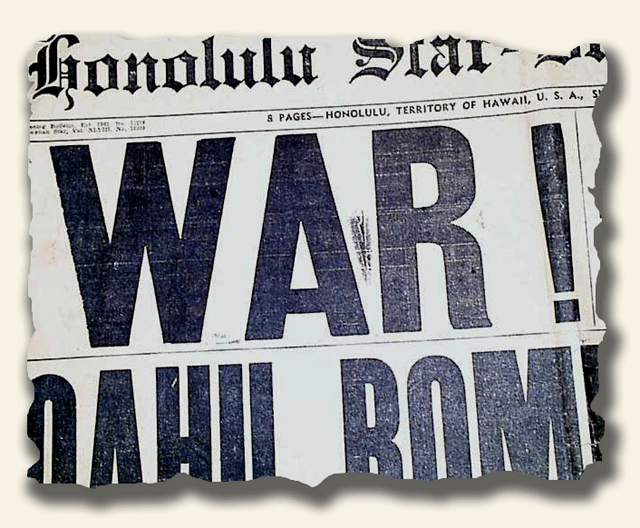 The “Honolulu Star-Bulletin” of Dec. 7, 1941 mentioned above is not on the Library of Congress check-list, however it’s easy to spot a reprint. The genuine issue has an ink smear between the “A” and “R” in the huge word “WAR!” on the front page (see photo). They cleaned it up on the reprint so it won’t be present.
And a news flash–I just learned that the “Dallas Morning News” issue of Nov. 23, 1963 reporting Kennedy’s assassination has been reprinted. Look for the word “Reprint” in the dateline just after the four stars. Do note those we have on our website & have sold for over 20 years are all genuine!
Common sense can be the best guide. The requirements to reprint an 8 page Civil War newspaper with a minor battle report could cost hundreds of dollars while the genuine issue might sell for $20, so chances are good such finds are genuine. For this reason our hobby is a fascinating one not prone to the pitfalls of other collectibles.
Our community of collectors is quite small which has worked in our favor. All of us are in an enviable position of being able to assemble great collections of historic material before the world at large “discovers” our hobby and changes the environment in years to come.
Enjoy!
Historically significant: one from our inventory…
March 21, 2009 by TimHughes · Leave a Comment
 Although we would like to think we have a large number of interesting and fascinating newspapers within our inventory, there are few which float to the top when it comes to being very historically significant.
Our “American Weekly Mercury” from Philadelphia, 1735 is certainly one. The title and date alone would qualify its rarity, as American newspapers from that time are exceedingly scarce; from when Ben Franklin was just beginning his career. It is a handsome issue as well as the masthead features two wood engravings which make this a very decorative issue.
This was the first newspaper not only in Pennsylvania but also the Middle Colonies, having begun in 1719 by famed newspaper publisher Andrew Bradford, and continued until its demises in 1746. It was also just the third newspaper in all the colonies.
The content is certainly noteworthy, reporting on the very founding of the colony of Georgia. See the photos for the report and the involvement of James Oglethorpe. Its appeal as a purchase might be limited to those with a strong interest in Georgia history, but anyone could appreciate the value of having such an inconspicuous gem of a report on the front page of a newspaper.
Click on the link and enjoy.
Contest Winners… “In Search for the Unusual and Bizarre”
March 18, 2009 by GuyHeilenman · Leave a Comment
AND the winners are…
A few weeks ago the History’s Newsstand Blog ran a contest asking members to contribute unusual and/or bizarre articles they’ve discovered through the years. Many unique entries were submitted, and the voting, done by both members and staff, resulted in a photo finish. The results:
1st Place ($100 website gift certificate) -Phil Howland who submitted a St. Louis Missouri Republican, June 22, 1826, regarding “A MISSOURI TRAPPER”
2nd Place ($50 website gift certificate) – Joe Rainone, who submitted THE DAY’S DOINGS, February 10, 1872, regarding General Custer and Miss Spotted Tale”
3rd Place ($25 website gift certificate) -Erik Anderson, who submitted The Gentleman’s Magazine, dated March, 1732, regarding “Vampires”
The entire text all of entries may be viewed at:
“In Search for the Unusual and Bizarre”
Thanks to all those who took the time to submit an entry. Many members indicated by e-mail as to how much the enjoyed reading the entries. The MISSOURI TRAPPER:


Most historic: Pre-Revolutionary War…
March 16, 2009 by TimHughes · 5 Comments
As our last discussion point on the most historic event to have in an early American newspaper collection we’ll consider the pre-Revolutionary War era.
What a period of time, from the mid-1600’s thru 1775. Keep in mind that the only newspapers to be had with American content thru 1704 would be British, most likely limited to the Oxford/London Gazette. The “Boston News-Letter” as America’s first successful newspaper began in 1704 but it can be exceedingly difficult to find any American newspaper prior to 1730. In any case let’s consider the event & not the rarity of the newspaper itself. Remember, we’re dreaming here anyway.
Dig out your history books and give thought to what single historic event in American history from this period you would like to have in your newspaper collection.

Source: The Smithsonian
Much of the late 17th century was dealing with settling the “New World” and territorial issues not just with the Native Americans but the various European countries, all trying to establish a foothold, and increasing it at that. The early 18th century saw the creation of colonial governments and continuing territorial problems, leading to the French & Indian War, which in itself created financial problems in England which led to greater taxation in America to pay for related expenses. Of course the colonists were not keen on tightening controls and increased taxation levied by a government 3000 miles away and before long there was a revolution.
My choice would be the “Pennsylvania Journal & Weekly Advertiser” issue of Oct. 31, 1765. Known as the “tombstone edition” because of the great graphics, it signaled the beginning of the Stamp Act in America, the most hated of the taxes up to that point, only to be following by more from Great Britain. The Stamp Act was the catalyst for a disintegrating relationship with the mother country. This newspaper (see photo) is both visually dramatic and historically significant in presaging the biggest event in 18th century America history.
What’s your thought?
Words of wisdom…
March 14, 2009 by TimHughes · Leave a Comment
 “Harper’s Weekly” of Dec. 5, 1857 has a small item:
“Dr. Stone, of New Orleans, speaking of yellow fever, says–‘The fever has a certain course to run. Keep the patient from dying, and he’ll get well.’ There’s wisdom for you.”
Newspapers are not the only place to find buried treasure…
March 13, 2009 by GuyHeilenman · Leave a Comment
 During the past several months we have enjoyed exploring the hidden gems often found within rare and historic newspapers. One of our friends drew our attention to another recently discovered treasure which relates to our beloved historic collectible, specifically, the Revolutionary War era. There appears to be a new finding involving Bunker Hill in Boston, as reported by the Boston Globe:
Bunker Hill dead may lie under gardens… (read more)
A related graphic may be found at: http://www.boston.com/news/local/massachusetts/articles/2009/03/08/history_of_the_remains/.
Although history may never be more facinationg than when it’s read from the day it was 1st reported, current discoveries certainly add depth to our walk through the past.
Note: If you’ve never taken a Walking Tour of Historic Boston, it is worthy of your time. The next time your in the Boston area, this tour is a must.
Most historic: The Declaration of Independence in your collection…
March 12, 2009 by TimHughes · 8 Comments
I’m not sure there is much of a contest for the “most historic event of the Revolutionary War”. Can anyone make a case for anything beyond the Declaration of Independence? We’d all love to hear from you if so.
 My experience is that this document is the most desired to have in an American newspaper, not just from this era but from the entire spectrum of American history. Well, an exception might be an issue of “Public Occurrences Both Foreign and Domestic“, the Sept. 25, 1690 newspaper printed in Boston which lasted but one day and of which only one copy is known to exist. I’d trade that remarkable find for a Declaration of Independence, but nothing else.
A year or so ago I was aware of a Philadelphia newspaper containing the Declaration of Independence which brought over $400,000 in auction. So much for the average collector adding an American printing to their collection, which is why interest has been heightened in British periodicals with the document.
And it did appear in at least several British magazines and newspapers. The popular “Gentleman’s Magazine” from London carried it in their August, 1776 issue as did the “Universal Magazine” and the “London Magazine“. The “Gentleman’s & London Magazine” carried the historic text in their September issue (note: the only American magazine in print in 1776, the “Pennsylvania Magazine”, carried the Declaration text in their July issue).
It’s curious that the “London Gazette” newspaper never printed the Declaration, likely for political reasons, but it did appear in the “London Chronicle” of August 17 as well as the “Edinburgh Evening Courant” issue of August 21. I suspect we’ve sold other British periodicals containing the Declaration through the years but their titles & dates escape me.
With American imprints containing the Declaration likely to remain out of reach for most collectors–but we always hope for that magical find–I would encourage consideration of printings in other periodicals. British titles are the best as there is no language barrier and they are from a country which had, should we say, a vested interest in the event. And their prices are still within the range of many collectors. The “Gentleman’s Magazine” printing are typically under $4000 when in inventory and the “London Chronicle” is still in four figures. I suspect French, Dutch or German printings would have less interest to the average collector, although their prices would be lower when they become available.
The key for any nice newspaper collection is having a period printing, meaning a report from the time it happened. A printing of the Declaration in 1799 or 1826 just wouldn’t have the collector appeal of a July, August, or even September printing from 1776.
How desirable is owning a period printing of the Declaration of Independence to you, and what date, title, or condition compromises are you willing to make to add such an issue to your collection?