
Search
The Rare & Early Newspapers Hobby

Receive the Newsletter

Buy Historic Newspapers

Topsy the elephant… Thomas Edision vs. Nikola Tesla…
April 18, 2012 by GuyHeilenman · Leave a Comment
 Each day at Rare Newspapers brings new discoveries. Today we found an item which is quite historic. In 1903, the battle between Thomas Edison and Nikola Tesla (and Westinghouse) as to which form of electrical current (DC or AC) was to become the standard, was largely decided – with Edison’s DC current being the loser. Not willing to give up without a fight, Edison attempted to win public and political support by stressing the greater danger of death by electrocution from contact with AC current. In a highly publicized dramatic event, Edison organized and helped supervise the filming and electrocution by AC current of Topsy, a Coney Island circus elephant which had recently killed three men. While the execution was successful, and was overseen by the Society for Prevention of Cruelty to Animals, Edison was highly criticized for the event which did not accomplish his desired goal. The report was found on the front page of the ALLEGHENY COUNTY REPORTER, Wellsville, New York, January 6, 1903. I wonder if the S.P.C.A. would support such an action today?
The Traveler… a sad headline day…
April 16, 2012 by The Traveler · Leave a Comment
 Today I found myself in a period of time that is so familiar to all that unfortunately not much really needs to be written about it. The Tribune, Los Angeles, April 16, 1912, reported the sad headline of “Titanic Sinks; 675 Are Saved 1800 Go Down In Ship, Report” and contains many reports, photos, illustrations, and passenger lists. While I have spent most of my travels looking for the off-the-beaten-path articles/news of the day, some days the main event is so tragic, to look for anything trivial would be inappropriate.
~The Traveler
The Titanic… and newspapers…
April 11, 2012 by TimHughes · 2 Comments

Advertisement for the return trip back to London.
Few newspapers in 20th century world history are more desired that those which report the sinking of the Titanic. The combination of the scale of the tragedy, it being the maiden voyage of the world’s largest ship, it claiming to be unsinkable, and the loss of some of the wealthiest & more famous names in America, all combine to make for a desirable event. And add to this the tremendous success of the 1997 movie and interest explodes. We find that interest is piquing once more with the re-release of the successful movie, which begs the question: Just what do collectors desire most in this report?
From comments by collectors and what they pay for the best we have offered through the years, the “best of the best” would include:
* As huge a headline as possible. Type with letters 3 issues tall are more dramatic & displayable than those with letters half an inch tall.
* The words “Titanic” and “Sunk” somewhere within the headline. The more dramatic the headline the better.
* A banner headline–which stretches from edge to edge–rather than a two column headline. For many newspapers that was simply not their format. But banner heads have always been more desired than small headlines.
* Not necessarily first reports. Many reports dated April 15 tended to have sketchy reports, smaller headlines, and inaccurate statements. Several noted that the Titanic was being safely towed into port. Issues dated April 16–when more accurate information was known–tended to be not only more historically correct but more dramatic as well.
* Best condition possible. Those which came from bound volumes tend to be in great condition since they were protected within the volume for 100 years. Never-bound issues tend to suffer from wear and staining.
* Complete issues only. Front pages only might be fine for display but maximum desirability is only for issues with all published pages.
* A graphic. Some newspapers used a pre-existing photo of the Titanic. But of more interest are artists’ renditions of what the sinking may have looked like. Some were very dramatic. The larger the better.
* Famous titles such as the New York Times, Chicago Tribune, etc. tend to have more desirability, but a dramatic presentation will always trump a famous title.
Note: To view a selection of Titanic disaster headlines on Pinterest, go to:
The Titanic Sinks – Historic Newspapers
Happy Passover… Happy Easter…
April 6, 2012 by GuyHeilenman · Leave a Comment
President George Washington is known for his letters to various Hebrew congregations (Newport, Savannah, etc.) and churches which are filled with spiritual references. Considering the recipients, such language might be expected even if the writer was not a person of faith. However, the following is a speech he gave to the leaders of Philadelphia upon his visit to the city while in transit to New York to take the oath of office. At a time when he could have said anything, what he chose to say and how he chose to say it speaks volumes. Please enjoy his address as it appeared in The Massachusetts Centinel, May 2, 1789: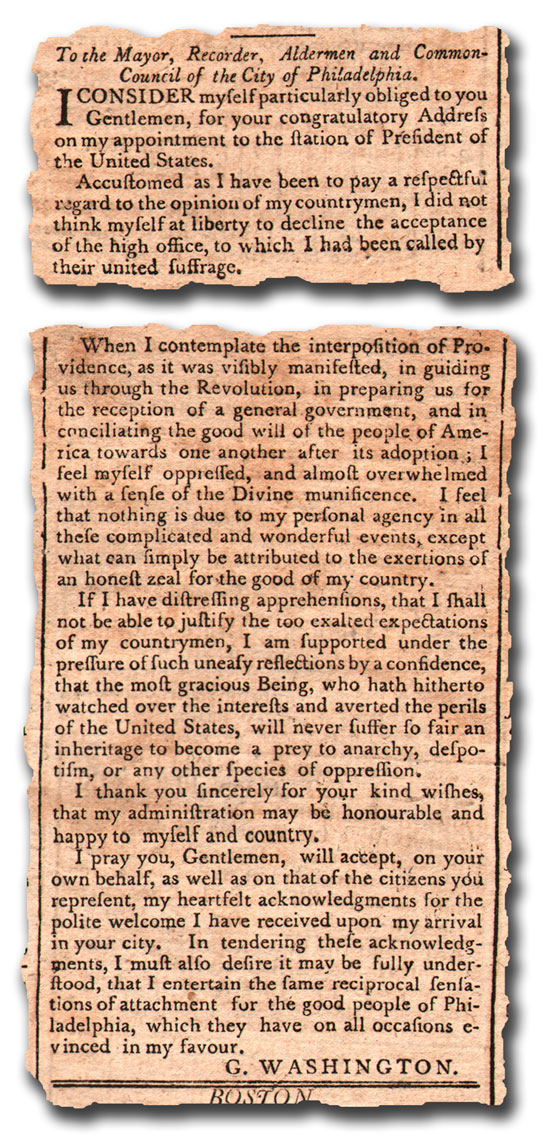
The first newspaper in Utah…
March 26, 2012 by TimHughes · Leave a Comment
The Mormons created a great migration to the West in 1847 as 2000 Mormons crossed the western plains seeking a location in which they could follow undisturbed the precepts of their religion. The first party reached the Salt Lake valley on July 24, 1847, and among the items they brought were implements, seeds, cattle, sheep, hogs, chickens, and a printing outfit purchased in Philadelphia.
At the time the area was owned by Mexico, but with the treaty of 1848 ending the Mexican ar ownership passed to the United States. With no steps taken by federal authorities to establish a system of government for it, the Mormons took matters into their own hands and in 1849 organized the “State of Deseret” (land of the honey bee) with Brigham Young as governor.
The very first issue of the “Deseret News” was printed on June 15, 1850 with Brigham Young noted as the publisher and Horace Whitney, who had printing experience at the Mormon town of Nauvoo, Illinois, listed as the printer. This newspaper continued for just over a year when it was suspended for 3 months due to lack of paper. It began as a weekly but four months later became a semi-monthly until 1854 when it again became a weekly. It eventually became a daily on Nov. 21, 1867. A sample of a volume 1 issues may be found at: Deseret News, August 17, 1850
It was in late 1858 when Kirk Anderson started the “Valley Tan” in Salt Lake City, lasting for just over a year. The “Mountaineer” was started on Aug. 27, 1859 and “Farmer’s Oracle” was a semi-monthly which began on May 22, 1863, both of which lasted for less than two years. A military newspaper titled the “Union Vidette” began on Nov. 20, 1863, done by soldiers stationed at Camp Douglass, a military post near Salt Lake City.
Start Spreading the News…
March 17, 2012 by GuyHeilenman · Leave a Comment
Stephanie Finnegan from TREASURES MAGAZINE – Antique to Modern Collecting recently interviewed Tim Hughes for an article which was printed in the February, 2012 issue. A copy of the article is below. Thanks and appreciation goes out to Stephanie for her fine work.


First newspapers in Tennessee…
February 27, 2012 by TimHughes · 3 Comments
 Tennessee–or at least a portion of it–had an interesting history. The Northeastern part originally belonged to North Carolina, and a plan was afoot to cede it to the national government. A serious of conventions at Jonesborough resulted in the adoption in 1784 of a constitution under the name of the state of Franklin. Ultimately statehood plans ended in 1788.
The first printing in Tennessee happened in Rogersville by George Roulstone, who on November 5, 1791 he printed the first issue of the Knoxville “Gazette“, because he intended to move the press to Knoxville when it was expected that town would be the permanent capital of the territory. This ultimately happened in 1792. He printed his first issue there on May 4, 1793 where it continued until 1797.
After a year in absence, Roulstone resumed the newspaper under the title of the “Register” with a subtitle of: “The Genius of Liberty“. After another year of lapse the “Gazette” was revived which in 1799 was consolidated with the “Impartial Observer“. A string of other newspapers begin in the early years of the 19th century.
First newspapers in South Dakota…
February 13, 2012 by TimHughes · Leave a Comment
The very first printing of any kind to be done in present-day South Dakota wasn’t until Sept. 20, 1858, relatively late for that section of the country. It was an election notice, and less than a year later the first newspaper appeared on July 2, 1859 titled the “Democrat“, printed in Sioux Falls. It published on an irregular schedule for less than a year when it was discontinued for lack of support. Reports are that the newspaper was revived as the “Northwestern Democrat“, however no copies under that name have survived. The press was destroyed by a band of hostile Sioux Indians in 1862.
 The second newspaper in South Dakota was the “Weekly Dakotian” begun in Yankton on June 6, 1861, by Frank Ziebach. A year later it was absorbed by its rival, the “Press“, becoming the “Press and Dakotan“, and a bit later the “Dakota Union“.
Note: Images are not currently available for any of the above… but will be added if/when they are available.
Perhaps the most famous 19th century title is “The Black Hills Pioneer” which was printed in Deadwood City beginning in 1876. It would be an issue in early August of that year that would report the death of Wild Bill Hickok while playing cards that would be one of the most sought after newspapers for any collection.
John Wilkes Booth appears at Ford’s Theater, in 1863…
January 30, 2012 by TimHughes · Leave a Comment
The November 4, 1863 issue of the “Daily National Intelligencer” contains a curious and ironic bit of reporting, page 2 containing a lengthy report on the appearance of the distinguished son of Junius Brutus Booth–John Wilkes–at the new Ford’s Theatre in Washington. The next column contains an innocuous letter signed in type by the President: A. Lincoln.
The facing page includes an advertisement for “Ford’s New Theatre!” noting the appearance for the: “…first and only time…the distinguished tragedian, MR. J. WLKES BOOTH in Schiller’s great master piece, the Robbers…”.
Of course no one could have suspected the tragic connection between these two famous names which appeared on the same page in the same newspaper, some one and one-half years before fate would find their names on the same page once again:
A gem in the American Antiquarian Society… The Michigan Essay…
January 14, 2012 by TimHughes · Leave a Comment
In celebration of its 20oth anniversary the American Antiquarian Society published a beautiful exhibition catalog titled “In Pursuit Of A Vision – Two Centuries of Collecting at the American Antiquarian Society”. Featured are a fascinating array of books, documents, maps & other paper ephemera, as well as several very rare & unusual newspapers we felt worthy of sharing with our Rare & Early Newspapers’ collectors (with permission from the A.A.S.).
 “Michigan Essay; or, The Impartial Observer“, Detroit Michigan, August 31, 1809
Isaiah Thomas devoted substantial space in The History of Printing in America (Cat.9) to a history of American serial publications, closing with an eight-page census of newspapers “Published in the United States in the beginning of the year 1810.” Thomas sought help in its compilation in March 1810 by placing a widely reprinted notice in The Massachusetts Spy, requesting publishers “to forward one or two of their papers … that the right titles of their several Newspapers, may be correctly inserted.” Many responded, and the newspaper issues sent to Thomas were later donated to AAS.
This example — the first and only extant issue of the first Michigan newspaper — arrived too late for inclusion in Thomas’s checklist. The manuscript notation on the side reads, “Utica, (N.Y.) Aug. 3d 1810. Mr. Thomas, Sir I send you this paper printed by a friend of mine to insert in your ‘History of Printing.’ If he sees your advertisement, he will send more, perhaps of a later date. Your obt. Servt. C.S. McConnell.” The Michigan Essay was printed by James M. Miller on Michigan’s first press, brought to Detroit from Baltimore in 1809 by Father Gabriel Richard. Most of the text is in English, but a few articles and advertisements are in French.