

Search
The Rare & Early Newspapers Hobby

Receive the Newsletter

Buy Historic Newspapers

Pennsylvania’s first newspapers…
December 12, 2011 by TimHughes · Leave a Comment
 It was only in Boston where a newspaper came off a printing press prior to any in Pennsylvania. It was 15 years after the “Boston News-Letter” of 1704 (not counting the one-issue run of Boston’s “Publick Occurrences Both Foreign & Domestick” in 1690) when, on December 22, 1719, Andrew Bradford began his “American Weekly Mercury” (see image) in Philadelphia, Pennsylvania’s first newspaper. This weekly would last until 1746.
But certainly the most successful newspaper in the colony, if not in all of colonial America, was the “Pennsylvania Gazette” begun in December, 1728 by Samuel Keimer. Within a year it was purchased by Benjamin Franklin. As Oswald notes: “…Under Franklin’s guidance, there appeared for the first time a colonial newspaper produced by a man of education who was in addition a capable printer, a versatile writer, and energetic news gatherer and an enterprising & resourceful businessman. This combination had the inevitable result of placing the “Pennsylvania Gazette” in the lead, and it thereby established a model for others to follow.” The “Gazette” would make Franklin a wealthy man and his name appeared on the imprint through 1765.
Pennsylvania has the distinction of having America’s first daily newspaper, the “Pennsylvania Evening Post & Daily Advertiser“, which started publication in 1775 as a tri-weekly and became a daily on May 30, 1783.
When did the “Gentleman’s Magazine” print the Declaration of Independence?
November 14, 2011 by TimHughes · 5 Comments
 Fellow collector Michael Gulvin asks a question which many other collectors may have wondered: “On what day of the month did the Gentleman’s Magazine for August, 1776 become available? We have a time-line for the American newspapers, and we know that the London Chronicle printed the Declaration in its August 17th issue, but do we know the actual date the Gentleman’s Magazine printed the Declaration of Independence for its August issue?”
Magazines typically published very late in the month shown on the title/contents page. With the “London Chronicle” publishing the Declaration of Independence in its August 17, 1776 issue, and presuming they had interest in publishing such a significant document as early as possible, it is presumed the Declaration was received in London very close to that date. Their previous issue was dated Aug. 15, so August 15-17 would be the presumed period when the document arrived in London. It is curious to note that the “London Gazette” never printed the Declaration of Independence.
Monthly publications are more difficult to pin down in terms of publication dates, however datelines of news reports found within offer great clues. The Historical Chronicle near the back of the August issue of the “Gentleman’s Magazine” has datelines beginning July 10 and the latest date mentioned is August 31, the very last day of the month. Obviously the magazine could not have printed prior to August 31, so the first day or two of September would be the presumed printing dates.
The same was true with American magazines as I recall the June, 1776 issue of “The Pennsylvania Magazine” had the very significant announcement that Congress had voted to approve the Declaration of Independence, with a dateline of July 2, 1776. Obviously that June issue was printed early the following month.
Condition and pricing…
October 10, 2011 by TimHughes · 3 Comments
 Many collectors may wonder what the relationship is between the condition of a newspaper and its price. Obviously the condition of a newspaper is subjective, and some problems bother some collectors more than others. But for issues offered through our company here are my thoughts as to how I price our newspapers:
* “Natural” faults are less of a problem than human-created. By this I mean problems with foxing (a darkening of portions due to the natural aging of the chemicals in the paper or the environment in which the newspaper was stored), folds, and minor edge tears. Such disfigurements are to be expected with newspapers of a certain age, and if considerable do affect the price but less so than other disfigurements. Even water staining I would consider a natural fault and can be excused as something to be expected and a minor problem if not causing loss of readability.
* Human-created disfigurements would include old tape mends & stains, trimming at the margins such that letters or words are partially shaved (caused when the bindery cuts too close to the text), lengthy tears into text, holes, portions clipped, etc. Such problems are annoying & could have been avoided with better care and I tend to discount the price of a newspaper more liberally than newspapers with natural faults. How much? It depends on the degree of the problem, so subjectivity is very important. If a newspaper has a noteworthy report which is not affected by the damage, it would be discounted less than had the notable report been affected. A small 2 by 1 inch piece clipped from the back leaf would be discounted less than a 2 by 10 inch clipped issue. A disfigurement to an inside page might result in a minimal price adjustment if the issue is offered for the displayability of the front page.
* Irregular margins, caused when a newspaper is improperly removed from a bound volume, will result in lowered values if the irregularity causes loss of type. Most irregular margins involve only the blank spine & the price adjustment would be minimal.
* Some damaged issues are relegated to our damaged pile to be sold in lots of 100 or more at a discounted price. But rare or historic issues are offered individually & priced according to the damage. Many collectors are attracted to damaged, discounted newspapers as they provide an opportunity for rare or historic reports at a much lower cost.
* Particularly bothersome to me are issues which are close-trimmed. Had the worker doing the trimming at the bindery been more carefully such faults could easily be avoided.
* Less bothersome are wear problems with “never bound” newspapers. Such issues are in their natural state as provided to the subscriber or sold on the newsstand, and logically tend to be more worn than issues taken from bound volumes. Such natural wear, when minimal, adds a certain patina to the item and would not detract from its value. For serious collectors, never-bound issues are preferable to issues from bound volume, but tend to be considerably less common.
* Guillotined issues, which are mechanically cut cleanly at the spine to facilitate microfilming, is a minor disfigurement if ample spine margin remains. Depending on the issue we might rejoin the issue at the spine with glue, rejoin using archival tape, or simply keep the issue loose.
* Repairing issues can be controversial. Some believe in repairing tears and others prefer they be left as is. In general I tend to repair rather than not repair. My primary reason is to prevent further tearing which can occur when a leaf is turned, as a tear is a weak spot which often gets worse when handling. We use a very thin strip of archival tape which does not stain and is almost invisible if properly used. When an issue is extensively repaired mention is made in the description. A newspaper’s price may be affected when archivally repaired, depending on the extensiveness of such repairs.
From the publisher of the Harper’s reprints…
August 29, 2011 by TimHughes · Leave a Comment
 While Timothy Hughes Rare & Early Newspapers’ archives contain nearly every issue of Harper’s Weekly… available for purchasing… all original… I suspect more collectors are aware of the “reissue” editions of Harper’s Weekly from the Civil War years, easily noted by: “THE REISSUE OF” printed just above the “H” in “Harper’s…” on the front page. Done 100 years after the Civil War, they were a successful educational tool in classrooms across the country.
I recently found this letter from the President of the firm which did the reprints, and thought it offers some interesting insight into the history of the reprint series. It is not dated, but I suspect it was written in December, 1861.
The end of the world… false alarm…
August 6, 2011 by GuyHeilenman · Leave a Comment
 A few years ago several collectors contacted us wondering if the end of the Rare & Early Newspapers collectible was at hand. They had just received news about Google’s newspaper digitizing project and wondered if this would lead to an end in people wanting to collect historic newspapers. “Might this be the end of the old newspaper’s collectible world?” We tried to reassure them them that collecting the actual newspaper from the day it was 1st printed/read as compared to reading digitized versions is akin to eating an ice-cream sundae rather than looking at a picture of one. No matter how perfect the picture of the sundae reproduces the look of an actual one, it can never compare to the real deal. Apparently, time has proven this to be so. 2011 brought news from Google announcing the end of the digitizing project. The date of the announcement is rather ironic. Please read:
Google Announces End Of Newspaper Digitizing Project
🙂 🙂 🙂
Ideas on how to collect Rare & Early newspapers…
July 30, 2011 by GuyHeilenman · Leave a Comment
 While we at Rare Newspapers’ History’s Newsstand Blog are committed to continually adding material to help support the hobby, every now and then we come across informative material produced by others. Just recently we found a set of videos related to the collectible produced by eHow.com. They may be viewed at:
http://www.ehow.com/videos-on_5949_collecting-comics-newspapers_-tips-strategies.html
Please enjoy!
First newspapers printed in Oregon…
July 18, 2011 by TimHughes · Leave a Comment
It was in 1843 when the great migration over the Oregon trail to the Pacific Northwest began, with some 3000 settling in Oregon City just a few years later. Located on the Willamette  River, this town became the Oregon Territory’s first capital.
It was also the location of the first newspaper in the territory, titled the “Oregon Spectator” which began publishing on Feb. 5, 1846. This newspaper changed hands several times, and one of its editors, George L. Curry, left the newspaper in 1848 to start the Oregon City “Free Press” printed on a press he crafted by hand out of wood and scrap iron. This newspapers lasted for less than eight months.
On June 8 in 1848, at Tualatin Plains, a religious newspaper was begun by the Rev. John Smith Griffin titled the “Oregon American & Evangelical Unionist“. By the early 1850’s Portland was being settled and numerous newspapers made their appearance, the first being the “Weekly Oregonian” on Dec. 4, 1850. As more migrated West, more newspapers (The Morning Oregonian & more) made their appearance in not only Portland but other settlement towns in the Oregon Territory. Oregon would become the 33rd state in early 1859. (credit: “Printing In The Americas”)
Rhode Island’s first newspapers…
July 4, 2011 by TimHughes · Leave a Comment
 This history of Rhode Island’s European settlements goes back to roger Williams in 1604 but it was no until well over 100 years later that Rhode Island got its first newspaper. It was on Sept. 27, 1732 when James Franklin begin the “Rhode Island Gazette“, but it lasted for only 20 issues. James Franklin also started the “New England Courant“, one of the first newspapers in Boston, and is perhaps most famous for creating an apprenticeship for his younger brother, Benjamin, who would go on to be a very successful newspaper publisher (among many other accomplishments) in Philadelphia.
It would be another 25 years before the next newspapers would be founded in Rhode Island, it being the “Newport Mercury” begun in that coastal town in 1758. Providence would have its first newspaper, “The Providence Gazette“, in 1762.
First newspapers in Oklahoma…
May 9, 2011 by TimHughes · Leave a Comment
The history of present-day Oklahoma is different from most states, as most of the district was set apart by Congress in 1834 for the occupation of five tribes of southern Indians who were taken there from 1820-1840. In 1889 part of the area was opened for white settlement, although a considerable number moved into the territory before lawful entry, causing them to to be called “Sooners”. Oklahoma did not become a state until 1907, the third last of the continuous 48 to do so (New Mexico & Arizona were the last).
 The first Oklahoma printing press came by way of Georgia & Tennessee where it published various Indian pamphlets. The first newspaper in Oklahoma was the “Cherokee Advocate” which began Se[pt. 26, 1844 at Tahlequah, printed in both English and Cherokee. It was preceded by one month by the “Cherokee Messenger” but it was more of a magazine than a newspaper, and it lasted for just 13 issues. The “Advocate” continued publishing–with some interruptions–for over 60 years.
The “Choctaw Telegraph” was issued at Doaksville in the Choctaw Nation near the end of 1848 but it did not last beyond a year. But it was then revived in 1870 and continued until 1907. Yet another newspaper was printed at Doaksville in May, 1850, called the “Choctaw Intelligencer“. Printed in both English & Choctaw it lasted for about a year. The other pre-Civil War newspaper was actually a high school publication called the “Cherokee Rosebud” and done by the students of Park Hill Female Seminary at Tahlequah. It began in 1848.
Antebellum American Newspapers… AAS…
April 11, 2011 by GuyHeilenman · Leave a Comment
Vincent Golden of the American Antiquarian Society, recently produced a video which describes the history and characteristics of Antebellum American newspapers. We thought our readers might enjoy this informative piece, from the Curator of the AAS: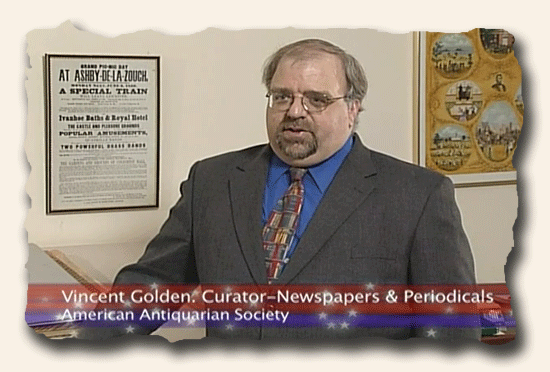
Antebellum American Newspapers from American Antiquarian Society on Vimeo.