
Search
The Rare & Early Newspapers Hobby

Receive the Newsletter

Buy Historic Newspapers

The magic of old newspapers, in 1844…
May 24, 2018 by TimHughes · Leave a Comment
 An 1844 issue of the “Adams Sentinel” (Oct. 14th) from Gettysburg, Pennsylvania, has an interesting front page item concerning the fascination of reading old newspapers, noting in part: “…few preserve them…brings up the very age, with all its bustle…marks its genius & its spirit more than the most labored description of the historical…” with more (see). An interesting perspective on the value of collecting old newspapers, written 174 years ago.
Women and baseball… Have things changed?
January 29, 2018 by TimHughes · Leave a Comment
 Even when when baseball was in its infancy the connection between women and baseball was worthy of comment in the “Porter’s Spirit of the Times” newspaper of Sept. 6, 1856.
Under the heading “Base Ball” which has much on a game played, are comments: “…and the attendance at each was not only very large, but made brilliant by great gatherings of ladies, whose interest in the sport seemed to be not at all short of that experienced by the most occupied observers of the other sex. We are inclined to think too, that this feature of these occasions has no little effect in inspiring the players in the games, and that the last energy of every contestant is taxed by the consciousness that he must win or lose in the minds of an exceedingly keen and scrutinizing class of lookers on. We are much pleased to see the beautiful and fair of this city lend the charm of their presence to the healthful out-door sports and exercises, and we have a shrewd opinion that more than one of them attends to ground with the view of sharply measuring among the players the qualities of what might make a serviceable future husband…”.
Political bias no stranger to today’s newspapers…
October 23, 2017 by TimHughes · Leave a Comment
It seems the polarizing of day’s media is greater than ever, but it is certainly nothing new under the sun. Practically since the creation of the first newspaper political opinion was a focus the publisher, supporting or opposing the efforts of those in power. And as popular as we view Abraham Lincoln today (he consistently ranks among the top three in scholarly polls) he was not liked by all during his time in office.
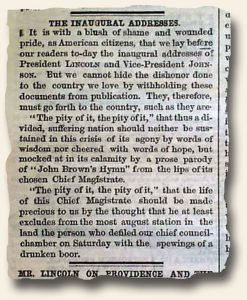 “The World” newspaper from New York City was the leading democratic organ at the time, while Lincoln was a Republican. In their issue of March 6, 1865 which reported his inauguration & inaugural address the editorial page contained at least two biting commentaries. One includes in part: “It is with a blush of shame and wounded price, as American citizens, that we lay before our readers to-day the inaugural address of President Lincoln…But we cannot hide the dishonor done to the country we love by withholding these documents from publication…The pity of it…that the life of this Chief Magistrate should be made precious to us by the thought that he at least excludes from the most august station in the land the person who defiled our chief council chamber on Saturday with the spewings of a drunken boor…”.
The other can be seen in the photos.
“Texas Made A Nation” was the result of Operation Longhorn…
August 17, 2017 by TimHughes · Leave a Comment
 Occasionally an “odd-ball” newspaper comes into our inventory, and our “Lampasas Dispatch” is certainly one. With a dateline of “Juvember 33, 1969” (not a typo on our part) and a banner headline announcing: “TEXAS MADE A NATION” we knew this wasn’t a legitimate newspaper. The masthead also includes: “For Maneuver Purposes Only—This Publication Created for Operation Long Horn–Not Intended For General Distribution.” So with a bit of searching on the web we soon learned of the story behind this newspaper.
See this website for much more on “Operation Longhorn“. The site begins: “In the spring of 1952, as Cold War tensions heightened, Lampasas Countians’ worst fears seemingly materialized, as “enemy troops” stormed the area, “captured” Lampasas and declared martial law. The U.S. military simulation, dubbed “Operation Longhorn,” was just a test…One of the largest peacetime military exercises ever implemented in the United States, Operation Longhorn took place in March and April 1952, and cost an estimated $3.3 million“.
This is just a single sheet with the reverse being page 8 of the “Lampasas Dispatch” April 3, 1952, coinciding with the date of Operation Longhorn. A fascinating fictitious newspaper from a long-forgotten event in American history.
They put it in print… aerial garage?
August 10, 2017 by TimHughes · Leave a Comment
Articles of the past century can bring up interesting changes in what words were used for various items, places, or events. An article on the Wright brothers from 1908 (The Omaha Daily Bee, Sept. 9, 1908) mentioned a curious term for what we commonly call a “hangar”, where airplanes are stored. The article reads in part: “…and on another trip flew over the ‘aerial garage’ where the aeroplane is housed…”. The quotation marks for “aerial garage” were the writer’s addition, as if the person did not know what else to call it, or perhaps the term “hangar” had yet to be commonly used. But “aerial garage would seem to be a more logical term! Wonder why it never caught on?
The photo below shows the full text of the article.
Fake Lincoln Proclamation… An attempt to profit in the gold market…
July 24, 2017 by TimHughes · Leave a Comment
The “Boston Daily Courier” of May 19, 1864, contains a fascinating sidebar in American history, the printing of a “fake” Lincoln Proclamation which appeared in two New York newspapers but was ultimately determined to be bogus. The “proclamation” is prefaced with a cautioning statement: “The document which made its appearance yesterday, purporting to be a proclamation of President Lincoln, is copied for the information of our readers:”, then the full text (see below).
This was a scheme by Joseph Howard, a newspaper journalist and a bit of a prankster throughout his career. Howard and an acquaintance had hoped to make a profit on declining gold prices if news from the front was bad. They acquired the stationery and other items necessary to make it look as if a story had come in on the wires to the headquarters of the Associated Press of New York, the clearing house for official wire stories coming from Washington. They forged the Proclamation from the president, which called for the drafting of an additional 400,000 soldiers, obvious evidence the war wasn’t going well. It was delivered to the offices of various New Your newspapers. Only two actually published the story but it caused such that Howard was arrested two days after the story appeared and placed in Prison. He was released on Lincoln’s personal order on August 24, 1864.
Death of Button Gwinnett: rare find in an American newspaper…
June 8, 2017 by TimHughes · Leave a Comment
The name “Button Gwinnett” is one most have never heard, yet his signature remains perhaps the most rare and valuable of all Declaration of Independence signers.
 Why? He was a relatively obscure figure prior to the war, and he died less than a year after signing the Declaration. Those who like to assemble a complete set of signatures of the 56 signers of the Declaration of Independence need his signature, and only ten are known to exist in private hands.
The reason for his early death after the 4th of July is a duel. He had disagreements with a rival military commander, Lachlan McIntosh, concerning a military defeat in Florida. Gwinnett & McIntosh blamed each other for the defeat and McIntosh publicly called Gwinnett “a scoundred and lying rascal.” Gwinnett challenged McIntosh to a duel which was fought on May 16, 1777. They exchanged pistol shots at 12 paces, both wounded, with Gwinnett dying of his wounds 3 days later.
The July 24, 1777 issue of the “Continental Journal” newspaper from Boston provides a very rare report of Gwinnett’s death by duel. This is the first we have encountered in an American newspaper.
Great to find an obscure report about an equally obscure but notable name from the Revolutionary War era.
*Error headlines make interesting collectibles…
March 14, 2017 by TimHughes · 2 Comments
Headlines of events that never happened offer a fascinating focus in the world of newspaper collecting. Unlike radio or television broadcasts where errors can be corrected in minutes, and without any “physical evidence” of the mistake, once ink is on the paper it cannot be retracted.
Certainly the most notable and desirable would be the famous Chicago Tribune mistake of November 3, 1948 which proclaimed in its early edition: “DEWEY DEFEATS TRUMAN” with issues in nice condition now extending well beyond the $1000 mark. Even in a later edition they continued the error but softening the headline by proclaiming: “G.O.P. WINS WHITE HOUSE!“, which I believe to be more rare than the more famous earlier edition.
One error newspaper which recently surfaced from our inventory comes with an interesting story, growing from the hysteria created by the surprise attack upon Pearl Harbor by Japan, which helped to usher in the U.S. involvement in World War II.
The Los Angeles Examiner “War Extra” of Feb. 25, 1942 proclaimed in large letters across its front page: “AIR BATTLE RAGES OVER LOS ANGELES“. Puzzled by the headline, as I wasn’t aware of any WWII battles reaching the shores of the United States, I did a bit of investigating.
The short answer is there was no air battle over Los Angeles. Just some hysteria run amuck. During the night of February 24/25, 1942, unidentified objects caused a succession of alerts in southern California. On the 24th, a warning issued by naval intelligence indicated that an attack could be expected within the next ten hours. Probably much of the confusion came from the fact that anti-aircraft shell bursts, caught by the searchlights, were themselves mistaken for enemy planes. In any case, the next three hours produced some of the most imaginative reporting of the war: “swarms” of planes (or, sometimes, balloons) of all possible sizes, numbering from one to several hundred, traveling at altitudes which ranged from a few thousand feet to more than 20,000 and flying at speeds which were said to have varied from “very slow” to over 200 miles per hour, were observed to parade across the skies. These mysterious forces dropped no bombs and, despite the fact that 1,440 rounds of anti-aircraft ammunition were directed against them, suffered no losses. There were reports that four enemy planes had been shot down, and one was supposed to have landed in flames at a Hollywood intersection. Residents in a forty mile arc along the coast watched from hills or rooftops as the play of guns and searchlights provided the first real drama of the war for citizens of the mainland. The dawn, which ended the shooting and the fantasy, also proved that the only damage which resulted to the city was such as had been caused by the excitement (there was at least one death from heart failure), by traffic accidents in the blacked-out streets, or by shell fragments from the artillery barrage. Go here to read the full text of this fascinating “battle” as provided by the “Virtual Museum of the City of San Francisco”.
Do you have any interesting error headlines in your collection? Feel free to share with others.
*Note: This post was originally posted on 11/11/2008.
A political cartoon from 1776 themed on the Revolutionary War…
February 23, 2017 by TimHughes · Leave a Comment
 Political cartoons are ever-present in our world today. It would be difficult to find a daily or weekly publication today without at least one. And they have been around for a long time–perhaps longer than you might think.
There was the occasional political cartoon in 18th century magazines, only a few of which are American-themed, and fewer still can be found as most have been removed years ago. Although we have had a few in years past, we recently purchased not only a very nice one, but one from a title difficult to find in today’s world of collecting.
The November, 1776 issue of “The London Magazine: Or, Gentleman’s Monthly Intelligencer”, not to be confused with the more common “Gentleman’s Magazine”. A full page plate in the issue has a very political cartoon themed on the Revolutionary War, captioned: “News From America, or the Patriots in the Dumps.” and shows Lord North standing on a platform holding a letter announcing successful campaigns by the British troops in America. A distraught woman, ‘America’, holding a liberty cap, sits at the base of the platform. Others present react to the news. There are several websites concerning this political cartoon, one of which can be seen here.
An internet idea, far ahead of its time?
February 13, 2017 by TimHughes · Leave a Comment
A fascinating article in the “St. Louis Globe-Democrat” of September 15, 1878 seems to include a man’s idea which is far ahead of his time. Only problem is he didn’t have access to the technological developments the next 125 years would provide.
The column heads announce: “The Newsograph” “A Most Remarkable Application of Edison’s Last Patent” “The Device of a Park Philosopher for Bringing the Word’s News To Every Man’s Home”. The article details an idea of bringing “verbal” news into every person’s home by using Edison’s phonograph patent, thereby eliminating the need for a physical newspaper (see below). A curious concept in light of today’s internet technology. Go to the link above for the full article.