

Search
The Rare & Early Newspapers Hobby

Receive the Newsletter

Buy Historic Newspapers

It’s a family affair…
January 31, 2009 by TimHughes · Leave a Comment
Just for fun… Another interesting report…
 A report in the CONNECTICUT COURANT of Hartford, April 16, 1790 notes:
“A gang of thieves, near 30 in number, which has for a long time infested Middlesex county, has lately been broken up. Thirteen of them, belonging to one family, were tried last week at Concord, from the Grandfather down to the grandchild.”
Before they became famous…
January 29, 2009 by TimHughes · 2 Comments
Part of the fun in collecting newspapers is finding reports in newspapers or magazines of the day about a person or event before it or they became famous. Typically such reports are very inconspicuous and brief, which adds to the excitement in making such a discovery.
 Such finds are not uncommon in this hobby. We have sold many issues of the installation in the Philadelphia State House steeple that which would become the physical manifestation of freedom –the Liberty Bell–as reported in a Gentleman’s Magazine of 1753. There are several mentions of political neophyte Abraham Lincoln from the 1830’s & 1840’s, well before he would be thrust into American history with the advent of the Civil War. Mentions of Davy Crockett from before his heroic death at the Alamo can still be found.
A recent find is equally as intriguing and perhaps more so as it is no small report. The SCIENTIFIC AMERICAN magazine of February 22, 1902 has most of a page taken up with a report of Wilbur Wright “…of Dayton, Ohio…” and his experiments with flight and includes not just one but five photos of his early machines. This was some 22 months before he and his brother would make their historic flight in Kitty Hawk, North Carolina, which would change the world forever.
This issue has languished on our warehouse shelves for many years only to be discovered by accident. Such are the joys of collecting! I hope all of you have experienced some exciting finds unnoticed by others.
What reports of historical people or events have you found which predate their greater moment of significance? Feel free to share.
From the private collection: a title to share…
January 26, 2009 by TimHughes · Leave a Comment
I have always be intrigued by unusually titled newspapers, and there are many from the past two to three hundred years.
 One from our private collection which is rather bizarre not just for its name but for its theme—analyzing the records of childhood deaths from the previous 100 years—is: “THE HISTORY OF CRADLE-CONVULSIONS” with an extended title including: “Vulgarly called Black and White Fits: Monthly Observations on the Weekly Bills of Mortality…” and even more (see photos).
The publisher uses the entirety of this single sheet newspaper to discussion the deaths of children, although modern translations are lacking as to what is meant by “cradle convulsions”, “black & white fits”, “gripes in the guts” or “convulsions of the bowels”, although one could guess. The text of the entire newspaper is shown here for your reading enjoyment.
Not surprisingly, a newspaper with such a morbid theme did not last long. In fact this issue “numb. 1” was the first and the last despite mention by the publisher of future monthly issues. According to Crane & Kaye this title is not held by any library in the United States.
Thoughts on the collecting of Obama inauguration newspapers…
January 21, 2009 by TimHughes · 2 Comments
It seems that with every election or inauguration I get asked about the collectability of such newspapers, so I thought I might share my thoughts with you, and encourage you to do the same.

USA Today – Obama Election & Inuguration
As for pure collectability, sure, election and inauguration issues are collectible because they document a very important part of American history and the democratic process. The smooth transfer of power from one person or administration to another does not come easily to many countries today. And to be able to add such historic issues to a collection for 50 cents or a buck is a great opportunity.
But I suspect the real interest of many who inquire about the collectability (of Barrack Obama election and inauguration issues) is the potential for such issues to increase in value. My opinion is, in general, no. They will not increase much in value in years to come. Now I’m speaking of “recent” history, say the last 30 years or so. I feel the public has become very collector-focused the last several decades, and many, many “historic” newspapers have been set aside in attics and drawers only to be found by their children many years later.
For a newspaper to appreciate dramatically in value I believe it requires several things: 1) Historic content. Yes, elections and inaugurations are historic; 2) Rarity. No, elections and inaugurations of the past 30 years are not rare because they were hoarded in large quantities and will always be relatively common; and 3) Something unique or dramatic. A “screaming” headline in tall, bold letters, or a cleverly worded headline, or something else which makes the issue unusual.
Supposedly the New York Times printed an extra one million issues of its January 21 inauguration issue, and I suspect most of them will be hoarded in quantity. The Washington Post printed a much larger quantity than normal, but they didn’t comment on the exact quantity. I’m sure it was sizable, and many of those issues will be hoarded. All this means that 20 years from now issues will be showing up on eBay (or its equivalent at that time) and anywhere else people might try to sell collectibles. With millions of such newspapers in the marketplace will the values get higher and higher? I doubt it.
Issues which tend to increase in value are those which were NOT saved. Most major headlines pre-World War II have appreciated nicely in value because they were not hoarded in quantities. I just don’t think the American public was collector-conscience then, so consequently they are genuinely rare in additional to being historic. And add a huge headline or terrific graphic and you have the potential for a very desirable newspaper; one which has appreciated nicely in value.
As an interesting side note, I understand that the New York Post printed a special afternoon inauguration edition on January 20. Given that most major newspapers are morning publications, coverage of the inaugural proceedings would be in their September 21 issue. But the Post had coverage in their January 20 issue, the same day as the election. A friend, stopping by a newsstand in New York city bought several issues of the Times of January 21 and noted a stack of other issues in the back. Inquiring what they were he was told it was the Post of the 20th, “…but they came in too late to be sold on the newsstand, so they will be returned. We can’t sell a day old newspaper…” the friend promptly purchased them all. I’d be curious to hear how many of the January 20 afternoon edition were actually sold on the streets and not returned for destruction. Perhaps that edition will have a real rarity component.
But don’t let this deter you from collecting historic events of the last 30 years and events yet to come. One of the great aspects of this hobby is the ability to assemble a great collection of truly historic newspapers at a nominal cost–at the newsstand price if you are lucky.
What are your thoughts?
Note: The Times News (out of Lehighton, PA) interviewed Tim concerning this topic. The article may be accessed at: http://www.tnonline.com/about
Most historic: 1784 thru 1800…
January 20, 2009 by TimHughes · Leave a Comment
Continuing with our discussion on the “most historic” reports to be found in newspapers, we have been discussing the events of American history by era, the last being the 1801-1860 era. This post will discuss the most significant event in American history of the post-Revolutionary War, 18th century era from 1784 thru 1800.
Much happened in American history during this brief 17 year period but I’m not so sure there are many events which qualify as the “most historic”. From 1784 to 1787 much effort was made to organize the loosely attached colonies into a cohesive whole (see Articles of Confederation as an example), which ultimately led to the Constitutional Convention and the resultant Constitution which remains to this day. Through the ratification process it was evident that more rights needed to be clarified, resulting in the Bill of Rights of 1789. During this same year the first presidential election happened and the federal government was established, and in subsequent years a permanent site was created for the federal government, the Native Americans’ concerns were dealt with as the nation crew beyond the original 13 states, The Whiskey Rebellion challenged the collection of federal taxes, Jay’s Treaty with England was consummated, and growing troubles with France & other nations put greater focus on formalizing a federal military. All these events and more played a role in molding America during these critical formative years.

The Constitution of the United States of America
But the most historic? My vote has to go with the creation of the Constitution. And a newspaper with the printing of this document would be a very prized addition to any collection.
What is your thought?
Campaign newspapers: a hobby within a hobby…
January 19, 2009 by TimHughes · Leave a Comment
Before the days of television, radio and certainly the internet, how did Presidential candidates get their platforms across the the electorate? Daily newspapers could not be counted upon as most were politically aligned with one of the parties so reporting had an obvious bias.
“Campaign newspapers” were one vehicle for candidates. Rather than rely on the ethics of the local publisher, parties produced their own newspapers during the campaign with the emphasis on the platform of the candidate. Logically such newspapers were short-lived and are relatively rare today as a result.
William Miles did a book titled: “The People’s Voice: An Annotated Bibliography of American Presidential Campaign Newspapers, 1828-1984” which lists chronologically and by party over 700 titles. The following is excerpted from his Preface:
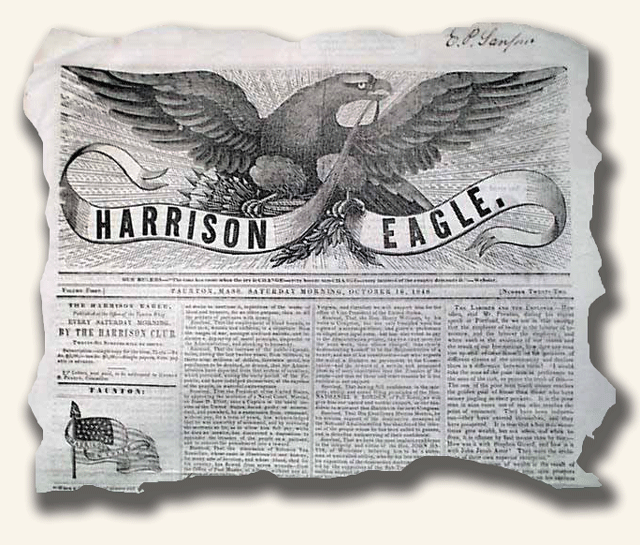 “Every four years since at least 1828 the campaign newspaper, like the campaign biography, song, poster, and similar election paraphernalia, has reappeared as a familiar part of the American presidential electoral process. Unlike the general party or partisan newspaper, these sheets were published specifically to support the cause of an aspiring candidate or an officially nominated ticket. Usually issued only during the period of the campaign itself, they were the campaign documents that emphasized the strengths and the importance of political organization at all levels; and to attack, generally in vitriolic language, the opposition. No matter if established and issued by party committees or by committed private individuals, or as “extras” and subsidized papers by already established partisan journals, the purpose was the same: organize the party faithful to work on behalf or electing the national, and by extension, the state and local tickets.”
Such elusive titles do provide an interesting array of titles including “Hickory Sprout” “Coon Hunter” “Harry Of The West” “Rebel Youth” “Hickory Tree” “On Our Way” “Rail Splitter” “Sober Second Thought” “Soup-Spiller” “Magician” “Grape Shot” “Rough & Ready” “Barnburner” “Dirty Shirt” “Kickapoo” and “Straight-Out Harrisonian” to name but a few.
Collecting campaign newspapers can be a fascinating hobby within a hobby, if only for the variety of titles available. Do you have any great-named campaign newspapers in your collection? Feel free to share.
An institutional need…
January 19, 2009 by TimHughes · Leave a Comment
One of our fellow collectors recently made the following inquiry seeking missing issues of an African-American newspaper from North Carolina. Not having any magical answers for him, I offer his request to all our customers in hopes someone might have a lead or suggestion. Feel free to respond through this blog.
African-American Newspaper–Durham, North Carolina
I’ve been casually interested in old newspapers and magazines for a number of years, and have regularly used them in my university classes (I recently retired as a professor of environmental policy at Duke, and often used them to document early conservation struggles.)
A few weeks ago, I got involved in a volunteer project at the historical collection of the Durham, NC county library, indexing microfilmed copies of a weekly African-American newspaper called the Carolina Times, published between 1927 and the present.
The content, especially in the 1930s and 1940s, is amazing. I had known a fair amount of Durham history, but was taken aback by the many specific injustices documented even here (supposedly one of the South’s most progressive cities) in the Jim Crow era. There is much original research still to be done, and the newspaper provides a vivid counterpoint to the local white media, which are also available.
Unfortunately, our microfilm lacks all issues between 1927 to 1937 and 1944-48. Also missing is the early version of the paper, the Durham Standard Advertiser, 1919-1927. Extensive searching reveals that no other library in the country has these issues, in any format (everyone has the same, incomplete, microfilm). I’ve used all my research skills to try to track them down, without success.
It would be a real contribution to both Durham history and African-American history to make this missing material available to scholars and others. Might you have any ideas? Private collectors? Archives that would not show up in the usual searches of libraries or internet troves. Peak circulation was 20,000 (in the 1940s) so it is not a completely obscure title. The paper’s offices burned in 1975, so the original archive was lost.
I can really recommend this kind of material to anyone interested in modern history. Any help with my own quest would be appreciated.
Collecting statehood newspapers…
January 12, 2009 by TimHughes · 3 Comments
There are many “series” of historical significance which lend themselves nicely to the hobby of collecting newspapers. Reports of presidential elections, presidential inaugurations, major military battles, state-of-the-union addresses, and an issue from every possible decade are but a few ways to create a collection with a common theme.
 Statehood newspapers are a logical theme for collecting as well. With states joining the union from 1787 until the mid-20th century a very wide range of dates and reporting styles are evident. The earliest official statehood events were when each ratified the Constitution and can be challenging finds, although we’ve offered most if not all through the years. Later statehood entries were typically inconspicuous and brief, which adds to the quaintness of reporting styles of the 19th century given their historical significance.
Of recent attention is the 50th anniversary of Alaska statehood which happened on January 3, 1959. Later this summer we will celebrate the 50th anniversary of Hawaii, the last state to Join the Union.
The search can turn up some interesting tidbits and provide some trivia facts which would surprise most. Do you realize that five states joined the Union in the 20th century? (Oklahoma, New Mexico, Arizona, Alaska, Hawaii). What was the last of the 48 contiguous states to join? (Arizona: Feb. 14, 1912). What was the first state beyond the original 13 to join the Union? (Vermont: 1791). What was the only state to join the Union during the Civil War? (West Virginia: 1863). What was the first state to join in the 19th century? (Ohio: 1803).
Search for such issues can be fun and interest will grow with each statehood report found.
What other “series” of events have you found interesting?
Ways to collect: beautiful mastheads…
January 8, 2009 by TimHughes · Leave a Comment
 When I started collecting early newspapers many years ago, beyond the intrigue of something printed hundreds of years ago I was struck by the engravings found in the mastheads of many newspapers. I am still intrigued today, and I’ll admit that many of the newspapers found in our private collection are there because of their masthead engravings, not for their historic content. As a dealer one of my frustrations in the early years was publishing a catalog which did not accommodate photos. Later editions had a select few (most still do) but now many of our pricier catalog issues can be viewed online. And of course any newspaper we sell on our website or our eBay Store has multiple photos, allowing us to share the beauty of masthead engravings of centuries past.
 Eagle engravings are a favorite of mine and the variety available from the 18th & 19th century has to number well into the hundreds. The photo shows an issue of the “The Eagle”, the title apparently so obvious that the words never appeared in the masthead (but see the top of the first column). This is a rare title from Castine, Maine which lasted for only two years.
Themes in masthead engravings have been a focus of many of our customers. One man only buys newspapers with engravings of people shaking hands, and surprisingly I was able to find several for him.
What masthead engravings intrigue you? Do you have a favorite?
Collecting spurs research, spurs “neat stuff”…
December 26, 2008 by TimHughes · 1 Comment
As all of you know reading old newspapers can provide an interesting perspective on history, and cause one to question what we remember from history class of long ago. And with the advent of the internet, verifying some “facts” as reported 100+ years ago can lead to even more intriguing footnotes to history which we’d otherwise miss.
One interesting tidbit came to light earlier today and is worth sharing. The NEW YORK TRIBUNE of Feb. 28, 1862 includes on the backpage a printing of the words and music with a heading: “A Song That Is Now Rather Popular”. I recognize the music as the “Battle Hymn of the Republic”, and was aware of the lyrics which began: “John Brown’s body lies a mould’ring in the grave…” and of course the well known chorus (see photos). I was also aware that Julia Ward Howe wrote the words to “Battle Hymn…” but a website provided an interesting backdrop:
 “In 1861, after a visit to a Union Army camp, Julia Ward Howe wrote the poem that came to be called “The Battle Hymn of the Republic.” It was published in February, 1862, in The Atlantic Monthly.
Howe reported in her autobiography that she wrote the verses to meet a challenge by a friend, Rev. James Freeman Clarke. As an unofficial anthem, Union soldiers sang “John Brown’s Body.” Confederate soldiers sang it with their own version of the words. But Clarke thought that there should be more uplifting words to the tune.
Howe met Clarke’s challenge. The poem has become perhaps the best-known Civil War song of the Union Army, and has come to be a well-loved American patriotic anthem.”
Equally as interesting was another site concerning the “John Brown” mention, which I always presumed to be a reference to John Brown of Harper’s Ferry fame. Apparently not so:
“During a visit to Washington in the autumn of 1861, poet Julia Ward Howe attended a public parade and review of Union troops. On her way back to Willard’s Hotel she found her carriage delayed by marching regiments. To spend some time, she and her cohorts in the carriage sang a few of the war songs so popular those days, among them, “John Brown’s Body,” which contained the provocative words, “John Brown’s body lies-a-mouldering in the ground…. His soul is marching on.”
Howe would have assumed that the John Brown of the song was the famous abolitionist. But the song belonged to a young Scotsman in the Massachusetts Volunteer Militia who shared Brown’s name.
The Scotsman was well aware of John Brown the abolitionist. Having the same name made him a prime target for many good-natured jokes. As the soldiers marched, they would hammer out, in folk-song fashion, the tune that Julia Ward Howe would later hear. Lines like “His Soul’s Marching On” were meant to tease the Scotsman. But as the catchy verse traveled to other units, it was known only as a song about the John Brown who was captured at Harpers Ferry. New verses were constantly added:
Old John Brown’s body is a-mouldering in the dust,
Old John Brown’s rifleís red with blood-spots turned to rust,
Old John Brown’s pike has made its last, unflinching thrust,
His soul is marching on!
The morning after hearing the song, Julia Ward Howe wrote her own words to the tune. Soon after, it was published in the “Atlantic Monthly” as “The Battle Hymn of the Republic.”
John Brown the Scotsman would not live to hear this version. He died early in the war, drowned in the Shenandoah River at Front Royal, Virginia.”
Just a few of the interesting tidbits of history one learns by reading old newspapers!