
Search
The Rare & Early Newspapers Hobby

Receive the Newsletter

Buy Historic Newspapers

Ten Golden Rules…
November 5, 2011 by TimHughes · Leave a Comment
The very first issue of “The British Workman” from 1856, our item 541456, contains a list of “Ten Golden Rules” which are as appropriate today as they were over 150 years ago:
Colonial newspaper founded by a woman… A rare find…
October 31, 2011 by TimHughes · Leave a Comment
A recent collection which came into our inventory included a rare title which didn’t strike me until I looked more closely.
 “Salem Gazette” is a somewhat common from the 18th century so I wasn’t surprised to see the title when quickly examining the collection. But then I noticed the date from the Revolutionary War, which I thought odd. Upon investigation I found there were actually four different newspapers titled “Salem Gazette“, one from 1774-1775, one from 1781-85, and one from 1790 thru the 19th century. These latter two are were quite familiar to me, but our issue was yet a fourth title, one which I had never encountered in 35 years, and this one lasted but 36 issues during the year 1781. But of greater significance was that the masthead noted it was published by a woman, Mary Crouch. See the hyperlink for much more on her fascinating life, but suffice it to say she was no stranger to publishing a newspaper as she had much experience in South Carolina.
The hyperlinked article mentions she took over the publication of her husband’s (Charles) “South Carolina Gazette” after he died in 1772. She then began her own newspaper, the “Charlestown Gazette“, in August of 1778. When the British occupied her town in 1780, being a staunch patriot, she moved north to Salem, Massachusetts, where she began publishing this “Salem Gazette” in 1781. The number we have is dated February 6, 1781 and is issue number 6 of the 36 published (see the hyperlink). Relatively few institutions hold any issues of this title, and only four issues of this date are held by institutions.
There were a number of women who published newspapers in the 18th century & virtually all that I could discover did so by continuing a printing business upon the demise of their respective husbands. One exception was Mary Goddard who published the “Maryland Journal” during her brother’s absence from 1774-1783. But Anne Catherine Green took over her late husband’s “Maryland Gazette” upon his death in 1767; Hannah Watson took over her husband’s (Ebenezer) “Connecticut Courant” upon his death in 1777; Margaret Draper took over the “Massachusetts Gazette” upon the death of her husband Richard in 1774; Clementine Rind took over “The Virginia Gazette” in 1773 when her husband William died; and Ann Franklin published the “Newport Mercury” upon the death of her son James in 1762. I am sure there are others as well.
From what I could determine Mary Crouch may well be the first American woman to create a newspaper, and she did so twice. Her first being the “Charlestown Gazette” and her second the “Salem Gazette“. Any research to the contrary would be gratefully received and shared with our fellow collectors.
Mark Twain on Mark Twain…
October 29, 2011 by TimHughes · Leave a Comment
This item, originally appearing in the “Edinburgh Scotsman” was picked up by the “Jerusalem News” issue of March 20, 1920.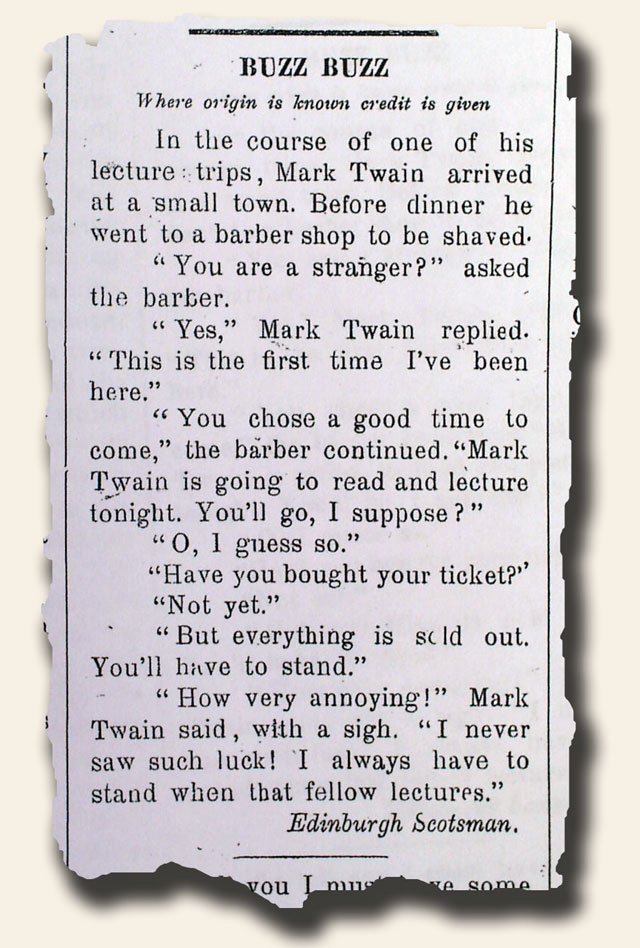
Collector Eric Fettmann on Babe Ruth & Yankee Stadium…
October 24, 2011 by TimHughes · 2 Comments
 Our website item #584134 offers a New York Times newspaper from 1914 which has the earliest mention of Babe Ruth in that newspaper, and possibly any newspaper. Has anyone found earlier mention? The listing also mentions a report of a new Yankee Stadium being built–with an illustration of it–but I could find no documentation of it elsewhere. Eric offers further information on both with his comments:
Tim,
Advice to the working men of England…
October 22, 2011 by TimHughes · Leave a Comment
The very first issue of: “The British Workman” from London, our item 541456, offers advice from Lord Palmerston, a British statesman and two-time Prime Minister of the United Kingdom, which included forward-thinking comments no the use of tobacco. The comments on alcohol are very appropriate today as well:
Condition and pricing…
October 10, 2011 by TimHughes · 3 Comments
 Many collectors may wonder what the relationship is between the condition of a newspaper and its price. Obviously the condition of a newspaper is subjective, and some problems bother some collectors more than others. But for issues offered through our company here are my thoughts as to how I price our newspapers:
* “Natural” faults are less of a problem than human-created. By this I mean problems with foxing (a darkening of portions due to the natural aging of the chemicals in the paper or the environment in which the newspaper was stored), folds, and minor edge tears. Such disfigurements are to be expected with newspapers of a certain age, and if considerable do affect the price but less so than other disfigurements. Even water staining I would consider a natural fault and can be excused as something to be expected and a minor problem if not causing loss of readability.
* Human-created disfigurements would include old tape mends & stains, trimming at the margins such that letters or words are partially shaved (caused when the bindery cuts too close to the text), lengthy tears into text, holes, portions clipped, etc. Such problems are annoying & could have been avoided with better care and I tend to discount the price of a newspaper more liberally than newspapers with natural faults. How much? It depends on the degree of the problem, so subjectivity is very important. If a newspaper has a noteworthy report which is not affected by the damage, it would be discounted less than had the notable report been affected. A small 2 by 1 inch piece clipped from the back leaf would be discounted less than a 2 by 10 inch clipped issue. A disfigurement to an inside page might result in a minimal price adjustment if the issue is offered for the displayability of the front page.
* Irregular margins, caused when a newspaper is improperly removed from a bound volume, will result in lowered values if the irregularity causes loss of type. Most irregular margins involve only the blank spine & the price adjustment would be minimal.
* Some damaged issues are relegated to our damaged pile to be sold in lots of 100 or more at a discounted price. But rare or historic issues are offered individually & priced according to the damage. Many collectors are attracted to damaged, discounted newspapers as they provide an opportunity for rare or historic reports at a much lower cost.
* Particularly bothersome to me are issues which are close-trimmed. Had the worker doing the trimming at the bindery been more carefully such faults could easily be avoided.
* Less bothersome are wear problems with “never bound” newspapers. Such issues are in their natural state as provided to the subscriber or sold on the newsstand, and logically tend to be more worn than issues taken from bound volumes. Such natural wear, when minimal, adds a certain patina to the item and would not detract from its value. For serious collectors, never-bound issues are preferable to issues from bound volume, but tend to be considerably less common.
* Guillotined issues, which are mechanically cut cleanly at the spine to facilitate microfilming, is a minor disfigurement if ample spine margin remains. Depending on the issue we might rejoin the issue at the spine with glue, rejoin using archival tape, or simply keep the issue loose.
* Repairing issues can be controversial. Some believe in repairing tears and others prefer they be left as is. In general I tend to repair rather than not repair. My primary reason is to prevent further tearing which can occur when a leaf is turned, as a tear is a weak spot which often gets worse when handling. We use a very thin strip of archival tape which does not stain and is almost invisible if properly used. When an issue is extensively repaired mention is made in the description. A newspaper’s price may be affected when archivally repaired, depending on the extensiveness of such repairs.
How Sitting Bull got his name…
October 8, 2011 by TimHughes · Leave a Comment
This interesting tidbit appeared in the “Pittsfield Sun“, Massachusetts, March 16, 1881 issue: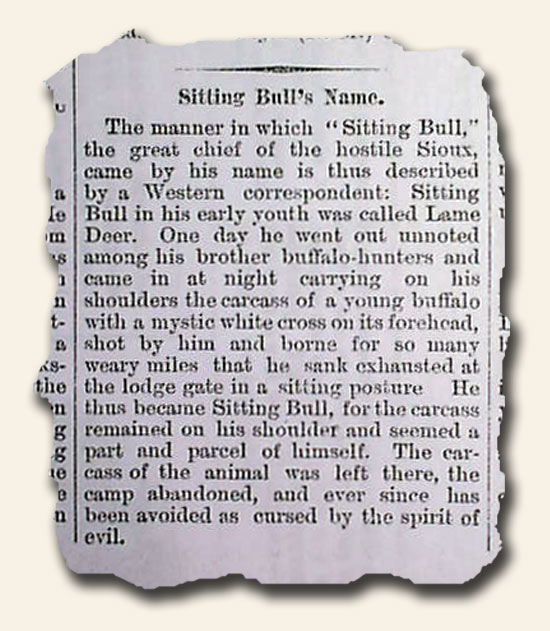
Newspaper publisher shows his bias…
October 1, 2011 by TimHughes · 1 Comment
This curious item appeared in “The Weekly Crescent City” newspaper from New Orleans, August 15, 1841. He goes to some length to show the value in paying for a subscription…
Few things change in politics…
September 24, 2011 by TimHughes · Leave a Comment
It’s interesting how, in some aspects of life, few things change over hundreds of years. Complaints about politicians not focusing on substantive issues was a problem back in 1790, in just the second year of the American federal government, as this article from the July 3, 1790 “Pennsylvania Packet“ of Philadelphia, clearly shows…
Before he would become “infamous”…
September 17, 2011 by TimHughes · 1 Comment
 Although the front page of “The New York Times” of Nov. 23, 1864 contains various reports on the Civil War as would be expected, the most intriguing item in this newspaper is an inconspicuous advertisement for a theatrical performance at the Winter Garden theater on page 7.
A one night performance was set for November 25 to benefit the Shakespeare Statue Fund. The performance featured the three Booth brothers, well known in the theatrical community: Junius, Edwin, and John Wilkes. This was the only time that the Booth brothers would appear on stage together.
Of course little did anyone know that less than five months later John Wilkes Booth would become one the more infamous names in American history with his assassination of Abraham Lincoln at Ford’s Theatre in Washington, D.C.
It is always fascinating to find mentions of notables in American history before they would become famous—or infamous.