
Search
The Rare & Early Newspapers Hobby

Receive the Newsletter

Buy Historic Newspapers

The Declaration of Independence…Our Lives, Our Fortunes and Our Sacred Honor…
July 4, 2026 by Laura Heilenman  Email This Post
|
Email This Post
|  Print This Post
 For roughly 5,000 years of recorded history, human civilization largely moved at a glacial pace. Empires rose and fell under kings, emperors, and tyrants. Most people lived under arbitrary rule, with limited rights, widespread slavery or serfdom, and slow technological and economic advancement. Then, in a remarkable burst beginning in the late 18th century, progress exploded, accelerated by the American Founding.
The Founders didn’t invent ideas from nothing—they synthesized the best principles from millennia of human experience, rooted in natural law, Judeo-Christian morality, English common law, and selective Enlightenment thought. They implemented these ideas into a new system of government that protected individual liberty and unleashed human potential like never before.
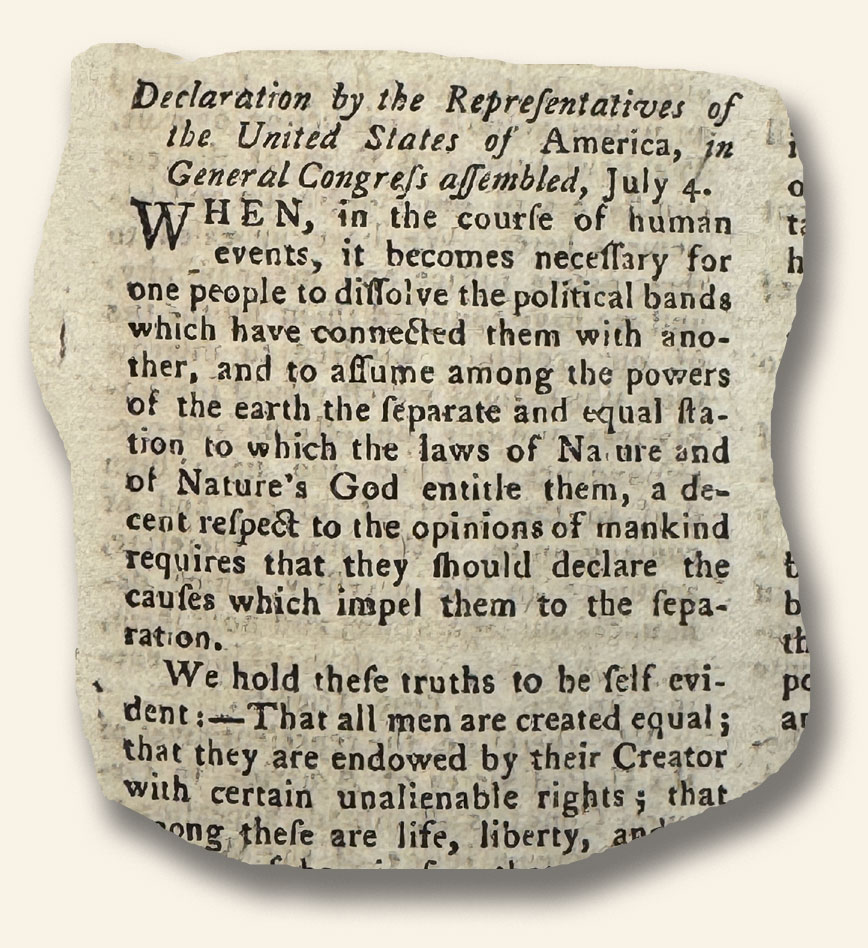
The intellectual roots of the Declaration of Independence (photo shown is from The Gentleman’s Magazine, London, August, 1776) stretch back thousands of years. Natural Law formed the bedrock with ancient thinkers like Aristotle and Cicero describing universal principles of justice discoverable by reason. Medieval Christian philosophers, especially Thomas Aquinas, integrated this with divine order. English common law and documents like the Magna Carta (1215) began limiting monarchical power and affirming rights.
Judeo-Christian traditions emphasized the inherent dignity of every person created in God’s image, moral accountability, and the idea that rulers are not above the law.
The Enlightenment provided key modern refinements. John Locke’s Second Treatise of Government (1689) powerfully argued for natural rights to life, liberty, and property; government by consent of the governed; and the right of the people to overthrow tyranny. Montesquieu influenced ideas of separated powers.
The American colonists, steeped in these traditions through education, sermons, and experience with British overreach, saw the Crown’s actions as violations of these timeless principles. They didn’t seek to create something entirely novel but to restore and perfect ancient liberties in a new republic.
The Declaration didn’t end history’s challenges, but it marked a turning point. By grounding government in natural law, consent, and unalienable rights—while building institutions around virtue, limited power, and free enterprise—the Founders created conditions where human potential could flourish as never before.
Below you will find the fruit of the painstaking assembly of thoughts these Founders labored through, searching history & the heart of their creator to lay a framework for all mankind. Today of all days, may we appreciate their singular focus on creating a republic that would last and inspire others.
Declaration of Independence: A Transcription | National Archives
If you liked this post, you may also enjoy...
- The Declaration of Independence – Jefferson’s Original Draft…
- A “hidden gem” within a 1785 newspaper leads to discovery, inspiration, and a correction…
- Stories Surrounding the Declaration of Independence… the Treason of Thomas Hickey…
- Most historic: The Declaration of Independence in your collection…
- More than just another anti-slavery newspaper… A recent find…
Comments
Feel free to leave a comment...
and oh, if you want a pic to show with your comment, go get a gravatar!