
Search
The Rare & Early Newspapers Hobby

Receive the Newsletter

Buy Historic Newspapers

Popcorn, Principle, and the Presidency: JFK’s Quiet Stand for Artistic Courage…
December 22, 2025 by GuyHeilenman · Leave a Comment
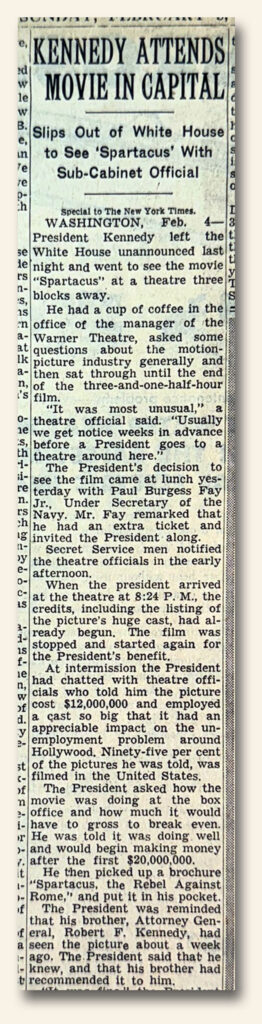 One of the many ways we build our database of key issues comes by way of requests from collectors? Case in point: A client recently asked if we had the February 5, 1961 issue of The New York Times which contained an inside report about President John F. Kennedy attending a movie at a local, D.C., public theater. Could such a report be significant; perhaps even collection-worthy? I immediately turned to the internet to see what I could find regarding this seemingly innocuous event. The following is a summary of what I discovered:
From the Silver Screen to the Oval Office: JFK’s Movie Night That Cracked the Blacklist
On February 3, 1961, just weeks after his inauguration, President John F. Kennedy quietly attended a screening of Spartacus at Washington, D.C.’s Warner Theatre. It may have looked like a simple night at the movies, but the moment carried deep cultural significance—marking the beginning of the end for Hollywood’s infamous blacklist.
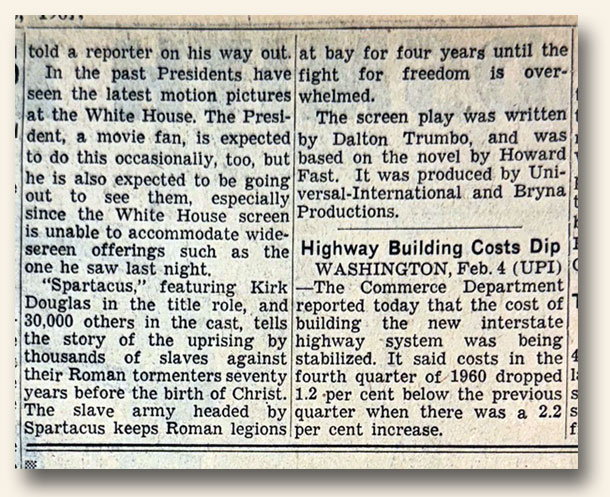
At the heart of the story was screenwriter Dalton Trumbo, one of the “Hollywood Ten,” who had been blacklisted during the McCarthy era for refusing to testify before Congress. For years, Trumbo wrote under assumed names, but Spartacus producer Kirk Douglas decided it was time to credit him openly, defying industry fear and government pressure.
Kennedy knew exactly what that meant. By attending the film—and later praising it—he effectively gave a presidential nod to artistic freedom and to those silenced by the Red Scare. That quiet gesture helped dismantle a decade of fear and restored a measure of integrity to Hollywood.
Symbolically, Spartacus’s story of rebellion and freedom echoed the challenges Kennedy himself would face in a world divided by the Cold War and rising civil rights tensions. What began as a night at the movies became a turning point in America’s cultural history—proof that sometimes the most powerful stands for freedom don’t happen on the battlefield, but in the back row of a darkened theater.
So the question remains: Is this newspaper collection-worthy? My vote is yes, but such a call is certainly subjective.