
Search
The Rare & Early Newspapers Hobby

Receive the Newsletter

Buy Historic Newspapers

The reason I collected it: an accordion fold newspaper…
January 23, 2026 by TimHughes · Leave a Comment
I’m sure I’ve commented before on the occasional need for “necessity” paper, meaning when supplies were restricted, printing conditions were stressed, or “siege” conditions prevented access to typical newsprint, publishers would be as resourceful as possible in finding something upon which to print.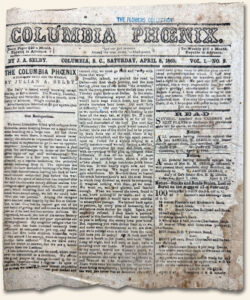 Not only was this issue (Columbia Phoenix, April 8, 1865) printed during the closing days of the Civil War, but due to the shortage of newsprint this publisher utilized short and uncommonly wide paper measuring just 8 3/4 inches high but over 24 inches long. As such it has an accordion fold which is unlike any other newspaper we have encountered.
During the Civil War, particularly in the South, securing newsprint was a common problem. During the closing days of the war, Columbia, South Carolina underwent siege conditions before it surrendered to Yankee forces on February 18, 1865. Although Columbia was occupied by Union forces on February 18 and largely destroyed by fire, this newspaper literally rose from the ashes [hence the phoenix title] and became the Confederate voice for the residents. So despite the city being in Union control, this newspaper kept its pro-Confederate leanings.
Information on the Library of Congress website provides further detail on this fascinating title and its Confederate publisher:
“The Columbia Phoenix arose out of the charred remains of Columbia, the capital city of South Carolina, in the aftermath of the Civil War to record its losses and bear witness to its gradual recovery. A triweekly newspaper, the Phoenix first appeared on Tuesday, March 21, 1865, mere weeks after fires had razed a third of the city. It struck a defiant tone, declaring, “Our city shall spring, from her ashes, and our Phoenix, we hope and trust, shall announce the glorious rising! God save the state!”
Proprietor Julian A. Selby boasted considerable experience in the newspaper business, having formerly owned the Tri-Weekly South Carolinian. In establishing the Columbia Phoenix, however, he literally started from scratch. In the weeks immediately following the city’s destruction, Selby scoured the state for paper, a press, and printing supplies. He and his assistants fashioned for themselves the things they could not find. He also secured the services of renowned Southern literary critic, novelist, and poet William Gilmore Simms as editor. Living conditions in the capital city were so desperate that, early on, the staff offered to accept food staples such as bacon, eggs, rice, and potatoes as payment in lieu of cash subscriptions. The first ten issues contained a detailed history of the burning of Columbia, which was separately published as Sack and Destruction of the City of Columbia, S.C., in October 1865 (itself edited and republished as A City Laid Waste in 2005).”
The content in this issue is great as well, being a few days after the fall of Richmond and just one day before Lee would surrender to Grant at Appomattox.
The front page has part 2 of: “Our Refugeeism” and some ads. Pages 2 and 3 are taking up with details of the: “Capture, Sack and Destruction of the City of Columbia” being chapters 30 thru 35. Half of another page is taken up with: “Evacuation of Richmond”. There is also an upbeat and obviously pro-Confederate report noting in part: “President Davis takes a right view of the results of the evacuation of Richmond. We have said elsewhere, that, in our opinion, it should have been evacuated long ago & that we should not have waited till this became a military necessity. The cheerful tones of President Davis is highly becoming…so long as the armies of Lee, Johnston and others are intact, they will speak and we trust to the purpose. God still rules in heaven.”
This issue is a fine example of the determination & resourcefulness of many early publishers.