
Search
The Rare & Early Newspapers Hobby

Receive the Newsletter

Buy Historic Newspapers

Thomas Jefferson helps to codify George Washington’s footsteps…
December 12, 2025 by GuyHeilenman · Leave a Comment
When it comes to collecting rare and early newspapers, those containing the text of presidential annual messages are quite desirable. While a handful are well known (Lincoln’s 2nd annual address, Washington’s 1st, Kennedy’s 1st, etc.), others fly well under the radar. A recently discovered broadsheet (Republican Argus, Extra, Oct. 16, 1808), containing Thomas Jefferson’s final address in 1808 brought this latter group to mind, yet, upon analysis in light of current events, seems to hold its own historically. The summary below, modified from multiple AI sources, is provided so you can draw your own conclusion. Enjoy.
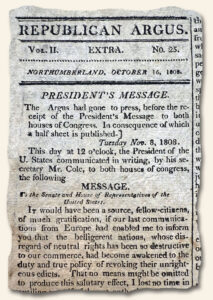
Thomas Jefferson’s Eighth Annual Message to Congress, delivered on November 8, 1808, came at the close of his presidency during a time of international conflict and domestic unrest. He used the address to defend the Embargo Act of 1807, which aimed to protect U.S. neutrality and avoid war with Britain and France by halting foreign trade. Despite its economic toll on American farmers and merchants, Jefferson maintained that economic pressure was preferable to military conflict. The speech also reflected ongoing foreign policy tensions, particularly regarding maritime rights, and the young republic’s efforts to uphold sovereignty amid European aggression.
Jefferson’s speech highlighted the challenges of maintaining neutrality, the importance of strengthening U.S. military defenses, and his vision for internal development, including peace through trade with Native American tribes. It also revealed the political friction of the time, with Jefferson facing criticism from both Federalists and members of his own party over the embargo and proposed federal infrastructure projects. This period of political division underscored deeper questions about the role and limits of federal power in a republic still defining itself.
Most significantly, Jefferson’s 1808 address signaled the end of his presidency and affirmed his decision not to seek a third term. Although he had announced this publicly in 1807, his final annual message served as a symbolic and practical demonstration of his commitment to republican principles. By following George Washington’s example, Jefferson helped establish the precedent that presidents should serve no more than two terms. This voluntary transfer of power reinforced the principle that no individual should hold executive power indefinitely, a safeguard essential to American democracy.
Jefferson’s choice not to pursue a third term, especially during a time of national strain, cemented a critical political norm that influenced every president until Franklin D. Roosevelt. The importance of this precedent lies in its protection against the concentration of power and its promotion of leadership rotation—core values in a constitutional republic. Jefferson’s 1808 address, then, is not just a reflection on policy but a foundational moment in American political tradition, ultimately leading to the formalization of the two-term limit through the 22nd Amendment.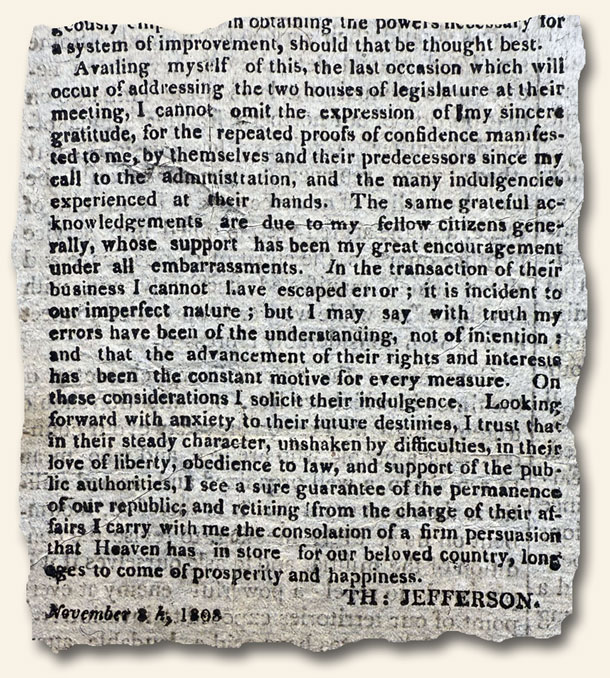
The more things change… Vaccinations and the immoral influences on children…
February 15, 2022 by Stephanie Williams · Leave a Comment
Currently, the whole world over is speaking of virus and antibodies, of carriers and immunization. Outbreaks are mapped in news blurbs, along with identified hot spots and constant status reports on flattening the curve. Comparisons are made to the “Spanish Flu”, but an article in a September, 1808 issue of The Gentleman’s Magazine led me to comparisons with smallpox instead. More specifically, they led me to the smallpox outbreak that eventually brought Edward Jenner into focus — he of the cowpox vaccination fame (or, infamy, as critics would have it).
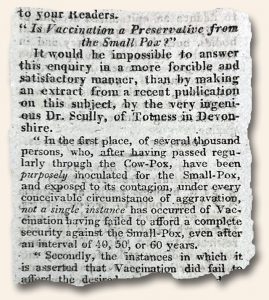 The mannerly Gentleman’s employs an ambitious article heading as it delves into the fray: “Practice of Vaccination Dispassionately Discussed.” As the Reverend Cotton Mather discovered in 1721, there is much passion involved in the subject. He, who pleaded for the adoption of the African method of inoculation to save the afflicted residents of Boston, was the object of threats and the target of a bombing. The periodical contributor, pen named “Cosmopolitan,” attempts a scholarly address of the merits just twelve years after Edward Jenner formalized the medical application of a controlled injection of the cowpox virus in order to immunize a human body against smallpox, which was disfiguring and killing people by the thousands.
After Mr. Cosmopolitan completes his summary of the beneficial relationship between the vaccine and the decreased virus contraction rate, he promises the editor, Mr. Urban, that as the science may not be completely convincing to all, he is prepared to offer testimonials in the next issue.
I was able to locate the fulfillment of that pledge in the October issue.
The facts which were there mentioned, must of themselves be nearly sufficient to convince an unprejudiced observer of the efficacy of the Vaccine preservative. It now remains to take an impartial review of the remaining part of the evidence on this interesting topick, which may be gathered from the experience of eminent individuals and from the avowed opinion of public bodies.
These are the same methods employed today about the still-controversial procedure of immunization — presentation of scientific data, followed by explanation of that data from medical professionals, and the promotion or recommendation of the practice by public officials. For the Coronavirus of today, the vaccine has not even been developed, and the debate is already heated.
PS This issue also has an article regarding juveniles obtaining access to “age-inappropriate literature” through libraries. Two current topics which reach back to the early 1800’s: “The more things change…”.