

Search
The Rare & Early Newspapers Hobby

Receive the Newsletter

Buy Historic Newspapers

Not written by the California Tourism bureau…
November 7, 2009 by TimHughes · Leave a Comment
The piece shown appeared in the “National Intelligencer” newspaper of Washington, D.C., December 25, 1847, although as noted it was reprinted from the “Detroit Daily Advertiser“. Some curious comments on California.

Celebrating 150 years since Arizona’s first newspaper…
November 2, 2009 by TimHughes · 2 Comments
The history of Arizona, an Indian word meaning “place of small springs”, goes back some 10,000 years B.C. with the arrival of the first Native Americans, while its history as recorded by Europeans dates to 1539 when the first white an, Marcus de Niza, a Franciscan friar arrived. It was organized as a territory in 1863 and admitted as a state in 1912, the last of the 49 contiguous states to join the Union.
Arizona’s first newspaper was the “Arizonian”, started at Tubac in March, 1859. Tubac lies about midway between Tucson and the Mexican border. For the following we credit Megan Thomas and the Chronkite News Service:
“For visitors at Tubac Presidio State Historic Park, (volunteer James) Pagels rolls ink and presses paper to metal to demonstrate a Washington Hand Press that was used to print the state’s first newspaper, “The Weekly Arizonian”. It still provides visitors with replicas of the paper.
“It’s living history,” Pagels said.
Arizona State Parks is preparing to celebrate the 150th anniversary of the arrival of the press in Arizona. Brought by ox cart from the Mexican port of Guaymas for William Wrightson of the Santa Rita Mining Co., the press turned out the first copy of the Arizonian on March 3, 1859, promoting the mining company and its agenda.
The “Arizonian” published out of Tubac for several months before moving to Tucson. According to an account by the late Douglas C. McMurtrie, a historian of printing in the U.S., the newspaper apparently ceased publication in the summer of 1860, resumed briefly in 1861 and resumed once again in 1867 – both times under different ownership – before finally folding for good in 1871. The press wound up in Tombstone, printing the Nugget newspaper for a time, and, according to McMurtrie, passed to the Arizona Historical Society in 1913.
Back home in Tubac and on permanent loan to Arizona State Parks, the press is a point of pride, said Joe Martinez, manager of the park.
“I think it’s amazing that the press came here in 1859 can still function today and we can show it to people and give them copies of the first edition,” Martinez said.
That edition describes attacks by Native Americans and crimes including horse thefts. It notes that stagecoaches were charging 40 cents to $1 per pound for extra baggage on runs between El Paso and San Diego. A section is devoted to the obituary of James Gadsden, who brokered the purchase from Mexico of nearly 30,000 square miles that are now part of southern Arizona and New Mexico.”
Wrappers and no wrappers…
October 1, 2009 by TimHughes · 1 Comment
 As regular customers have noticed, our only foray into the world of magazines is pretty much limited to 18th century titles. Magazine collecting of the 19th and 20th centuries is a world onto itself and there are many other dealers who make such items their specialty. I never felt a need to venture there.
Occasionally one will see our listings of magazines which note “with original wrappers” and perhaps wondered what this meant. Most magazines which were sold “on the street” came with a wrapper, or front and back cover, which was in addition to the typical title page of the magazine. Typically the wrapper would have a blue or blue-green tint. Some wrappers had a decorative embellishment and some had the table of contents. The reverse side of the front wrapper and both sides of the back wrapper commonly had advertisements, often for books or other publications offered by the printer.
But magazines with wrappers are rarely found. At least 98% of the 18th century magazines on the market today came from bound volumes. The volumes were created when libraries–whether personal or institutional–had an entire year’s edition of a title bound into book form for efficient storage & display on a bookcase. And many magazine publishers set aside extra copies of each month’s edition for binding and sale to patrons at the conclusion of each year. Since wrappers were considered superfluous they were almost always removed from the issues before being bound. The binding process also involved trimming the three exposed margins for a neater appearance. Consequently when loose issues became available to collectors centuries later through library deaccessionings, they were lacking the wrappers.

Those fortunate enough to find a magazine which survived the last several centuries without being bound may experience the great pleasure of having a magazine “as issued”, or with the wrappers intact and without the margins trimmed. Such find are quite rare.
I have discovered many over the course of the last 33 years, and have even had the pleasure to find an occasional bound volume of an 18th century title with the wrappers bound in, either with each of the monthly issues or grouped collectively at the back of the volume. Such wrappers would have trimmed margins, which is less then ideal, but wrappers with trimmed margins are far better than no wrappers at all. And perhaps in just one or two instances I encountered a volume with wrappers bound in and margins untrimmed.
In any case, magazines with wrappers intact are the goal for serious collectors of 18th century magazines. Not surprisingly such issues command a premium price, but their rarity also creates a high level of desirability.
“News Rooms”: a curiosity of the past…
September 21, 2009 by TimHughes · Leave a Comment
One last excerpt from Clarence Brigham’s book “Journals & Journeymen” is worthy of sharing with follow collectors as it explores a part of newspaper history of which most are unaware. The chapter is titled “News Rooms”:
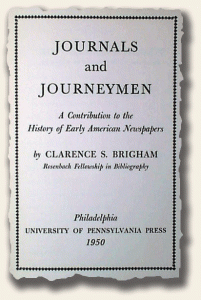 An interesting custom in newspaper history was the establishment in the early 1800’s of news rooms at nearly all of the larger towns. Somewhat akin to this idea was a project carried out at a much earlier day at Bridgeton, New Jersey. Here in December 1775, & continuing for two months, a weekly paper called “The Plain Dealer”, consisting of essays but with topics relating to the problems of the colonies, was written out in manuscript and posted up in Matthew Potter’s tavern. It enabled readers to gather at a central meeting place and peruse a weekly publication, which they would not trouble, or perhaps could not afford, to purchase.
Soon after 1800 reading rooms sprang up in several towns. In Boston the Anthology Reading Room was established in 1806, with 160 subscribers, and making available all the leading newspapers of the country. In 1808 Samuel Gilbert established at Boston what may have been the first commercial news room in the country. It was located in the Exchange Coffee House, erected in 1808, with its “Reading Room and Marine Diary” on the entrance floor where newspaper files could be consulted.
In New York, John H. Payne in 1811 opened a reading room where could be found the most important newspapers and magazines of the day. Charleston had a newsroom in 1813 where the terms were ten dollars for subscribers and strangers one dollar a month. In fact, almost every city and larger town before 1820 had its news room where leading newspapers were regularly filed. To enumerate them would require a lengthy chapter and necessitate an exacting study of early newspaper advertisements. Unfortunately there is no record of a new room proprietor preserving his files for posterity.
“New Series” of a newspaper…
September 7, 2009 by TimHughes · Leave a Comment
 A recent inquiry by a concerned customer about the words “fifth series” printed in the dateline of his “Niles’ National Register” prompted me to share my comments with our blog readers should you have similar concerns of such notes atop this and other titles held in your collection.
Through the life of any newspaper which lasted beyond ten years it would not be uncommon for the title to change, either slightly or dramatically. This could happen for a number of reasons, such as the merging with another newspaper, the purchase of the paper by a new publisher, new city of publication, an altering in the size, theme, or format of the newspaper, etc. While some titles made no note of such changes in their volume and issue numbering, some chose to create a “new series” and start anew with the volume & issue numbering.
 “The Weekly Register“, which began in Baltimore, chose the latter. The photos show five of the title or location changes in a 38 year time spread, not to mention size and type font changes as well. Note that its location moved from Baltimore to “Washington City” to Philadelphia.
Fortunately Niles chose to also retain the original volume numbering as well (right side of the dateline) as well as the “whole number”, or the number since the very first issue was published. Other titles did not choose to do so, making it more difficult to determine the newspaper’s age.
“Telegraph” newspapers prior to 1844?
July 20, 2009 by TimHughes · Leave a Comment
 It is commonly known that the magnetic telegraph was developed in 1844 by Samuel Morse, so perhaps you’ve wondered—like I have—why so many newspapers had the title “Telegraph” dating long before this date? Clarence Brigham in his book “Journals & Journeymen” provides some details.
Between 1792 & 1794 several systems of telegraphic signals were developed in England & France. They were dependent upon cross-bars pivoting into difference positions at the top of high poles.
In 1795 a paper was established at Carlisle, Pennsylvania, titled “The Telegraphe”. The first issue did a history of telegraphic experiments taken from British & French periodicals, & stated it was the first paper in America to use the title. This was true, but less than a month after the Carlisle paper’s beginning the “Fells Point Telegraphe” was established at Baltimore, and shortly thereafter newspapers in Charleston, Greenfield (Mass.), and again in Baltimore changed their titles to include the word “Telegraphe”. In the next five months another 4 newspapers incorporated this word into their titles.
By 1820 forty newspapers in America had employed this word into their mastheads, but the phenomena was almost entirely American. Curiously only 2 papers in London & Paris used the word in 1794 and none after that until later in the 19th century.
Definition of “half drunk” and “whole drunk”…
July 4, 2009 by TimHughes · Leave a Comment
 The Massachusetts Spy newspaper of Worcester, dated July 21, 1830, includes in interesting tidbit on the intoxication levels of four young surgeons in London.
Hobby trivia: most used newspaper titles…
June 29, 2009 by TimHughes · 1 Comment
 By far the most common of early titles were “Gazette” and then “Advertiser“. Between 1704 and 1820 “Gazette” was used either by itself or as part of a newspaper title 488 times. This was closely followed by “Advertiser” with 440 times, showing the deference which publishers paid to their advertisers who made up the greater part of a newspaper’s profit.
These two titles were followed by “Herald” with 115 times, “Journal” 114, “Intelligencer” 104, “Register” 86, “Republican” 77, “Chronicle” 75, “Patriot” 57, “Centinel” or “Sentinel” 56, and “Courier” 45.
Titles frequently used, but in lesser number, were “Eagle“, “Mercury“, “Messenger“, “Monitor“, “Museum“, “Observer“, “Post“, “Recorder“, “Repository“, “Star” and “Times“.
It is curious that “Times” was rarely used before 1820, and there is no mention whatever of “Tribune” or “Transcript“, all somewhat common within newspaper titles today.
(The above is excerpted from the book “Journals and Journeymen” by Clarence Brigham)
Don’t tell the Chamber of Commerce…
April 4, 2009 by TimHughes · Leave a Comment
 A brief piece in the “Niles’ National Register” newspaper of Baltimore, January 14, 1843, obviously came from a disgruntled visitor to the West:
“Capt. Kendall, in describing Santa Fe, says it is a little mud-built city, that stands between civilization and the jumping off place.”
If you’ve visited Sante Fe, New Mexico recently, you can certainly attest to the significant improvements which have been made since 1843.