
Search
The Rare & Early Newspapers Hobby

Receive the Newsletter

Buy Historic Newspapers

Countdown to “Newspapers that changed the world…”
October 24, 2012 by GuyHeilenman · Leave a Comment
Each month Timothy Hughes Rare & Early Newspapers releases a catalog containing a new set of historic and collectible newspapers (1600′s through 20th century). However, on November 1, 2012, at 12:01 AM ET, the special edition, “Newspapers that changed the world…” will be released. Whether you already collect newspapers, or desire to simply view a sampling of what the hobby has to offer, check back for this special occasion:
Prior to November 1, 2012 and after November 30, 2012, the link below will take you to the most recent offerings of Timothy Hughes Rare & Early Newspapers… History’s Newsstand! During the month of November it will take you to the special release catalog, “Newspapers that changed the world”.
View: “Newspapers that changed the world…“
Newspaper Confederate bank note creates a crisis…
October 1, 2012 by TimHughes · 2 Comments
Having recently come across the Feb. 24, 1862 issue of “The Philadelphia Inquirer” (see photo) it reminded me of what this innocent looking front page image of the Confederate five dollar note did in creating a crisis in the Confederate Treasury.
Several months ago the “Opinionator” blog of the New York Times did a very nice piece on the fascinating history of this note and its consequences, which we share with our collectors:
 In March 1862, an unusual ad began appearing in Northern newspapers. Among the shops selling pianos and patent medicines, sheet music and sewing machines, this one stood out: it promised “perfect fac-similes” of Confederate currency. There were seven kinds of notes for sale, and testimonials from The New York Tribune and others praising the replicas for their high quality and low prices. Five cents bought you one. Two dollars bought a hundred. Fifteen dollars bought a thousand. The word “counterfeits” never appeared. These were “Mementos of the Rebellion,” sold by a Philadelphia shopkeeper named Samuel Curtis Upham.
Upham didn’t look like a counterfeiter. He didn’t hide out in the woods or perform daring jailbreaks. He didn’t run from the police. He was a respectable small-business owner and devoted Northern patriot. He ran a store that sold stationery, newspapers and cosmetics. But he was also an entrepreneur with an eye for easy profit, and the Civil War offered the business opportunity of a lifetime: the ability to forge money without breaking the law. Confederate currency, issued by a government that was emphatically not recognized by the Union, had no legal status in the North, which meant Upham could sell his “fac-similes” with impunity.
Over the next 18 months he built the most notorious counterfeiting enterprise of the Civil War — one that also happened to be perfectly legal. His forgeries flooded the South, undermining the value of the Confederate dollar and provoking enraged responses from Southern leaders. He waged war on the enemy’s currency, serving his pocketbook and his country at the same time.
Upham first got the idea the month before, on Feb. 24, 1862. That day, customers kept coming into his shop to buy The Philadelphia Inquirer. Puzzled, he asked one of them what made that particular edition so popular. The answer was on the front page: the Inquirer’s editors had printed a copy of a five-dollar Confederate note. Philadelphians had never seen Rebel money before and were fascinated by it.
Upham saw a chance to cash in. He raced to the Inquirer’s offices, bought the plate of the note, and printed 3,000 copies on French letter paper. They sold extremely well. Along the bottom of each bill, he included a thin strip that read, in small print, “Fac-simile Confederate Note,” with his name and address. The tags could easily be clipped off, transforming the “fac-simile” into an excellent counterfeit.
After his first print run, Upham rapidly expanded his inventory. He took out ads in newspapers, promising to pay in gold for more specimens of Southern money. At first, it seemed possible that he sincerely thought of his reproductions as souvenirs. In early 1862, most Northerners still expected the war to be brief and glorious. They wanted “mementos of the Rebellion” before the Union crushed it. By the time Upham launched his publicity campaign in March, however, his business had clearly evolved from a modest retail operation into a high-volume wholesaling enterprise. No one needed 1,000 souvenirs: people were clearly using his products for a less innocent purpose.
By April, Upham’s fakes began appearing in Richmond, the Confederate capital. They caused a sensation at the Confederate Treasury Department, and a Treasury officer persuaded the editors of the Richmond Daily Dispatch to inform the public about the new threat. “This note is well calculated to deceive, and in nearly every particular is a fac-simile of the original,” they wrote, condemning the forgeries as “Yankee scoundrelism.” In May, the Dispatch discovered one of Upham’s notes with the margin bearing his name and address still attached. “Who is this man Upham?” they asked. “A knave swindler, and forger of the most depraved and despicable sort.”
By then, Upham had grown his business considerably. In an advertisement published in late May, he claimed to have sold half a million notes in the past three months. He now offered 14 varieties of Confederate notes, postage stamps, and “shinplasters” — fractional bills worth anywhere from 5 to 15 cents — and printed his fakes on real banknote paper. Ingeniously, he even fulfilled orders through the mail. For 50 cents, plus 18 cents for postage, customers throughout the Union could have a hundred of Upham’s notes delivered.
Southerners responded with outrage. They became convinced that Upham belonged to a covert Union plot to devalue the Confederate dollar. For the Philadelphia shopkeeper to be able to advertise his counterfeits openly and send them through the mail meant the authorities must have given him permission or, possibly, material support. Moreover, Union troops spent counterfeit Confederate cash in large quantities — evidence of “a deep laid scheme on the part of the thieving, counterfeiting North … to undermine the Confederate currency,” in the eyes of the Daily Richmond Examiner.
In the summer of 1862, Upham’s notes inundated northern Virginia, brought by Union forces marching south from Washington. A Southern journalist observed men “fortified with exhaustless quantities of Philadelphia Confederate notes,” which they used to buy everything from horses to sugar to tobacco. When one of the soldiers ended up a prisoner in Richmond, the Confederates found one of Upham’s advertisements on him. The shopkeeper’s counterfeits appeared “wherever an execrable Yankee soldier polluted the soil with his cloven foot,” fumed the Richmond Daily Dispatch.
By the summer of 1862, as fake cash flowed across the border in ever greater quantities, the Confederate leadership took notice. On Aug. 18, President Jefferson Davis discussed the threat in a message to the Confederate Congress. Counterfeit Confederate notes were “publicly advertised for sale” and furnished to “the soldiers of the invading army” with the full “complicity” of the Union government, Davis declared. Later that day, Confederate Treasury Secretary Christopher Memminger submitted a report to the House of Representatives that reiterated Davis’s concerns and singled out Upham’s role in the crisis: “[P]rinted advertisements have been found stating that the counterfeit notes, in any quantity, will be forwarded by mail from Chestnut street, in Philadelphia.” By then, forged bills had been found far from the Union border, in Atlanta, Savannah, Montgomery and other cities of the Deep South. There was “no means of knowing to what extent they have been circulated,” the Richmond Daily Dispatch warned.
Hamstrung by a disorganized government and mounting logistical challenges, the Confederacy couldn’t stanch the surge of counterfeit currency. Despite Southern claims, however, it’s unlikely that the Union government ever actively promoted the forging of Confederate money. Federal authorities most likely found it easier to ignore the forging of Southern bills than to take a position either for or against it. They certainly never interfered with Upham, who freely continued forging Confederate cash until August 1863. By that time, the value of the Southern dollar had fallen so low that it was hardly worth counterfeiting. During the 18 months that Upham operated his venture, the purchasing power of the Confederate dollar disintegrated. Between February 1862 and August 1863, the value of Confederate paper money fell by ninety percent.
Upham wasn’t the only reason behind this collapse. Fake cash plagued the Confederacy from the beginning, supplied by Northern and Southern counterfeiting gangs. Gross mismanagement of Southern finances led to runaway inflation, which posed an even greater danger to the Confederate dollar. But Upham’s impact was significant. He later estimated that he had produced $15 million worth of Confederate bills. If all of that ended up in the South, it would have made up almost 3 percent of the total money supply — a large amount for a single counterfeiter. In March 1862, his business had only just begun. Over the next year and a half, he would become one of the strangest success stories of the Civil War: a legal counterfeiter, driven by patriotism and personal gain, who struck at the financial heart of the Confederacy from the safety of downtown Philadelphia.
Civil War Era Newspapers on Pinterest…
June 29, 2012 by GuyHeilenman · Leave a Comment
 We at Timothy Hughes Rare & Early Newspapers have made a brief attempt at providing an overview of the Civil War via images of historic newspapers. These images may be viewed at: Rare Newspapers on Pinterest. We invite you to join with us in telling the story by going to www.rarenewspapers.com to find additional issues you believe should be added to “the story”. Feel free to provide us with the item number(s) of any you would like to have added. You may contact us by responding to this post or by e-mail (guy@rarenewspapers.com).
Southern Illustrated News images on Pinterest…
April 20, 2012 by GuyHeilenman · 2 Comments
 The Southern Illustrated News (Richmond, Virginia) was the Confederate counterpart to Harper’s Weekly Illustrated (NY, New York). While its distribution and duration were limited, the issues have become quite collectible. Portraits of Stonewall Jackson, Robert E. Lee, John S. Mosby, J.E.B Stuart, John H. Morgan, along with nearly every other notable figure from the Confederacy adorned the front page of this highly sought-after publication. Rare & Early Newspapers has taken on the task of posting images of every issue on Pinterest. While this project may take years, feel free to enjoy the progress to-date at: The Southern Illustrated News on Pinterest.
The Civil War… 150 years ago… March 1, 1862…
March 1, 2012 by GuyHeilenman · Leave a Comment
 An ongoing reflection on the Civil War… 150 years prior to this post…
Arkansas, Tennessee, Virginia, North Carolina, Ohio… where was this war being fought? How are our loved ones doing? Are they near live action? Are they even still alive… or perhaps injured? Is the war coming to me? Are we safe? Will soldiers harm civilians? Will we ever be able to visit our relatives on the other side again? Would they even want to see us? What does all this mean? Today we look at original newspapers printed for March 1, 1862, and try to understand what it was like to walk in their shoes. Please enjoy:
Original Newspapers Read On March 1, 1862
“History is never more fascinating than when it’s read from the day it was first reported.”, Timothy Hughes, 1976
The Civil War… 150 years ago… February 8, 1862…
February 8, 2012 by GuyHeilenman · Leave a Comment
An ongoing reflection on the Civil War… 150 years prior to this post…
 150 years ago today, citizens, from both the north and the south, sat down over a cup of coffee (if they were lucky) to read newspapers telling of the capture of Fort Henry, the Battle of Mill Spring, the available (advertisement) speech by Frederick Douglass, and more, while perhaps looking over large detailed maps of related regions. The daily newspaper was their connection to the events touching nearly every household in America. Enjoy a glimpse of the issues printed for the day:
Original Newspapers Read On February 8, 1862
“History is never more fascinating than when it’s read from the day it was first reported.”, Timothy Hughes, 1976
The Civil War… 150 years ago… February 1, 1862…
February 1, 2012 by GuyHeilenman · Leave a Comment
An ongoing reflection on the Civil War… 150 years prior to this post…
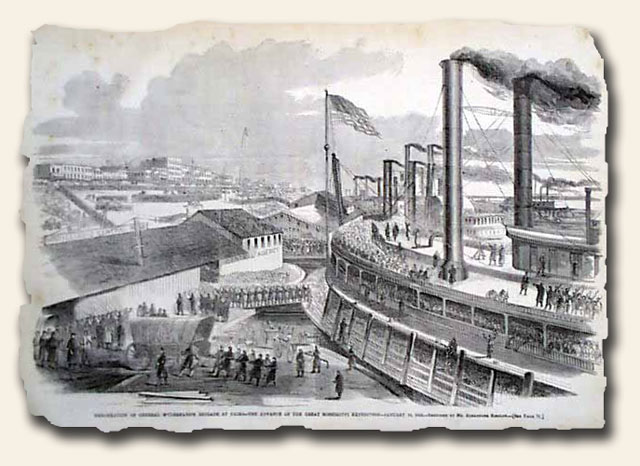 On February 1, 1862, the following issues were all held… and read… by those living during the American Civil War. Feelings of fear, sorrow, and uncertainty were prevalent as readers searched for news which would provide a glimmer of hope that loved ones would be safe, the greater good would prevail, and soon all would be well. Experience a glimpse of their world as you browse through the following:
Original Newspapers Read On February 1, 1862
“History is never more fascinating than when it’s read from the day it was first reported.”, Timothy Hughes, 1976
John Wilkes Booth appears at Ford’s Theater, in 1863…
January 30, 2012 by TimHughes · Leave a Comment
The November 4, 1863 issue of the “Daily National Intelligencer” contains a curious and ironic bit of reporting, page 2 containing a lengthy report on the appearance of the distinguished son of Junius Brutus Booth–John Wilkes–at the new Ford’s Theatre in Washington. The next column contains an innocuous letter signed in type by the President: A. Lincoln.
The facing page includes an advertisement for “Ford’s New Theatre!” noting the appearance for the: “…first and only time…the distinguished tragedian, MR. J. WLKES BOOTH in Schiller’s great master piece, the Robbers…”.
Of course no one could have suspected the tragic connection between these two famous names which appeared on the same page in the same newspaper, some one and one-half years before fate would find their names on the same page once again:
The Civil War… 150 years ago… January 25, 1862…
January 25, 2012 by GuyHeilenman · Leave a Comment
Today we continue our look back on the Civil War as reported within the newspapers held by those living during the Civil War… 150 years ago to-date (of this post). While many of the issues shown below are no longer available for sale, reading a snap-shot of what was printed for the given day will hopefully provide a glimpse of life during the critical period in American history. Each link shown will take you to the full description w/ images of authentic issues which were held by those living during the Civil War. Today’s selections are:
HARPER’S WEEKLY, NY, January 25, 1862 This issue features a nice full frontpage illustration entitled ‘Little Mac Out Again’ which shows McClellan on horseback. A fullpage features two halfpage illustrations ‘Fort Holt, Kentucky, Opposite Cairo’ and ‘Commodore Foote’s Gun-Boate Flotilla on the Mississippi’. A fullpage “Bird’s-eye View of the Vessels Composing the Burnside Expedition at Fortress Monroe, and Showing Norfolk and Its Approaches”. A halfpage “Map Showing Pamlico and Albemarle Sounds, and the Approaches to Norfolk From the South”. A very nice double page centerfold ‘Grand Reception at the White House, January, 1862’ shows Lincoln & many from the military. A half page “Embarkation of Part of General Burnside’s Expedition at Annapolix, on Board the ‘Hussar'” and a nearly half page “Execution of private Lanahan, of the Regular Army, for Murder, at Washington”. A full page “Birds-Eye View of Bowling Green, Kentucky, and Its Approaches”. A 1/3 page “War Map, Showing the Theatre of Operations of the Mississippi Expedition and General Buell’s Army. The back page features two political cartoons.
The Civil War… 150 years ago… January 18, 1862…
January 18, 2012 by GuyHeilenman · Leave a Comment
Today we continue our look back on the Civil War as reported within the newspapers held by those living during the Civil War… 150 years ago to-date (of this post). While many of the issues shown below are no longer available for sale, reading a snap-shot of what was printed for the given day will hopefully provide a glimpse of life during the critical period in American history. Each link shown will take you to the full description w/ images of authentic issues which were held by those living during the Civil War. Today’s selections are:
 Harper’s WEEKLY, Jan. 18, 1862 Ftpg. shows; ‘Fort Royal Ferry, Scene of the Battle of First Jan.’ & ‘Scene in the Parlor of Mr. Barnwell’s House at Beaufort, S.C.’ shows a Black family lounging & playing the piano. Fullpg: ‘The Vessels of Gen. Burnside’s Expedition at Annapolis’ halfpg: ‘The War In Va.–A Reconnaissance in a Laurel Brake’ ‘ & ‘Bringing In Rebel Prisoners’ & ‘The Union Prisoners at Richmond, Va.’dblpgctrfld: ‘The City of Richmond, Va.’ fullpg. by Winslow Homer: ‘The Skating Season’