
Search
The Rare & Early Newspapers Hobby

Receive the Newsletter

Buy Historic Newspapers

In the beginning…
June 8, 2009 by TimHughes · 1 Comment
 Some collectors like to pursue a newspaper from each of the original thirteen colonies, and ideally one dated as close as possible to the beginning of that colony’s first newspaper. For those active in this pursuit, we offer this list of the earliest in each.
Although the first newspaper in America was published in Boston in 1690, Benjamin Harris’ “Publick Occurrences Both Forreign & Domestick” lasted by a single issue before being suppressed by the Royal authorities. The first successful Massachusetts newspaper–and the first in all of the colonies–started 14 years later in 1704, also in Boston, titled “The Boston News-Letter” which continued until the British occupation of the city in 1776.
Here are the remaining colonies and the newspaper titles. As you see, originally in titles was not a strength among the newspaper publishers:
American Weekly Mercury (Penna.), 1719
The New York Gazette, 1726
The Maryland Gazette, 1728
The Rhode Island Gazette, 1732
The South Carolina Gazette 1732
The Virginia Gazette, 1736
The North Carolina Gazette, 1751
The Connecticut Gazette, 1755
The New Hampshire Gazette, 1756
The Newport Mercury (Rhode Is.), 1758
The Georgia Gazette, 1763
The New Jersey Gazette, 1777
It may seem curious that New Jersey was the last of the colonies to have its own newspaper, however given its location between the major metro areas of New York and Philadelphia there likely wasn’t an incentive to create its own until much later than the others.
Resources… The Library of Congress…
May 26, 2009 by GuyHeilenman · 1 Comment
 The Library of Congress has a wonderful collection of original newspapers along with an extensive digitized database of American titles. An informative website is maintained in an effort to provide useful information related to rare and historic newspapers. They describe themselves as:
“The Serial & Government Publications Division maintains one of the most extensive newspaper collections in the world. It is exceptionally strong in US newspapers, with 9,000 titles covering the past three centuries. With over 25,000 non-US titles, it is the largest collection of overseas newspapers in the world. Beyond its newspaper holdings, the Division also has extensive collections of current periodicals (70,000 titles) comic books (6,000 titles) and government publications (1 million items).”
Some of the features to be found at their Newspaper Division’s website are webcasts, a searchable data base, full text versions of many newspapers and periodicals, and a link to their ongoing project “Chronicling America”. Although we at Rare Newspapers maintain an extensive list of common reprints (thanks to Rick Brown at HistoryBuff.com) the Library of Congress also has an abbreviated list of common reprints with descriptions as to how one can determine whether their issue is authentic… or not.
Thanks L.O.C. for your ongoing efforts on behalf of historic newspapers.
My Story… Carl Aspler…
May 14, 2009 by GuyHeilenman · Leave a Comment
 For me, I love history and the first time I came across an old paper (I think it was the coronation of George V in 1911), I was smitten. I loved reading the headlines as they were years ago.
In the 80’s I also began collecting antique maps (also my love of history and discovery), and these took over for a while. Now I have antique maps and newspapers!
What gets me excited about the old news is to enjoy the personal connection that people make with the various stories. For example I used to keep a number of the front pages framed in my office at work. One day, a colleague came in and told me how he had admired the “Titanic Sinking” headline. This fellow, originally from Northern Ireland, told me that his father worked at the Belfast shipyard that built the ship, and that he had actually worked on the building of the Titanic. After thinking about it for a while, I gave him the paper. It meant a lot to him, and we all had a few tears in our eyes.
On another occasion I was talking to a friend and discovered that his father had been a soldier in the Canadian Army and had participated in the ill-fated Dieppe Raid in 1942. His father was captured by the Germans and spent the rest of the war in a Prisoner Camp. When I showed his the newspaper from a few days later, mentioning his father as “missing in action” it was also a very moving moment. I decided that I can live without it, and gave it to him.
Yet another time I mentioned to someone in the Salvation Army that I had a paper describing the sinking of the Empress of Ireland in 1914. The ship was on it’s way to an international congress of the Salvation Army. Most of the 150 members of the Army on board were drowned as was the Salvation Army Band. This was a difficult time for the Army (in fact the band was not reconstituted until 1969). I donated the paper to the Salvation Army museum, where more people can appreciate the story.
I also amaze my family from time to time. A few months ago, my teenage daughter was doing a history project on the London Blitz of 1940. I offered to loan her a front page describing the German first bombing assault on London. She originally wasn’t sure that people would be interested in an old newspaper. The fact that everyone thought it was “so cool” also gained me extra points with my daughter…
– – – – – – – – – – – – – – – – – – – – – – – – – – – – – – – – – – – – – – – – – –
Thanks for sharing your story Carl. If you would like to share your story of how you became interested in collecting rare and/or historic newspapers, e-mail it to guy@rarenewspapers.com and place “My Story” in the subject field. Although not necessary, feel free to include an image. Please do not include your e-mail address or a personal website as part of the text of your story. We will post collector stories every few weeks and will send you a notice when your story appears. Thank you for your contribution to the community.
Why does my newspaper look as if it came from a book?
April 30, 2009 by GuyHeilenman · Leave a Comment
 This is a common question many newcomers ask upon their 1st encounter with a rare newspaper from nearly every era (Revolutionary War, Civil War, Old West, and even Birthday/Day-You-Were-Born issues, to name a few). Whether it is the rough left spine present from the issue being removed from a larger volume, or the consecutive numbering which results in only the first issue printed during the year to have a “page 1”, a novice’s immediate (and logical) reaction is that the issue must have come from a book and therefore must be a reprint. However, the truth is actually the opposite. Such signs are good indicators that the issue is likely authentic. To understand this, what is needed is a knowledge of how historic newspapers and magazines were handled up to as late as the 1960’s.
 Many publishers of early newspapers started numbering their pages from 1 at the start the year and continued with the consecutive numbering throughout the year. This made it very easy to reference content. Examples of early well-known titles which did this are Harper’s Weekly, The War, Gentleman’s Magazine, Niles’ Register, and Leslie’s Illustrated, to name a few. Although this gave the newspapers a book effect, early readers would not have given this another thought. As far as the spine residue/disbinding evidence (which gives the appearance that the issue came from a book) is concerned, nearly every institution which held rare newspapers bound them together at the end of each year for protection & permanent storage in libraries. Almost all newspapers through the 1960’s were held in this manner. Your local library likely holds its early newspapers in this form. Two resources which may alleviate any concerns you might have related to this issue are the Library of Congress’ Newspaper Division & the American Antiquarian Society. HistoryBuff.com also provided additional information regarding this topic.
Great reference work for pre-1821 American newspapers…
April 27, 2009 by TimHughes · Leave a Comment
 We are often asked about appropriate reference books for rare newspaper collectors, particularly when it comes to relative rarity of newspapers. When one encounters an early title not seen before, how can we judge how rare or common it might be?
Thankfully for all collectors, Clarance Brigham undertook an exhaustive 30 year project to record all know issues of every newspaper title printed in the United States prior to 1821. This effort, published by the American Antiquarian Society (Brigham was directory of the Society) back in 1947, is titled: “History & Bibliography of American Newspapers 1690-1820“, a two volume set with some 1500 pages in total.
This work lists all American newspapers from the noted timespan, by state, then by city, then by title. The true value of this work is the brief historical account of each title with the exact dates of changes of titles & names of publishers, followed by a checklist of all files located. This last piece is what reflect relative rarity. If a title has just one or two holdings in institutions, and only a few issues within these institutions, then it would be consider rare. If a title has 15 institutional holdings noted, and complete or near complete holdings within those institutions, the title might be considered common.
This set has been out of print for many years, including the more recent edition done in 1975, but they occasionally come up on eBay or web-based rare book sites such as abebooks.com. Prices tend to run from $200 to $400 for a set, but a lucky person might find it for much less. I believe we have a set of the 1947 edition priced at $265.
I would encourage any collector of pre-1821 newspapers to think about adding this work to their reference library. It contains a wealth of information and is a resource which I have used regularly for over 30 years.
Responding to the patriotic call…
April 25, 2009 by TimHughes · Leave a Comment
 The Columbian Centinel newspaper from Boston, April 28, 1792 contains a very inconspicuous notice at the bottom of the front page which calls for recruits for the military. It’s the wording which is a delight, as the call was put forth:
“To the sons of ambition—Those noble fellows whose courage and superiority of soul dictate to them to enter the list of Fame…Her field is now open and filled with every inducement for a Soldier; every necessary of life and every chance for fortune. It will be your fault if she does not stamp on your names HERO to be caught by every ear…” with more.
See the photo for the full text of this delightful little gem from the 18th century.
Twelve issues, twelves different cities…
April 23, 2009 by TimHughes · Leave a Comment
Occasionally one finds a single title which had two or maybe three cities of publication, particularly some of the Old West titles which moved from place to place during their early years. Even the venerable Gazette of the United States moved from New York to Philadelphia when the seat of government moved, in order to be close to the political action it was reporting.
 The Trans-Continental had a different take on printing in different cities. It’s creation was a stroke of historical genius in the mind of its editor, W. R. Steele, when on May 24, 1870 over 130 passengers boarded a beautiful eight car Pullman train built under special orders of George M. Pullman specifically for this trip, the first chartered excursion by rail from the Atlantic to the Pacific. On board was carried small printing press which was used to publish 12 issues of the “Trans-Continental” newspaper, each at a different point along the round-trip journey. By what is read in these twelve issues it was a glorious affair enjoyed by all, amid the splendor of the finest mode of living ever constructed on wheels.
For their enjoyment, the passengers were lavished with the finest food, surrounded by a setting which few of the finest mansions constructed could rival. Sights of the new West as well as extraneous news & anecdotes of the day were recorded in the pages of this newspaper, witnessed by the passengers continually in awe of the splendor of the prairies, magnificence of the Rockies and the warmth & hospitality of the people they met along the way.
The Trans-Continental lasted but 42 days and twelve issues–six printed on the westward journey & six printed on the return to the east coast. What is unique is that each issue not only carries a different date but a different city of publication.
Unfortunately for the collector exceedingly few genuine issues of the Trans-Continental remain. Having a complete set in our private collection we had each issue professionally reproduced and bound into a SINGLE BOOKLET so any collector can read from one of the more intriguing & unusual newspapers of the 19th century.
You may never own an original but you can take some vicarious enjoyment in the trip by reading what those 130 passengers enjoyed nearly 140 years ago by clicking on the “single booklet” link above. After all, isn’t this what brought is all to the hobby in the first place?
The plight of newspapers & its impact on the hobby…
April 20, 2009 by TimHughes · 3 Comments
 In recent years–and to a greater degree recent months–we’ve been hearing about the demise of the newspaper, at least that edition which has appeared on newsstands & doorsteps for many generations. Much blame goes to the internet and our increasingly digital society, although the proliferation of cable news, now available 24 hours a day, shares in the blame as well.
For us hobbyists, who have collected the “hard copy” while they are still rolling off the presses across America, what will the impact be if print editions die off completely?
 If the past is any example I would suggest there will be heightened interest in collecting newspapers. Much of what is popular today in the collecting world are items which are now obsolete: phonograph records, old telephones, mustache cups, treadle sewing machines, and on and on. While one school of thought is that interest is heightened once an item is no longer produced, another thought is that collecting interest will fade when they are no longer produced. How many thousands of items which have faded from memory & long ago ceased production are not on the “radar” of collectors?
Let hear of your thoughts. You are the collectors; your passion and holdings may well be impacted one way or the other if current newspapers cease publication. How do you think this could impact the hobby?
Collection Spotlight: One man’s passion for pulp… From Antique Trader…
April 16, 2009 by GuyHeilenman · Leave a Comment
Joe Rainone, a member of the Rare & Early Newspapers Community, recently had a featured article in a post at AntiqueTrader.com. His passion is focused primary on pulp magazines, with some cross-over to collectible newspapers. The article begins:
 “My passion for collecting started in the mid 1980s although I did enjoy collecting stamps, coins and reading comics as a child. I started to collect comic books again with my 9-year-old son who loved Spider-Man. This was my introduction to popular fiction.
I became intrigued with pulp magazines. In time, I became more interested, not only in the artwork, but also the history of how and where it all began…”
To read more, go to http://www.antiquetrader.com/article/One_mans_passion_for_pulp. Great job Joe!
The rare newspaper community is pregnant with scores of members with their own collectible passion. One of the beauties of the hobby is the endless varieties of directions one’s collection can go. If you’d like to share about your collectible area of interest, please do.
Editorial policy (?) and the potential impact upon an issue’s collectibility…
April 11, 2009 by GuyHeilenman · Leave a Comment
The following are a few thoughts by Morris Brill (guest contributor) concerning slight differences in the printing of the Declaration of Independence within the London Chronicle (dated August 17, 1776) vs. the printing within the Gentleman’s Magazine (dated August, 1776):
Recently on Ebay two different sellers offered a printing of the Declaration of Independence in the Gentleman’s Magazine. I also noted your offering of the Declaration within the London Chronicle.
I (Morris) noted, while reading the text of Gentleman’s Magazine, as photographed on Ebay, a particular sentence in which two words were missing and substituted with a line, i.e. ___________
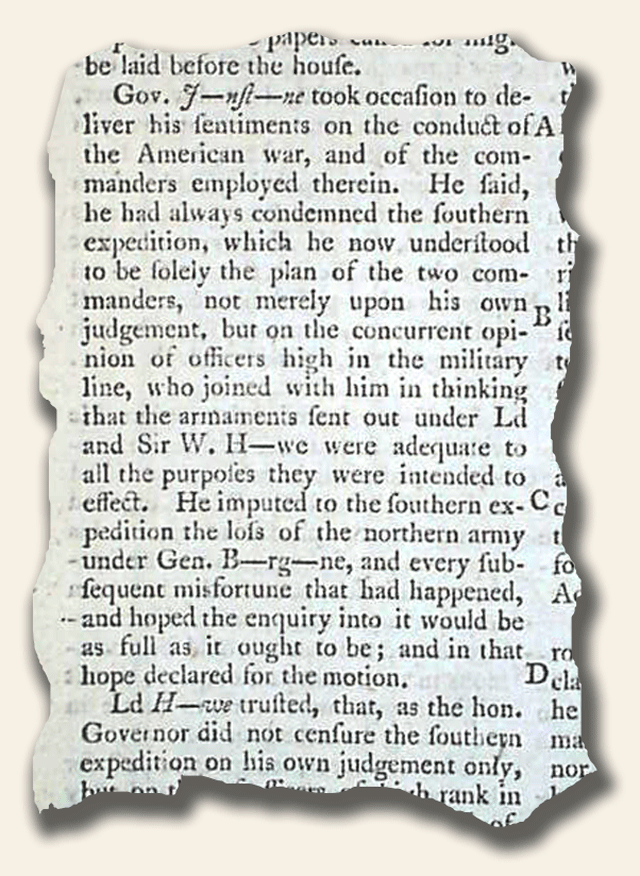 The sentence is as follows:
“A prince, whose character is thus marked by every act which may define a tyrant, is unfit to be the ruler of a free people.”
In the Gentleman’s Magazine the words ” prince” and “tyrant” are deleted.
I find it interesting that although the Gentleman’s Magazine and the the London Chronicle are both British that one paper printed the words prince and tyrant, yet the other did not.
To me, the deletion of the two words certainly diminishes the historic value of the printing as it appeared in the Gentleman’s Magazine, although I would not pass up the opportunity to own this paper. Perhaps it has to do with an opposing editorial policy, or the political persuasion of the two publishers.
Morris
Note: If anyone is aware of the formal policy which led to the deletion of certain words within the Gentleman’s Magazine, please share your insight with the rare newspaper community.