
Search
The Rare & Early Newspapers Hobby

Receive the Newsletter

Buy Historic Newspapers

What could have been…
December 13, 2010 by TimHughes · Leave a Comment
One might wonder how some significant events in history might have been responded to had reaction been different from what the history books note. During the Civil war the “Albany Atlas” decided to fool with history a bit following the Emancipation Proclamation, and supposed a “Counter Proclamation” by the Confederate President, Jeff Davis. The article shown–which appeared in the Confederate newspaper “Memphis Daily Appeal” of January 23, 1863 (while printing in Jackson, Mississippi at the time)–makes for some interesting reading on what could have happened in history (see below).
A collector sells bound volumes in 1878…
December 11, 2010 by TimHughes · Leave a Comment
This advertisement appeared in the “Scientific American” issue of June 22, 1878, noting a collector who has various bound volumes of the title, selling for $1 each. How prices have changed.
What could happen to a rumor…
December 9, 2010 by TimHughes · Leave a Comment
“The Daily Journal” newspaper of August 20, 1861 from Wilmington, North Carolina, a Confederate publication, printed an interesting series of dispatches of a fictitious assassination attempt upon President Lincoln (see below). They provide an interesting perspective on how a dramatic event could be much less so once more trustworthy news reports found their way to the press.
The reliability of news reports was a big problem in the 18th & 19th centuries during the pre-telegraph, pre-wire service days when word of mouth was often the source of what made it into the newspaper. This somewhat comical piece illustrates a quandary likely dealt with by most newspaper publishers of the day.
First use of the term “Columbia”…
December 6, 2010 by TimHughes · 2 Comments
Finding “first” mentions of significant, people, places and terms is always a delight for the rare newspaper collector, and with the internet–and the time required–many fascinating items can be found.
The term “Columbia” as a reference to America, very commonly used through the 19th century in both print & image, was first used in the London publication “Gentleman’s Magazine” in 1738. Because the printing of Parliamentary debates was illegal in England, they appeared under the thinly veiled heading of “Debates in the Senate of Lilliput” or similar heading, with names & places often fictitious or taken from Johnathan Swift’s famous work, which was the literary sensation at that time. The term Columbia was coined by the famed Samuel Johnson, a regular contributor to the “parliamentary” reports found in “The Gentleman’s Magazine“.
In the June issue of 1738, the debates from Parliament note: “…It is observable that their conquests and acquisitions in Columbia (which is the Lilliputian name for the country that answers our America,) have very little contributed to the power of those nations…”.
A significant “first use” of a very popular poetic name for the United States of America.
Lamenting the handwritten word…
December 4, 2010 by TimHughes · Leave a Comment
In today’s world of email, instant messaging, and twitter, there are many who lament the “old days” when people took the time to type out a letter, sign it, and use a stamp & envelope to get it to its destination. This item, found in “The Townsend Messenger” of Montana, issue date of March 18, 1892, takes that “lament” back one step further when the typewriter replaced the handwritten note.
General Butler… “The Beast”…
December 2, 2010 by TimHughes · Leave a Comment
Editorials in Confederate newspapers are always interesting reading–as are many of those from the North–as there is much bias skewed in favor of those reading the newspaper. The Jan. 12, 1865 issue of the “Richmond Examiner” contains a rabidly anti-Butler editorial, even managing to interject his nickname in the South: “The Beast”. This one is worth sharing for all to read:
A rare report… Wild Bill Hickok…
November 22, 2010 by TimHughes · 3 Comments
Some reports have gained greater notoriety long after the event happened, particularly those of the Old West which have been romanticized by television, movies and countless books on the era. The gunfight at the O.K. Corral is one, and the report of the killing of Wild Bill Hickok is another. Neither are commonly found in newspapers of the day with the Hickok report being one of the more difficult to find, and typically on a brief report when found.
We recently came across the “New York Herald” of August 13, 1876 with the report & thought it worth sharing: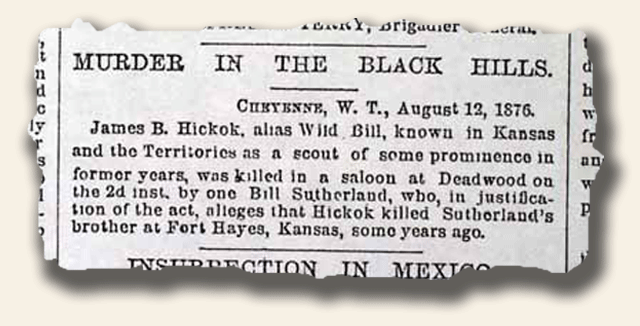
Removing those annoying address labels…
November 11, 2010 by TimHughes · 2 Comments
 Fellow collector Morris Brill raises a question which others may have pondered as well: “Is there a safe way of removing the label without harming or staining the newspaper?”
Address labels come in various sizes. The earliest ones are generally from the post-Civil War years and those labels tend to be relatively narrow strips with just the subscriber’s name or an institution’s name. A city might be included as well. Those of the 20th century tend to be one-half to three-quarters of an inch tall and contain the full address of the subscriber.
If discretely placed above the masthead & not touching any text they can be quite harmless and add a certain “charm” and authenticity to the newspaper, but those which cover portions of the masthead or headline are annoying. And they can be removed.
 In every case I’ve encountered the glue is water soluble, and once softened the label can be peeled off with little trouble. Since the label is almost always of thicker paper stock than the newspaper, the quickest way to soften the glue is to moisten the reverse side, meaning the actual newspaper from page two. Once the outline of the label is felt (or hold up to the light & note the outline), I use a cotton swab and warm water (distilled would be best) to dampen the back side of the label. Patience and experimentation are important, as often two or three applications of water and up to ten minutes of waiting are required for the glue to soften such that the label can be removed by using an exacto-knife to peel it up from a corner.
Once removed and the dampness dries there may or may not be a minor water stain which remains, but I always find this much less offensive than the label covering part of the headline. It is my opinion that the value of the newspaper is enhanced by having the label removed despite a minor stain.
If you have had success with other methods of removing address labels, feel free to share.
Minister needed to be clever to say only nice things…
November 6, 2010 by TimHughes · Leave a Comment
This interesting report In the “Richmond Examiner” issue of August 27, 1864 shows some creativity by the preacher:
A ghost robs a bank…
October 30, 2010 by TimHughes · Leave a Comment
And just in time for Halloween, a report from “The Observer” of London, January 1, 1797: