

Search
The Rare & Early Newspapers Hobby

Receive the Newsletter

Buy Historic Newspapers

First newspapers in Massachusetts…
May 31, 2010 by TimHughes · 1 Comment
 It would be of no surprise that Massachusetts has the longest history of newspaper publishing anywhere in the colonies. The very first printing press in the colonies was set up there, and by 1690 a newspaper was published in Boston, “Public Occurrences Both Foreign and Domestick”, but lasting but a single issue. In November of 2008 I did a post specifically on this title so I won’t dwell on this effort other than to say that it lasted but a single issue before being suppressed.
It was not for another fourteen years that Bartholomew Green, of the very famous Green family of printers, had the honor of printing the first newspaper to be permanently established in the colonies, the Boston “News-Letter“. Green published it for the owner, John Campbell, for 18 years and when Campbell retired Green & his successors continued the publication until the evacuation of Boston 1776, at which point the newspaper ceased.
The third newspaper in Massachusetts, also in Boston, was the famed “Boston Gazette“, printed for owner William Brooker by James Franklin, elder brother to Benjamin. This newspaper started on Dec. 21, 1719 and when sold James Franklin decided to begin a newspaper of his own. The “New-England Courant” began Aug. 7,1721 and it was on this project that Benjamin Franklin gained his apprenticeship as a printer. He would then move to Philadelphia, buy the Pennsylvania Gazette, and the rest is, well, history.
So it was that the first three newspapers in the American colonies were all published in Boston, although it was a close call. The first newspaper outside of Boston, the “American Weekly Mercury“, began in Philadelphia on Dec. 22, 1719, just one day after the “Boston Gazette“.
An historical anecdote…
May 1, 2010 by TimHughes · Leave a Comment
The following item from the “Massachusetts Centinel” of Boston, August 29, 1787, is evidence of some timely humor when the country was awaiting the results of the Constitutional Convention.
Brevity can say much…
February 18, 2010 by TimHughes · Leave a Comment
Often times very brief, inconspicuously located reports (see below) can be just filled with historical significance. There were many newspaper reports announcing the Declaration of Independence with a simply one sentence statement.
Another report which is significant yet brief is found in “The London Gazette” from England, May 26, 1701. The back page, with no heading save for the “London, May 23” dateline, has the report shown in the photo. This newspaper remains one of the premier issues for those adding significant pirate reports to their collection.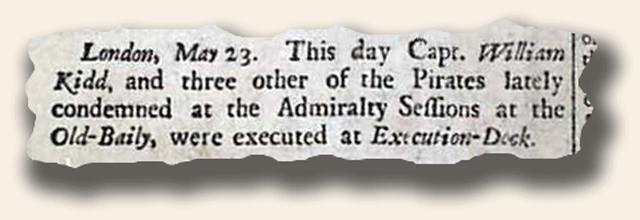
A sale that worked out just fine…
November 21, 2009 by TimHughes · Leave a Comment
In a day & age when sales of items between people can be fraught with troubles, here is an interesting “sale” that seemed to work out just fine. It appeared in “The London Chronicle” issue of June 4, 1767:

“News Rooms”: a curiosity of the past…
September 21, 2009 by TimHughes · Leave a Comment
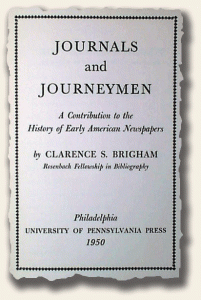
One last excerpt from Clarence Brigham’s book “Journals & Journeymen” is worthy of sharing with follow collectors as it explores a part of newspaper history of which most are unaware. The chapter is titled “News Rooms”:
 An interesting custom in newspaper history was the establishment in the early 1800’s of news rooms at nearly all of the larger towns. Somewhat akin to this idea was a project carried out at a much earlier day at Bridgeton, New Jersey. Here in December 1775, & continuing for two months, a weekly paper called “The Plain Dealer”, consisting of essays but with topics relating to the problems of the colonies, was written out in manuscript and posted up in Matthew Potter’s tavern. It enabled readers to gather at a central meeting place and peruse a weekly publication, which they would not trouble, or perhaps could not afford, to purchase.
Soon after 1800 reading rooms sprang up in several towns. In Boston the Anthology Reading Room was established in 1806, with 160 subscribers, and making available all the leading newspapers of the country. In 1808 Samuel Gilbert established at Boston what may have been the first commercial news room in the country. It was located in the Exchange Coffee House, erected in 1808, with its “Reading Room and Marine Diary” on the entrance floor where newspaper files could be consulted.
In New York, John H. Payne in 1811 opened a reading room where could be found the most important newspapers and magazines of the day. Charleston had a newsroom in 1813 where the terms were ten dollars for subscribers and strangers one dollar a month. In fact, almost every city and larger town before 1820 had its news room where leading newspapers were regularly filed. To enumerate them would require a lengthy chapter and necessitate an exacting study of early newspaper advertisements. Unfortunately there is no record of a new room proprietor preserving his files for posterity.