The 15th installment of: Who’s Who in Newspapers [1]
 When it comes to “man on the street” interviews, the lack of knowledgeable responses often received never fails to confound. We enjoy watching these—which is a bit troubling in itself—but if an interviewer asked, “Who invented the light bulb?”, I’d bet 75% would answer correctly, especially with a few “Thom… Thomas… Thomas Ed…” clues.
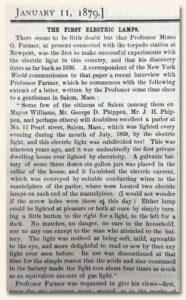
However, and to be fair, few of us (myself included) could name the pioneers who paved the way. Enter Moses G. Farmer. Thanks to a January 11, 1879, issue of Scientific American [2] titled “THE FIRST ELECTRIC LAMPS,” I discovered this fascinating inventor who lit his Salem, MA, home in 1859—two decades before Edison’s breakthrough.
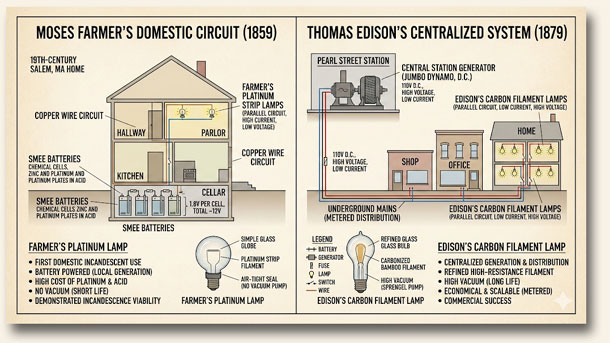
Using platinum filaments and batteries he had mounted for the purpose in his cellar, Farmer proved electricity could replace gas. Though the cost of platinum and the lack of a vacuum prevented commercial success, his “parlor lights” were the first to move electric light from the lab into a domestic reality – often enlightening dinner guests with his invention.
Farmer provided the “blueprint of failures” Edison needed. He proved electricity could light a home; Edison simply figured out how to make it last longer than a dinner party.
A modern sketch comparing Farmer’s and Edison’s work is shown below.
I love this collectible – and how it fuels the engine of life-long learning.