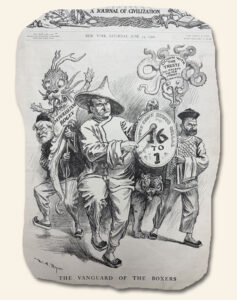
 One of the fascinating areas of historic newspaper collecting is the ability to see patterns over time. Last week, I found a Harper’s Weekly for a collector with a fascinating front page print that caught my attention and the caption triggered a deeper search. The Boxer Rebellion of the 1900’s [1] included a group called “Vanguards”. Although familiar with this term, I was curious as to other times this concept had popped up throughout history. The following is an overview of my discovery…
The concept of the “vanguard” became central to revolutionary theory during the 1917 Russian Revolution, as articulated by Vladimir Lenin [2]. He argued that the working class, left to spontaneous action, could not develop full revolutionary consciousness under capitalist oppression. A tightly organized group of professional revolutionaries was therefore essential to guide and lead the masses. The Bolshevik Party, led by Lenin, served as this vanguard of the proletariat. Through strategic agitation, infiltration of workers’ councils (soviets), and decisive action in the October Revolution, the Bolsheviks seized power, overthrew the provisional government, and established Soviet rule. This model influenced communist movements globally, prioritizing elite leadership over mass spontaneity to achieve societal transformation.
Originally a military metaphor for an advance force, the term “vanguard” later named actual activist groups in the United States during times of social upheaval. In the 1930s, amid Great Depression labor unrest, New York’s anarcho-syndicalist Vanguard Group published a journal promoting revolutionary unionism while criticizing both capitalism and Bolshevik-style authoritarianism. In 1966 San Francisco, a queer youth organization called Vanguard formed in the Tenderloin district, uniting marginalized gay, transgender, and drag people facing police harassment. Backed by progressive clergy, Vanguard organized protests and led the Compton’s Cafeteria riot—a key pre-Stonewall uprising that marked early militant resistance in the LGBT+ liberation movement. Thus, from Lenin’s theoretical vanguard to these grassroots efforts, the term has consistently represented self-appointed leaders spearheading radical change in turbulent times. Fascinating that the Boxer Rebellion predated Lenin and causes one to speculate as to its impact on his Bolshevik Revolution.