Over the last 50 years we have sold many genuine issues of the famous “Vicksburg Daily Citizen” issue of July 2 (4), 1863. Its desirability is in the curious background of its creation. If you have received our catalogs through the years, you have likely read of at least one of our offerings, with the details as to how the July 2 issue was left on the press when the Confederates left town when the Yankee forces moved in. As the story goes, Yankee printers found the July 2 issue still on the press, changed the last paragraph to reflect the historic changes that had happened over the previous two days, and printed the paper.
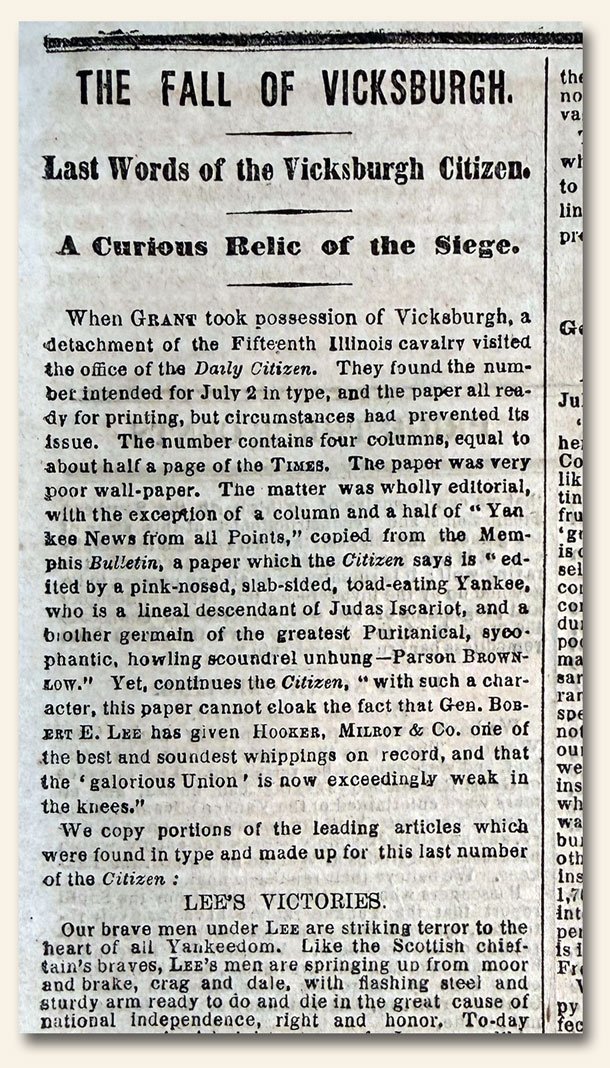
We were not aware until recently that a contemporary issue of the “New York Times” told the story quite well. Page 2 of the August 5, 1863 issue has over a column headed: “The Fall of Vicksburgh” “Last Words of the Vicksburgh Citizen” “A Curious Relic of the Siege”.
The report begins: “When Grant took possession of Vicksburgh, a detachment of the Fifteenth Illinois cavalry visited the office of the ‘Daily Citizen”. They found the number intended for July 2 in type, and the paper all ready for printing, but circumstances had prevented its issue…the paper was very poor wall-paper. The matter was wholly editorial, with the exception of a column and a half of: “Yankee News from all Points” copied from the Memphis Bulletin, a paper which the Citizen says is ‘edited by a pink-nosed, slab-sided, toad-eating Yankee, who is a lineal descendant of Judas Iscariot…” with much more.
Further on, it explains how the last paragraph of the Vicksburg issue came to be: “The Illinois men who visited the office of the ‘Citizen’ thought that this admirable number ought not to be withheld from the subscribers. They set to work at once to print it off, but as it was now the Fourth of July and some changes had taken place since the original editor made up his sheets for the 2d, they brought up the news to date in the following postscript…” , which is the famous paragraph at the bottom of the page that begins: “Two days bring about great changes…”.
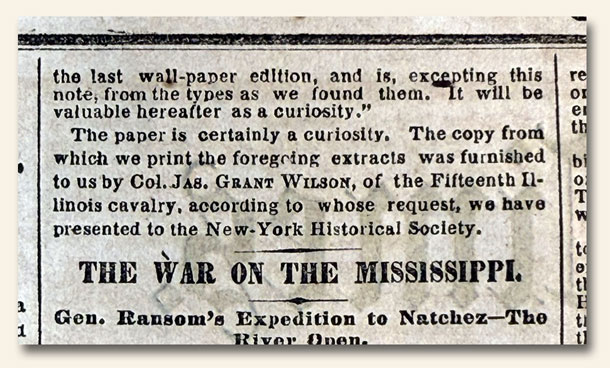
The Times article notes in conclusion: “…The copy from which we print the foregoing extracts was furnished to us by Col. Jas. Grant Wilson, of the Fifteenth Illinois cavalry, according to whose request, we have presented to the New York Historical Society.”
Although there are many issues in the realm of rare newspapers that are curious, unusual, or perhaps exceedingly historic in a very unusual way, rarely are collectors treated to a contemporary account of how they came to be. This is one.